



Centromochlus akwe Coelho, Chamon & Sarmento-Soares, 2021
Uploaden van uw Foto's en video's
Google afbeelding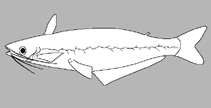 No image available for this species;
drawing shows typical species in Auchenipteridae.
Google afbeelding
drawing shows typical species in Auchenipteridae.
Classificatie / Namen Lokale namen | Synoniemen | Catalog of Fishes(Genus, Soort(en)) | ITIS | CoL | WoRMS | Cloffa
> Siluriformes (Catfishes) > Auchenipteridae (Driftwood catfishes) > Centromochlinae
Etymology: Centromochlus: Greek, kentron = sting + Greek, mochlos, -ou = lever, crowbar (Ref. 45335); akwe: Named after the Akwê (Xerente self-denomination) indigenous people.
Etymology: Centromochlus: Greek, kentron = sting + Greek, mochlos, -ou = lever, crowbar (Ref. 45335); akwe: Named after the Akwê (Xerente self-denomination) indigenous people.
Milieu: milieu / Klimaatzone / Diepte / verspreidingsgebied Ecologie
; zoet water benthopelagisch. Tropical
Verspreiding Gebieden | FAO regio's | Ecosystemen | Voorkomen | Verspreidingskaart | Introducties | Faunafri
South America: Brazil.
Grootte / Gewicht / Leeftijd
Korte beschrijving Determinatiesleutels | Morfologie | Morfometrie
This species is distinguished from Centromochlinae by having a vermiculated color pattern on the dorsum (vs. dorsum uniform in all Centromochlinae, except Tatia brunnea, T. dunni, and T. meridionalis). It is distinguished from these three aforementioned species by having the eye ventrolaterally displaced on head in a way that almost the entire eye is visible in ventral view (vs. eye displaced dorsolaterally and not visible in ventral view). It shares derived characters with other Centromochlus species such as the ventrolateral position of eye socket, a sphenotic notched for the exit of infraorbital canal, and with posterior serrations along pectoral-fin spine numerou. It is distinguished from its congeners by having the pectoral-fin spine with dark bars, alternating with light bars (vs. pectoral-fin spine with light and uniform color); further differs except C. carolae by the ventral surface of head moderate to largely pigmented (vs. ventral surface of head unpigmented in C. heckelii, C. existimatus, C. orca, C. musaicus, C. schultzi or with few scattered dark chromatophores in C. macracanthus and C. melanoleucus); differs from C. carolae by the presence of vermiculated color pattern or scattered chromatophores on lateral surface of the body that extends to the caudal peduncle (vs. lateral surface of the body with distinct demarcation between dark and light areas continuous posteriorly onto the caudal peduncle whereas the dark pigmentation extends nearly to the ventral midline); differs from C. schultzi by lacking dark large and rounded blotches over a pale background on head and trunk (vs. present; and by the smaller length of the dorsal-fin spine 18.1-27.1% of SL (vs. more than 27% of SL in C. macracanthus, C. heckelii, C. existimatus), and pectoral-fin spine 24.2-32.2% of SL (vs. more than 33% of SL in C. macracanthus, C. heckelii, C. existimatus) (Ref. 123897).
Cross section: oval.
Cross section: oval.
This species was found hidden in crevices within laterititic bedrock substrate covered by alluvial sediment, typical of the median portion of the Araguaia River basin and were manually collected and sometimes it was necessary to break the rocks to remove specimens that were hidden. The laterite is a geomorphological formation that originates from the weathering of lateritic crusts that cover the geological units, and is common at the middle and lower rio Araguaia stretches. Several species of Siluriformes that occur syntopically with this species were also collected: Centromochlus schultzi, Tatia intermedia, Auchenipterichthys longimanus, Rhinodoras boehlkei, Platydoras armatulus, Rhamdia quelen, Leporacanthicus galaxias, Peckoltia vittata, P. sabaji, Parancistrus aurantiacus, Pseudacanthicus sp., and Spectracanthicus javae. Specimens were collected in the twilight and daytime, with most of these collected during the morning and at periods of capture, the collected specimens were in lethargic condition (Ref. 123897).
Levenscyclus en paargedrag Maturiteit | Voortplanting | Paaien | Eieren | Fecunditeit | Larven
Hoofdreferentie
Upload uw referenties | Referenties | Coördinator : Ferraris, Jr., Carl J. | Medewerkers
Coelho, F.L., C.C Chamon and L.M. Sarmento-Soares, 2021. A new species of driftwood catfish Centromochlus Kner, 1858 (Siluriformes, Auchenipteridae, Centromochlinae) from Tocantins-Araguaia River drainage. Zootaxa 4950(1):149-165. (Ref. 123897)
CITES
Not Evaluated
Gevaar voor de mens
Harmless
Gebruik door de mens
FAO - Publication: search | FishSource |
Meer informatie
Trofische ecologie
Voedsel (prooien)
Dieetsamenstelling
Voedselconsumptie
Voedselrantsoenen
Predatoren
Voedsel (prooien)
Dieetsamenstelling
Voedselconsumptie
Voedselrantsoenen
Predatoren
Ecologie
Ecologie
Ecologie
Populatiedynamica
Groeiparameters
Max. leeftijden / maten
Lengte-gewicht rel.
Lengte-lengte rel.
Lengtefrequenties
Massaconversie
Rekrutering
Abundantie
Groeiparameters
Max. leeftijden / maten
Lengte-gewicht rel.
Lengte-lengte rel.
Lengtefrequenties
Massaconversie
Rekrutering
Abundantie
Levenscyclus
Voortplanting
Maturiteit
Rijpheid/kieuwen rel.
Fecunditeit
Paaien
Paaibestanden
Eieren
Ontwikkeling van de eieren
Larven
Larvale populatiedynamiek
Voortplanting
Maturiteit
Rijpheid/kieuwen rel.
Fecunditeit
Paaien
Paaibestanden
Eieren
Ontwikkeling van de eieren
Larven
Larvale populatiedynamiek
Anatomie
Kieuwoppervlak
Hersenen
Otoliet
Kieuwoppervlak
Hersenen
Otoliet
Fysiologie
Lichaamssamenstelling
Voedingsstoffen
Zuurstofverbruik
Type zwemmen
Zwemsnelheid
Visuele pigmenten
Vis geluid
Ziekten en parasieten
Toxiciteit (LC50)
Lichaamssamenstelling
Voedingsstoffen
Zuurstofverbruik
Type zwemmen
Zwemsnelheid
Visuele pigmenten
Vis geluid
Ziekten en parasieten
Toxiciteit (LC50)
Genetica
genoom
Genetica
Heterozygositeit
Erfelijkheid
Genetische diversiteit
genoom
Genetica
Heterozygositeit
Erfelijkheid
Genetische diversiteit
Menselijk gerelateerd
Aquacultuursystemen
Aquacultuurprofielen
Kweeklijnen
Ciguatera gevallen
Postzegels, munten, diversen.
Aquacultuursystemen
Aquacultuurprofielen
Kweeklijnen
Ciguatera gevallen
Postzegels, munten, diversen.
Tools
Speciale rapporten
Bekijk gegevens voor het houden in een aquarium | Bekijk Fact Sheets voor de soort | Bekijk Aquacultuur Fact Sheets
Download XML
Internetbronnen
AFORO (otoliths) | Aquatic Commons | BHL | Cloffa | Websites from users | Bekijk FishWatcher | CISTI | Catalog of Fishes: Genus, Soort(en) | DiscoverLife | ECOTOX | FAO - Publication: search | Faunafri | Fishipedia | Fishtrace | GloBI | Google Books | Google Scholar | Google | IGFA World Record | OneZoom | Open Tree of Life | Otolith Atlas of Taiwan Fishes | PubMed | Reef Life Survey | Socotra Atlas | TreeBase | Tree of Life | Wikipedia: ga naar, zoek | World Records Freshwater Fishing | Zoobank | Zoological Record
Schattingen op basis van modellen
Fylogenetische diversiteitsindex (Ref. 82804): PD50 = 0.5078 [Uniqueness, from 0.5 = low to 2.0 = high].
Bayesian length-weight: a=0.00490 (0.00199 - 0.01208), b=3.10 (2.88 - 3.32), in cm total length, based on LWR estimates for this (Sub)family-body shape (Ref. 93245).
Trofisch niveau (Ref. 69278): 3.3 ±0.4 se; based on size and trophs of closest relatives
Weerstandsvermogen (Ref. 120179): Hoog, minimale populatieverdubbelingstijd minder dan 15 maanden (Preliminary K or Fecundity.).