



Paloa villadolidi Roxas & Ablan, 1940
Hochladen Photos und videos
Google Bild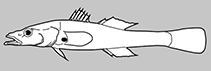 No image available for this species;
drawing shows typical species in Butidae.
Google Bild
drawing shows typical species in Butidae.
Klassifizierung / Names Namen | Synonyme | Catalog of Fishes(Gattung, Arten) | ITIS | CoL | WoRMS | Cloffa
Umwelt: Milieu / Klimazone / Tiefenbereich / Verbreitungsgebiet Ökologie
seewasser; süßwasser; brackwasser demersal. Subtropical
Verbreitung Territorien | FAO Gebiete | Ökosysteme | Vorkommen | Punkt Karte | Einführungen | Faunafri
Western Pacific: Japan and the Philippines.
Größe / Gewicht / Alter
Geschlechtsreife: Lm ? range ? - ? cm
Max length : 5.6 cm SL Männchen/unbestimmt; (Ref. 129074); 7.5 cm SL (female)
Max length : 5.6 cm SL Männchen/unbestimmt; (Ref. 129074); 7.5 cm SL (female)
Kurzbeschreibung Bestimmungsschlüssel | Morphologie | Morphometrie
Rückenflossenstacheln (insgesamt) : 7; Rückenflossenweichstrahlen (insgesamt) : 9 - 10; Afterflossenstacheln: 1; Afterflossenweichstrahlen: 8. This species is distinguished from all other species of Butidae by a combination of the following characters: upper and lower jaws with enlarged canine teeth on their outermost rows; more canines on upper jaw (7-11) than on lower jaw (4-7); no inner row of canines in the posterior half of lower jaw; upper jaw does not extend to anterior margin of eye; interorbital sensory pore D paired with wide interval; the fourth transverse row of sensory papillae (4) crossed with longitudinal papilla row (b) on the cheek; longitudinal scales 88-100, transverse scales 32-36, predorsal scales 51-65, transverse scales at caudal peduncle 22 or 23, circumpeduncle scales 40-43; D VI-I, 9-10; A I,8; pectoral fin 17; predorsal length 38.4-40.7% of SL; body depth at anal-fin origin 14.6-17.1% of SL; eye diameter 3.3-5.1% of SL. Colouration: no distinct markings on the unpaired fins and caudal peduncle (Ref. 129074).
Cross section: oval.
Cross section: oval.
This species is found in the tidal zone within or around mangroves in estuaries, and where four of the seven specimens were found hovering in small tidepools around the roots of mangrove trees [Bruguiera gymnorhiza (L.) Savigny] within the forest at night. The substrate of the tidepool was mud, and a thalassinid mud lobster, Thalassina anomala (Herbst, 1804) made a burrow system around the tidepool. Other fish species observed in that tidepool include Bostrychus sinensis, Eleotris melanosoma, Mugilogobius chulae, and Pisodonophis boro). One individual was found inside a polyvinyl chloride pipe buried in the muddy gravel bottom along the main course of the stream during the daytime, and this site was approximately 10 m from the mangrove. Another individual was collected from the burrow of an unknown builder on muddy substrate using a suction pump during the daytime. One juvenile specimen was found in a similar tidepool on Ishigaki Island, Japan. (Ref. 129074).
Lebenszyklus und Paarungsverhalten Geschlechtsreife | Fortpflanzung | Ablaichen | Eier | Fruchtbarkeit | Larven
Hauptreferenz
Laden Sie Ihre Referenzen hoch | Referenzen | Koordinator | Partner
Kobayashi, H., K. Nishigaki, T. Saeki and K. Maeda, 2023. First records of Paloa villadolidi from Japan with a redescription of Odonteleotris macrodon (Teleostei: Butidae). Species Diversity 28:165–175. (Ref. 129074)
IUCN Rote Liste Status (Ref. 130435: Version 2025-2 (Global))
Daten mangelhaft (DD) ; Date assessed: 21 March 2024
CITES
Not Evaluated
Bedrohung für Menschen
Harmless
Nutzung durch Menschen
FAO - Publication: search | FishSource |
Mehr Information
Trophische Ökologie
Lebensmittel (Beutetiere)
Nahrungszusammensetzung
Nahrungsaufnahme
Lebensmittelrationen
Räuber
Lebensmittel (Beutetiere)
Nahrungszusammensetzung
Nahrungsaufnahme
Lebensmittelrationen
Räuber
Ökologie
Ökologie
Ökologie
Populationsdynamik
Wachstumsparameter
Max. Alter/Größen
Länge-Gewicht-Rel.
Länge-Länge-Verhältnis.
Längenhäufigkeiten
Massenkonvertierung
Rekrutierung
Dichte
Wachstumsparameter
Max. Alter/Größen
Länge-Gewicht-Rel.
Länge-Länge-Verhältnis.
Längenhäufigkeiten
Massenkonvertierung
Rekrutierung
Dichte
Lebenszyklus
Fortpflanzung
Geschlechtsreife
Reifung/Kiemen rel.
Fruchtbarkeit
Ablaichen
Laichaggregationen
Eier
Eientwicklung
Larven
Larven Pop.Dyn.
Fortpflanzung
Geschlechtsreife
Reifung/Kiemen rel.
Fruchtbarkeit
Ablaichen
Laichaggregationen
Eier
Eientwicklung
Larven
Larven Pop.Dyn.
Anatomie
Kiemenoberfläche
Gehirn
Otolith
Kiemenoberfläche
Gehirn
Otolith
Physiologie
Körperliche Zusammensetzung
Nährstoffe
Sauerstoffverbrauch
Schwimmart
Schwimmgeschwindigkeit
Visuelle Pigmente
Fischgeräusche
Krankheiten und Parasiten
Toxizität (LC50s)
Körperliche Zusammensetzung
Nährstoffe
Sauerstoffverbrauch
Schwimmart
Schwimmgeschwindigkeit
Visuelle Pigmente
Fischgeräusche
Krankheiten und Parasiten
Toxizität (LC50s)
Genetik
Genom
Genetik
Heterozygotie
Vererbbarkeit
Genetische Vielfalt
Genom
Genetik
Heterozygotie
Vererbbarkeit
Genetische Vielfalt
Menschenbezogen
Aquakultur-Systeme
Aquakultur Profile
Zuchtlinien
Ciguatera-Fälle
Briefmarken, Münzen, Verschiedenes.
Aquakultur-Systeme
Aquakultur Profile
Zuchtlinien
Ciguatera-Fälle
Briefmarken, Münzen, Verschiedenes.
Tools
Zusatzinformationen
Download XML
Zusammenfassung | Punktdaten | Namen | Photos
Internet Quellen
AFORO (otoliths) | Aquatic Commons | BHL | Cloffa | Websites from users | FishWatcher Einträge suchen | CISTI | Catalog of Fishes: Gattung, Arten | DiscoverLife | ECOTOX | FAO - Publication: search | Faunafri | Fishipedia | Fishtrace | GloBI | Google Books | Google Scholar | Google | IGFA World Record | OneZoom | Open Tree of Life | Otolith Atlas of Taiwan Fishes | PubMed | Reef Life Survey | Socotra Atlas | TreeBase | Tree of Life | Wikipedia: Gehe zu, Suchen | World Records Freshwater Fishing | Zoobank | Zoologischer Rekord
Schätzungen auf der Grundlage von Modellen
Phylogenetischer Diversitätsindex (Ref. 82804): PD50 = 0.7500 [Uniqueness, from 0.5 = low to 2.0 = high].
Bayesian length-weight: a=0.00933 (0.00414 - 0.02103), b=3.06 (2.86 - 3.26), in cm total length, based on LWR estimates for this (Sub)family-body shape (Ref. 93245).
Trophische Ebene (Ref. 69278): 3.6 ±0.6 se; based on size and trophs of closest relatives
Widerstandsfähigkeit (Ref. 120179): hoch, Verdopplung der Population dauert weniger als 15 Monate. (Preliminary K or Fecundity.).