



Sube tu fotos y Vídeos
Google image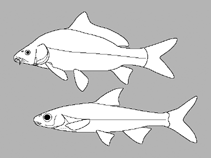 No image available for this species;
drawing shows typical species in Cyprinidae.
Google image
drawing shows typical species in Cyprinidae.
Clasificación / Nombres Nombres comunes | Sinónimos | Catalog of Fishes(Género, Especie) | ITIS | CoL | WoRMS | Cloffa
> Cypriniformes (Carps) > Cyprinidae (Minnows or carps) > Labeoninae
Etymology: Garra: Name based on a vernacular Indian name (Hamilton, 1822:343, Ref. 1813); a fish living in mud (Ref. 128817); rezai: Named for Reza Mousavi-Sabet, father of the first author, who was injured by chemical weapons in the region of the type locality of this species (also to respect and remember all Iranian and Iraqi victims of chemical weapons during the Iran-Iraq war, 1980-1988).
Etymology: Garra: Name based on a vernacular Indian name (Hamilton, 1822:343, Ref. 1813); a fish living in mud (Ref. 128817); rezai: Named for Reza Mousavi-Sabet, father of the first author, who was injured by chemical weapons in the region of the type locality of this species (also to respect and remember all Iranian and Iraqi victims of chemical weapons during the Iran-Iraq war, 1980-1988).
Entorno: milieu / zona climática / rango de profundidad / gama de distribución Ecología
; agua dulce bentopelágico. Subtropical
Distribución Territorios | Áreas FAO | Ecosistemas | Ocurrencias, apariciones | Mapa de puntos | Introducciones | Faunafri
Asia: Iran and Turkey.
Tamaño / Peso / Edad
Descripción breve Claves de identificación | Morfología | Morfometría
This species is distinguished from its congeners of the Garra variabilis species-group by the following set of characters, none of which are unique to the species: differs from G. variabilis by having two pairs of barbels (vs. one), scales on the predorsal midline between the dorsal-fin origin and the nape 15-19 (vs. 11-15), and total gill rakers on the first gill arch 11-16 (vs. 20-26); differs from G. kemali and G. klatti from Central Anatolia by having a mental disc (vs. absent), and barbels two pairs (vs. none); differs from G. nudiventris, G. roseae, G. rossica by having two pairs of barbels (vs. none in G. roseae; one pair in G.nudiventris and most populations of G. rossica, two pairs in some of G. rossica), a well-developed mental disc (vs. reduced in G. rossica), predorsal mid-line fully covered by scales (vs. naked in G.nudiventris), belly covered by scales (vs. naked in G.nudiventris); differs from G. roseae by having scales on the lateral line 35-40 (vs. 42-58), transverse scale rows between the lateral line and the dorsal-fin origin 5½-6½ (vs. 7½-8½), transverse scale rows between the lateral line and the pelvic-fin origin 4½-5½ (vs. 6½), axillary scale at the pelvic-fin origin present (vs. absent) (Ref. 128981).
Cross section: oval.
Cross section: oval.
Found in April 2016 in a spring in Boein-e-Olia (Iran), which was about 2-3 meters wide, the outflowing stream had a low velocity and the bed was covered by gravel. When the place was revisited in June 2021, the species could not be found anymore in the spring, but specimens were collected from the stream Boein-e-Sofla (which is fed by the spring). At the type locality (Boein-e-Olia spring and Boein-e-Sofla stream), the species was not found, but G. rufa is widespread in the Lesser Zab drainage, including the Chooman River drainage. In Turkey, all three sampling sites were shallow, with clear and swiftly flowing water and cobbles and pebbles substrate. Among the three sampling sites, Çıratan was visited several times during different seasons and this species is abundant in its Turkish distribution area. This stream hosts several regionally endemic species, such as Turcinoemacheilus kosswigi. Paracobitis zabgawraensis, Glyptothorax daemon, and G. kurdistanicus (Ref. 124212). In Çıratan, two adult individuals of G. rufa were found, one half-grown individual in the stream Büyük, both were syntopic with G. rezai (Ref. 128981).
Ciclo vital y comportamiento de apareamiento Madurez | Reproducción | Puesta | Huevos | Fecundidad | Larva
Referencia principal
Suba sus referencias | Referencias | Coordinador | Colaboradores
Mousavi-Sabet, H., S. Eagderi, M. Saemi-Komsari, C. Kaya and J. Freyhof, 2022. Garra rezai, a new species from two widely disjunct areas in the Tigris drainage (Teleostei: Cyprinidae). Zootaxa 5195(5):419-436. (Ref. 128981)
CITES
Not Evaluated
Amenaza para el ser humano
Harmless
Usos humanos
Pesquerías: sin interés
FAO - Publication: search | FishSource |
Más información
Ecología Trófica
Alimentos (presas)
Composición de la dieta
consumo de alimento
Raciones de comida
Despredadores
Alimentos (presas)
Composición de la dieta
consumo de alimento
Raciones de comida
Despredadores
Ecología
Ecología
Ecología
Dinámica de la población
Coeficiente del crecimiento para
Edades / tallas máximas
Longitud-peso rel.
Longitud-longitud rel.
Longitud-frecuencias
Conversión de masas
Reclutamiento
Abundancia
Coeficiente del crecimiento para
Edades / tallas máximas
Longitud-peso rel.
Longitud-longitud rel.
Longitud-frecuencias
Conversión de masas
Reclutamiento
Abundancia
Ciclo de vida
Reproducción
Madurez
Madurez/Gills rel.
Fecundidad
Puesta
Agregaciones de desove
Huevos
Desarrollo de los huevos
Larva
Dinámica larvaria
Reproducción
Madurez
Madurez/Gills rel.
Fecundidad
Puesta
Agregaciones de desove
Huevos
Desarrollo de los huevos
Larva
Dinámica larvaria
Distribución
Territorios
Áreas FAO
Ecosistemas
Ocurrencias, apariciones
Introducciones
BRUVS - Vídeos
Territorios
Áreas FAO
Ecosistemas
Ocurrencias, apariciones
Introducciones
BRUVS - Vídeos
Anatomía
Superficie branquial
Cerebro
Otolito
Superficie branquial
Cerebro
Otolito
Fisiología
Composición corporal
Nutrientes
Consumo del oxígeno
Tipo de natación
Velocidad de natación
Pigmentos visuales
Sonido de peces
Enfermedades y parásitos
Toxicidad (CL50)
Composición corporal
Nutrientes
Consumo del oxígeno
Tipo de natación
Velocidad de natación
Pigmentos visuales
Sonido de peces
Enfermedades y parásitos
Toxicidad (CL50)
Genética
Genoma
Genética
Heterocigosidad
heritabilidad
Diversidad genética
Genoma
Genética
Heterocigosidad
heritabilidad
Diversidad genética
Relacionados con el ser humano
Sistemas de acuicultura
Perfiles de acuicultura
Razas
Ciguatera cases
Sellos, monedas, varios
Sistemas de acuicultura
Perfiles de acuicultura
Razas
Ciguatera cases
Sellos, monedas, varios
Herramientas
Libro electrónico | Guía de campo | Asistente para frecuencias de tallas | Herramienta de ciclo de vida | Mapa de puntos |
Catch-MSY |
Informes especiales
Comprobar el mantenimiento del acuario | Buscar fichas sobre especies | Consulte las hojas informativas sobre acuicultura
Descargar XML
Fuentes de Internet
AFORO (otoliths) | Aquatic Commons | BHL | Cloffa | Websites from users | Check FishWatcher | CISTI | Catalog of Fishes: Género, Especie | DiscoverLife | ECOTOX | FAO - Publication: search | Faunafri | Fishipedia | Fishtrace | GloBI | Google Books | Google Scholar | Google | IGFA World Record | Bases de datos nacionales | OneZoom | Open Tree of Life | Otolith Atlas of Taiwan Fishes | PubMed | Reef Life Survey | Socotra Atlas | TreeBase | Árbol de la vida | Wikipedia: Go, búsqueda | World Records Freshwater Fishing | Zoobank | Expediente Zoológico
Estimaciones basadas en modelos
Índice de diversidad filogenética (Referencia 82804): PD50 = 0.5000 [Uniqueness, from 0.5 = low to 2.0 = high].
Bayesian length-weight: a=0.00794 (0.00359 - 0.01758), b=3.04 (2.87 - 3.21), in cm total length, based on LWR estimates for this Genus-body shape (Ref. 93245).
Resiliencia (Referencia 120179): Alto, población duplicada en un tiempo mínimo inferior a 15 meses (Preliminary K or Fecundity.).