



Hochladen Photos und videos
Google Bild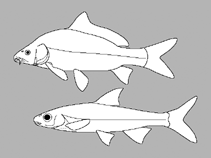 No image available for this species;
drawing shows typical species in Cyprinidae.
Google Bild
drawing shows typical species in Cyprinidae.
Klassifizierung / Names Namen | Synonyme | Catalog of Fishes(Gattung, Arten) | ITIS | CoL | WoRMS | Cloffa
> Cypriniformes (Carps) > Cyprinidae (Minnows or carps) > Labeoninae
Etymology: Garra: Name based on a vernacular Indian name (Hamilton, 1822:343, Ref. 1813); a fish living in mud (Ref. 128817); rezai: Named for Reza Mousavi-Sabet, father of the first author, who was injured by chemical weapons in the region of the type locality of this species (also to respect and remember all Iranian and Iraqi victims of chemical weapons during the Iran-Iraq war, 1980-1988).
Etymology: Garra: Name based on a vernacular Indian name (Hamilton, 1822:343, Ref. 1813); a fish living in mud (Ref. 128817); rezai: Named for Reza Mousavi-Sabet, father of the first author, who was injured by chemical weapons in the region of the type locality of this species (also to respect and remember all Iranian and Iraqi victims of chemical weapons during the Iran-Iraq war, 1980-1988).
Umwelt: Milieu / Klimazone / Tiefenbereich / Verbreitungsgebiet Ökologie
; süßwasser benthopelagisch. Subtropical
Verbreitung Territorien | FAO Gebiete | Ökosysteme | Vorkommen | Punkt Karte | Einführungen | Faunafri
Asia: Iran and Turkey.
Größe / Gewicht / Alter
Kurzbeschreibung Bestimmungsschlüssel | Morphologie | Morphometrie
This species is distinguished from its congeners of the Garra variabilis species-group by the following set of characters, none of which are unique to the species: differs from G. variabilis by having two pairs of barbels (vs. one), scales on the predorsal midline between the dorsal-fin origin and the nape 15-19 (vs. 11-15), and total gill rakers on the first gill arch 11-16 (vs. 20-26); differs from G. kemali and G. klatti from Central Anatolia by having a mental disc (vs. absent), and barbels two pairs (vs. none); differs from G. nudiventris, G. roseae, G. rossica by having two pairs of barbels (vs. none in G. roseae; one pair in G.nudiventris and most populations of G. rossica, two pairs in some of G. rossica), a well-developed mental disc (vs. reduced in G. rossica), predorsal mid-line fully covered by scales (vs. naked in G.nudiventris), belly covered by scales (vs. naked in G.nudiventris); differs from G. roseae by having scales on the lateral line 35-40 (vs. 42-58), transverse scale rows between the lateral line and the dorsal-fin origin 5½-6½ (vs. 7½-8½), transverse scale rows between the lateral line and the pelvic-fin origin 4½-5½ (vs. 6½), axillary scale at the pelvic-fin origin present (vs. absent) (Ref. 128981).
Cross section: oval.
Cross section: oval.
Found in April 2016 in a spring in Boein-e-Olia (Iran), which was about 2-3 meters wide, the outflowing stream had a low velocity and the bed was covered by gravel. When the place was revisited in June 2021, the species could not be found anymore in the spring, but specimens were collected from the stream Boein-e-Sofla (which is fed by the spring). At the type locality (Boein-e-Olia spring and Boein-e-Sofla stream), the species was not found, but G. rufa is widespread in the Lesser Zab drainage, including the Chooman River drainage. In Turkey, all three sampling sites were shallow, with clear and swiftly flowing water and cobbles and pebbles substrate. Among the three sampling sites, Çıratan was visited several times during different seasons and this species is abundant in its Turkish distribution area. This stream hosts several regionally endemic species, such as Turcinoemacheilus kosswigi. Paracobitis zabgawraensis, Glyptothorax daemon, and G. kurdistanicus (Ref. 124212). In Çıratan, two adult individuals of G. rufa were found, one half-grown individual in the stream Büyük, both were syntopic with G. rezai (Ref. 128981).
Lebenszyklus und Paarungsverhalten Geschlechtsreife | Fortpflanzung | Ablaichen | Eier | Fruchtbarkeit | Larven
Hauptreferenz
Laden Sie Ihre Referenzen hoch | Referenzen | Koordinator | Partner
Mousavi-Sabet, H., S. Eagderi, M. Saemi-Komsari, C. Kaya and J. Freyhof, 2022. Garra rezai, a new species from two widely disjunct areas in the Tigris drainage (Teleostei: Cyprinidae). Zootaxa 5195(5):419-436. (Ref. 128981)
CITES
Not Evaluated
Bedrohung für Menschen
Harmless
Nutzung durch Menschen
Fischereien: nicht kommerziell
FAO - Publication: search | FishSource |
Mehr Information
Trophische Ökologie
Lebensmittel (Beutetiere)
Nahrungszusammensetzung
Nahrungsaufnahme
Lebensmittelrationen
Räuber
Lebensmittel (Beutetiere)
Nahrungszusammensetzung
Nahrungsaufnahme
Lebensmittelrationen
Räuber
Ökologie
Ökologie
Ökologie
Populationsdynamik
Wachstumsparameter
Max. Alter/Größen
Länge-Gewicht-Rel.
Länge-Länge-Verhältnis.
Längenhäufigkeiten
Massenkonvertierung
Rekrutierung
Dichte
Wachstumsparameter
Max. Alter/Größen
Länge-Gewicht-Rel.
Länge-Länge-Verhältnis.
Längenhäufigkeiten
Massenkonvertierung
Rekrutierung
Dichte
Lebenszyklus
Fortpflanzung
Geschlechtsreife
Reifung/Kiemen rel.
Fruchtbarkeit
Ablaichen
Laichaggregationen
Eier
Eientwicklung
Larven
Larven Pop.Dyn.
Fortpflanzung
Geschlechtsreife
Reifung/Kiemen rel.
Fruchtbarkeit
Ablaichen
Laichaggregationen
Eier
Eientwicklung
Larven
Larven Pop.Dyn.
Anatomie
Kiemenoberfläche
Gehirn
Otolith
Kiemenoberfläche
Gehirn
Otolith
Physiologie
Körperliche Zusammensetzung
Nährstoffe
Sauerstoffverbrauch
Schwimmart
Schwimmgeschwindigkeit
Visuelle Pigmente
Fischgeräusche
Krankheiten und Parasiten
Toxizität (LC50s)
Körperliche Zusammensetzung
Nährstoffe
Sauerstoffverbrauch
Schwimmart
Schwimmgeschwindigkeit
Visuelle Pigmente
Fischgeräusche
Krankheiten und Parasiten
Toxizität (LC50s)
Genetik
Genom
Genetik
Heterozygotie
Vererbbarkeit
Genetische Vielfalt
Genom
Genetik
Heterozygotie
Vererbbarkeit
Genetische Vielfalt
Menschenbezogen
Aquakultur-Systeme
Aquakultur Profile
Zuchtlinien
Ciguatera-Fälle
Briefmarken, Münzen, Verschiedenes.
Aquakultur-Systeme
Aquakultur Profile
Zuchtlinien
Ciguatera-Fälle
Briefmarken, Münzen, Verschiedenes.
Tools
Zusatzinformationen
Download XML
Zusammenfassung | Punktdaten | Namen | Photos
Internet Quellen
AFORO (otoliths) | Aquatic Commons | BHL | Cloffa | Websites from users | FishWatcher Einträge suchen | CISTI | Catalog of Fishes: Gattung, Arten | DiscoverLife | ECOTOX | FAO - Publication: search | Faunafri | Fishipedia | Fishtrace | GloBI | Google Books | Google Scholar | Google | IGFA World Record | Nationale Datenbanken | OneZoom | Open Tree of Life | Otolith Atlas of Taiwan Fishes | PubMed | Reef Life Survey | Socotra Atlas | TreeBase | Tree of Life | Wikipedia: Gehe zu, Suchen | World Records Freshwater Fishing | Zoobank | Zoologischer Rekord
Schätzungen auf der Grundlage von Modellen
Phylogenetischer Diversitätsindex (Ref. 82804): PD50 = 0.5000 [Uniqueness, from 0.5 = low to 2.0 = high].
Bayesian length-weight: a=0.00794 (0.00359 - 0.01758), b=3.04 (2.87 - 3.21), in cm total length, based on LWR estimates for this Genus-body shape (Ref. 93245).
Widerstandsfähigkeit (Ref. 120179): hoch, Verdopplung der Population dauert weniger als 15 Monate. (Preliminary K or Fecundity.).