



Haplochromis aureus Vranken, Van Steenberge, Mbalassa & Snoeks, 2023
Envoyez vos Photos et vidéos
Images Google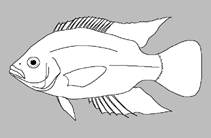 No image available for this species;
drawing shows typical species in Cichlidae.
Images Google
drawing shows typical species in Cichlidae.
Classification / Noms Noms communs | Synonymes | Catalog of Fishes(Genre, Espèce) | ITIS | CoL | WoRMS | Cloffa
> Cichliformes (Cichlids, convict blennies) > Cichlidae (Cichlids) > Pseudocrenilabrinae
Etymology: Haplochromis: Greek, Haploos = single + Greek, chromis = a fish, perhaps a perch (Ref. 45335); aureus: Specific name from Latin 'aureus', golden; referring to yellow chest, cheeks, and snout in dominant males and yellow pelvic fins in females (Ref. 128938).
Etymology: Haplochromis: Greek, Haploos = single + Greek, chromis = a fish, perhaps a perch (Ref. 45335); aureus: Specific name from Latin 'aureus', golden; referring to yellow chest, cheeks, and snout in dominant males and yellow pelvic fins in females (Ref. 128938).
Environnement : milieu / zone climatique / profondeur / gamme de distribution Écologie
; eau douce pélagique. Tropical
Distribution Territoires | Zones FAO | Écosystèmes | Occurrences | Carte par point | Introductions | Faunafri
Africa: Lake Edward.
Taille / Poids / Âge
Description synthétique Clés d'identification | Morphologie | Morphométrie
Épines dorsales (Total) : 14 - 16; Rayons mous dorsaux (Total) : 8 - 10; Épines anales: 3; Rayons mous anaux: 8 - 10; Vertèbres: 30 - 31. Diagnosis: Haplochromis aureus is a species with an acute snout; acutely pointed oral teeth; very broad interorbital area, interorbital width 56.8-66.6% of head width; very short predorsal distance, predorsal distance 31.7-34.4% of standard length; dominant males light blue with yellow snout, cheeks, and chest (Ref. 128938). Small specimens can be mistaken for Haplochromis pappenheimi or H. pelagicus, but differ from both by a deeper body, body depth 30.7-33.5% of standard length vs. 25.4-31.0%; longer upper jaw, upper jaw length 29.3-35.6% of head length vs. 26.5-29.4%; fewer gill rakers, 12-14 vs. 13-18 (Ref. 128938). It resembles H. mentatus in habitus and overlaps slightly in habitat (H. mentatus mostly restricted to littoral regions), differs by a shorter lower jaw, lower jaw length 41.1-46.4% of head length vs. 43.9-51.0%; more and smaller upper outer teeth, upper outer teeth 48-65 vs. 28-46, and dominant males light blue with yellow cheeks and chest vs. uniformly yellow-green with red flanks (Ref. 128938).
Body shape (shape guide): fusiform / normal.
Body shape (shape guide): fusiform / normal.
Abundant in the upper water layers of deepwater regions (Ref. 128938). It feeds on chaoborids and winged ants; most probably an insectivorous species that catches aquatic and terrestrial insects from the water surface (Ref. 128938).
Cycle de vie et comportement reproducteur Maturité | Reproduction | Frai | Œufs | Fécondité | Larves
Référence principale
Téléchargez vos références | Références | Coordinateur : Kullander, Sven O. | Collaborateurs
Vranken, N., M. Van Steenberge, M. Mbalassa and J. Snoeks, 2023. Just below the surface, the pelagic haplochromine cichlids from the Lake Edward system. Hydrobiologia 850:3173-3195. (Ref. 128938)
CITES
Not Evaluated
Menace pour l'homme
Harmless
Utilisations par l'homme
FAO - Publication: search | FishSource |
Plus d'informations
Écologie trophique
Aliments (proies)
Composition du régime alimentaire
Consommation alimentaire
Rations alimentaires
Prédateurs
Aliments (proies)
Composition du régime alimentaire
Consommation alimentaire
Rations alimentaires
Prédateurs
Dynamique des populations
Paramètres de croissance
Âges / tailles maximales
Longueur-poids rel.
Rel. longueur-longueur.
Fréquences de longueurs
Conversion de masse
Recrutement
Abondance
Paramètres de croissance
Âges / tailles maximales
Longueur-poids rel.
Rel. longueur-longueur.
Fréquences de longueurs
Conversion de masse
Recrutement
Abondance
Cycle de vie
Reproduction
Maturité
Maturité/épines rel.
Fécondité
Frai
Agrégats de frai
Œufs
Développement de l'œuf
Larves
Dynamique des populations larvaires
Reproduction
Maturité
Maturité/épines rel.
Fécondité
Frai
Agrégats de frai
Œufs
Développement de l'œuf
Larves
Dynamique des populations larvaires
Anatomie
Surface branchiale
Cerveau
Otolithe
Surface branchiale
Cerveau
Otolithe
Physiologie
Composition corporelle
Nutriments
Consommation d'oxygène
Type de natation
Vitesse de nage
Pigments visuels
Son de poisson
Maladies et parasites
Toxicité (CL50)
Composition corporelle
Nutriments
Consommation d'oxygène
Type de natation
Vitesse de nage
Pigments visuels
Son de poisson
Maladies et parasites
Toxicité (CL50)
Génétique
génôme
Génétique
Hétérozygotie
Héritabilité
Diversité génétique
génôme
Génétique
Hétérozygotie
Héritabilité
Diversité génétique
Liées à l'homme
Systèmes d'aquaculture
Profils d'aquaculture
Souches
Cas de ciguatera
Timbres, pièces de monnaie, divers
Systèmes d'aquaculture
Profils d'aquaculture
Souches
Cas de ciguatera
Timbres, pièces de monnaie, divers
Outils
E-book | Guide de terrain | Générateur de fréquences de longueur | Outil de dynamique de population | Carte par point |
Capture-MSY |
Articles particuliers
Télécharger en XML
Sources Internet
AFORO (otoliths) | Aquatic Commons | BHL | Cloffa | Websites from users | FishWatcher | CISTI | Catalog of Fishes: Genre, Espèce | DiscoverLife | ECOTOX | FAO - Publication: search | Faunafri | Fishipedia | Fishtrace | GloBI | Google Books | Google Scholar | Google | IGFA World Record | OneZoom | Open Tree of Life | Otolith Atlas of Taiwan Fishes | PubMed | Reef Life Survey | Socotra Atlas | TreeBase | Arbre de Vie | Wikipedia: aller à, chercher | World Records Freshwater Fishing | Zoobank | Zoological Record
Estimations basées sur des modèles
Indice de diversité phylogénétique (Réf. 82804): PD50 = 0.5000 [Uniqueness, from 0.5 = low to 2.0 = high].
Bayesian length-weight: a=0.01445 (0.00671 - 0.03113), b=2.99 (2.82 - 3.16), in cm total length, based on LWR estimates for this (Sub)family-body shape (Ref. 93245).
Niveau trophique (Réf. 69278): 3.4 ±0.4 se; based on size and trophs of closest relatives
Résilience (Réf. 120179): Haut, temps minimum de doublement de population inférieur à 15 mois (Preliminary K or Fecundity.).