



Distichodus microps Schmidt, Knobloch & Barrientos, 2021
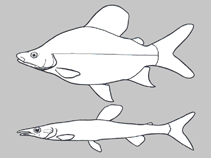
分類 / 名前 共通名の | 類義語 | Catalog of Fishes(部類, 種) | ITIS | CoL | WoRMS | Cloffa
> Characiformes (Characins) > Distichodontidae (Distichodus)
Etymology: Distichodus: Greek, di = two + Greek, stix, stichos = line, row (Ref. 45335); microps: The specific epithet is a combination of the Greek "micro" and "ops" and refers to the small eye relative to the snout and head length (Ref. 127217).
Etymology: Distichodus: Greek, di = two + Greek, stix, stichos = line, row (Ref. 45335); microps: The specific epithet is a combination of the Greek "micro" and "ops" and refers to the small eye relative to the snout and head length (Ref. 127217).
環境:環境 / 気候帯 / 深さの範囲 / 分布範囲 生態学
; 新鮮な水 底生の漂泳性. Tropical
分布 領土 | 国連食糧農業機関の区域 | エコシステム | 事件 | 目的のマップ | 導入 | Faunafri
Africa: Mbia River drainage in Equatorial Guinea (Ref. 127217).
サイズ / 重さ / 年齢
簡単な記述 検索表 | 形態学 | 形態計測学
背面の脊椎 (合計) : 0; 背鰭 (合計) : 15 - 17; 肛門の骨: 0; 臀鰭: 12 - 13. Diagnosis: Distichodus microps is readily distinguished from the larger-bodied, higher-scale count Distichodus species (D. antonii, D. atroventralis, D. fasciolatus, D. lusosso, D. mossambicus, D. sexfasciatus, D. langi, D. rostratus, D. engycephalus, D. kasaiensis, D. ingae, D. polli, D. petersii, D. nefasch, D. brevipinnis and D. schenga) in having fewer lateral line scales, 40-41 vs. more than 60, and in achieving a smaller maximum standard length, less than 15 cm vs. more than 30 cm (Ref. 127217). This species is also distinguished from the smaller-bodied, lower-scale count Distichodus species in the following ways: Distichodus microps is distinguished from D. decemmaculatus and D. teugelsi in having two rows of teeth on the lower jaw vs. one; it can be readily distinguished from D. noboli, D. hypostomatus and D. maculatus in having fewer scales along the lateral line, 40-41 vs. 45, 53-60 and 75 respectively; and distinguished from D. rufigiensis in not having prominent vertical bars along the sides (Ref. 127217). Distichodus microps is distinguished from D. kolleri and D. altus in having fewer dorsal-fin rays, 15-17 total rays vs. 21-26 and 17-18 respectively, and further distinguished from D. altus and D. affinis in having fewer total anal-fin rays, 12-13 vs. 21-22; it is distinguished from D. notospilus in having more scales along the lateral line, 41, rarely 40, vs. 37-39, rarely 40, a nearly inferior mouth vs. subterminal in D. notospilus, a curved posterolateral margin of the opercle vs. straight in D. notospilus, a smaller eye, 56.7-80.4% of snout length vs. 70.1-104.3%, and a less prominent elongated spot at the base of the caudal fin; it is distinguished from D. mbiniensis in having a shallower body, usually six scales from lateral line to the pelvic fin vs. 7, 34.1-38.7% of standard length vs. 33.6-42.4%, fewer anal-fin rays, usually 12 total rays vs. 13-14, a longer anal fin, 15.0-17.8% of standard length vs. 13.4-17.3%, a more inferior mouth vs. the subterminal mouth in D. mbiniensis, a deeper, 12.4-14.2% of standard length vs. 11.8-13.0%, and a longer caudal peduncle , 11.9-14.8% of standard length vs. 9.7-12.6%, a smaller eye, 56.7-80.4% of snout length vs. 58.6-88.0%, a more narrow and elongate subopercle, and a deeper infraorbital 1 with a more rectangular anterolateral margin vs. a more shallow infraorbital 1 with a curved anterolateral margin in D. mbiniensis (Ref. 127217).
ライフサイクルと交尾行動 成熟 | 繁殖 | 放精 | 卵 | 生産力 | 幼生
主な参考文献
参考文献のアップロード | 参考文献 | コーディネーター | 協力者
Schmidt, R.C., E.C. Knobloch and C. Barrientos, 2021. Cast netting new species: integrative taxonomy of Distichodus notospilus (Characiformes: Distichodontidae) discovers new species and overlooked areas of endemism in Central Africa. Zootaxa 4952(2):291-313. (Ref. 127217)
IUCNのレッドリストの状況は (Ref. 130435: Version 2025-2 (Global))
絶滅危惧 (EN) (B1ab(iii)); Date assessed: 21 July 2020
CITES
Not Evaluated
人間に対する脅威
Harmless
人間の用途
FAO - Publication: search | FishSource |
より多くの情報
養殖生態
食料品(獲物)
餌の構成
摂食量
食料配給
捕食動物
食料品(獲物)
餌の構成
摂食量
食料配給
捕食動物
生態学
生態学
生態学
人口動態
成長のパラメーター
最大年齢/サイズ
長さ-重量比。
長短関係。
体長組成
質量変換
補充
豊度
成長のパラメーター
最大年齢/サイズ
長さ-重量比。
長短関係。
体長組成
質量変換
補充
豊度
ライフサイクル
繁殖
成熟
成熟度/エラ
生産力
放精
産卵群
卵
卵の開発
幼生
幼生の動力
繁殖
成熟
成熟度/エラ
生産力
放精
産卵群
卵
卵の開発
幼生
幼生の動力
解剖学
カマ
脳
オトリス
カマ
脳
オトリス
生理学
体組成
栄養素
酸素消費
水泳タイプ
泳ぐ速さ
視覚色素
フィッシュ・サウンド
病気と寄生虫
毒性(LC50)
体組成
栄養素
酸素消費
水泳タイプ
泳ぐ速さ
視覚色素
フィッシュ・サウンド
病気と寄生虫
毒性(LC50)
遺伝子の
ゲノム
遺伝子の
ヘテロ接合性
遺伝
遺伝的多様性
ゲノム
遺伝子の
ヘテロ接合性
遺伝
遺伝的多様性
用具
特記事項
XMLをダウンロードして下さい
インターネットの情報源
AFORO (otoliths) | Aquatic Commons | BHL | Cloffa | Websites from users | Check FishWatcher | CISTI | Catalog of Fishes: 部類, 種 | DiscoverLife | ECOTOX | FAO - Publication: search | Faunafri | Fishipedia | Fishtrace | GloBI | Google Books | Google Scholar | Google | IGFA World Record | OneZoom | Open Tree of Life | Otolith Atlas of Taiwan Fishes | PubMed | Reef Life Survey | Socotra Atlas | TreeBase | 生命の木 | Wikipedia: 行く, 検索する | World Records Freshwater Fishing | Zoobank | 動物に関する記録