



Hypanus berthalutzae Petean, Naylor & Lima, 2020
Adicionar o seu Fotografias e vídeos
Fotografias | Imagem do Google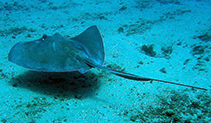 Hypanus berthalutzae
Fotografia de Carvalho Filho, A.
Fotografias | Imagem do Google
Fotografia de Carvalho Filho, A.
Classificação / Nomes Nomes comuns | Sinónimos | Catalog of Fishes(Género, Espécies) | ITIS | CoL | WoRMS | Cloffa
Elasmobranchii (tubarões e raias) (sharks and rays) > Myliobatiformes (Stingrays) > Dasyatidae (Stingrays) > Dasyatinae
Etymology: berthalutzae: Named for Bertha Lutz, a pioneering Brazilian woman zoologist, who was also involved in feminist issues and created the Brazilian Federation for Feminine Progress; alluding to this species restricted to the Brazilian waters and since most known specimens are females, it represents the recent feminine empowering, including in sciences.
Eponymy: Bertha Maria Júlia Lutz (1894–1976) was a Brazilian zoologist, politician and pioneering feminist, who founded the Brazilian Federation for Feminine Progress (1922). [...] (Ref. 128868), visit book page.
Etymology: berthalutzae: Named for Bertha Lutz, a pioneering Brazilian woman zoologist, who was also involved in feminist issues and created the Brazilian Federation for Feminine Progress; alluding to this species restricted to the Brazilian waters and since most known specimens are females, it represents the recent feminine empowering, including in sciences.
Eponymy: Bertha Maria Júlia Lutz (1894–1976) was a Brazilian zoologist, politician and pioneering feminist, who founded the Brazilian Federation for Feminine Progress (1922). [...] (Ref. 128868), visit book page.
Ambiente: milieu / zona climática / intervalo de profundidade / gama de distribuição Ecologia
marinhas demersal. Tropical
Distribuição Territórios | Áreas FAO | Ecossistemas | Ocorrências | Mapa dos pontos | Introduções | Faunafri
Atlantic: Brazil.
Tamanho / Peso / Idade
Maturidade: Lm ? range ? - ? cm
Max length : 68.0 cm WD macho/indeterminado; (Ref. 123757); 61.8 cm WD (female)
Max length : 68.0 cm WD macho/indeterminado; (Ref. 123757); 61.8 cm WD (female)
Descrição breve Chaves de identificação | Morfologia | Morfometria
This species is distinguished from non-Hypanus species that occur in the western Atlantic by the presence of dorsal a caudal ridge (vs. absence in Bathytoshia centroura, a dorsal caudal fold in Dasyatis hypostigma); absence of a w-shaped notch in the central ventral disc (vs. presence in D. hypostigma); and with the anterior portion of the disc with angle varying from 125°-135° and a clear ventral disc (vs. 150° and dark ventral disc in Pteroplatytrygon violacea). It differs from most Hypanus species, except those from the H. americanus species group, it can be distinguished by the diamond-shaped body with a short snout (vs. long snout in H. guttatus, H. sabinus); presence of ventral caudal fold and dorsal caudal ridge (vs. ventral and dorsal caudal folds in H. marianae, H. dipterurus, H. say, H. sabinus); a white spot between the eyes anterior to the precerebral fontanelle (vs. absent in H. marianae, H. guttatus, H. dipterurus, H. say, H. sabinus); differs from the species of the H. americanus clade (H. americanus, H. longus, H. rudis) by the presence of sparse black spots on the dorsal disc of live specimens (vs. absent) and by 11 morphometric measurements, the most relevant being spiracle length or SPL [18.62% (16.21%-22.47%) of head length or HDL vs. 19.61% (15.85%-32.81%) in H. americanus, 18.37% (17.03%-21.89%) in H. longus and 24.79% (23.55%-26.11%) in H. rudis] and ventral caudal fold height or VFH [1.92% (1.37%-2.3%) of DW vs. 1.74% (0.83%-2.83%) in H. americanus, 1.39% (0.75%-2.71%) in H. longus and 1.55% (1.1%-1.81%) in H. rudis]. In male adults of H. berthalutzae and H. americanus, the pelvic fin length or P2L is smaller than the distance from apopyle to clasper tip (ap-tip), whereas it is larger in H. longus. The measurement P2L/ap-tip is 54.16% in H. berthalutzae [vs. 49.43% (41.78%-56.33%) in H. americanus and 119.44% (113.20%-124.15%) in H. longus] (Ref. 123757).
Cross section: flattened.
Cross section: flattened.
Mostly a coastal species, usually at the continental shelf, and reported to occur in localities up to 250 km off the coast (Ref. 123757).
Ciclo de vida e comportamento de acasalamento Maturidade | Reprodução | Desova | Ovos | Fecundidade | Larvas
Referência principal
Carregar as suas referências | Referências | Coordenador : McEachran, John | Colaboradores
Petean, F.F., G.J.P. Naylor and S.M.Q. Lima, 2020. Integrative taxonomy identifies a new stingray species of the genus Hypanus Rafinesque, 1818 (Dasyatidae, Myliobatiformes) from the Tropical Southwestern Atlantic. J. Fish Biol. 97(4):1120-1142. (Ref. 123757)
Categoria na Lista Vermelha da IUCN (Ref. 130435: Version 2025-2 (Global))
Vulnerável (VU) (A2d); Date assessed: 08 August 2020
CITES
Not Evaluated
Ameaça para o homem
Harmless
Utilização humana
FAO - Publication: search | FishSource |
Mais informação
Ecologia Trófica
Produtos alimentares (presas)
Composição da dieta
Consumo alimentar
Rações alimentares
Predadores
Produtos alimentares (presas)
Composição da dieta
Consumo alimentar
Rações alimentares
Predadores
Ecologia
Ecologia
Ecologia
Dinâmica das populações
Parâmetros de crescimento
Idades / tamanhos máximos
Comprimento-peso rel.
Comprimento-comprimento rel.
Frequência de comprimento
Conversão de massa
Recrutamento
Abundância
Parâmetros de crescimento
Idades / tamanhos máximos
Comprimento-peso rel.
Comprimento-comprimento rel.
Frequência de comprimento
Conversão de massa
Recrutamento
Abundância
Ciclo de vida
Reprodução
Maturidade
Maturidade/Rel. das guelras
Fecundidade
Desova
Agregações de desova
Ovos
Desenvolvimento dos ovos
Larvas
Dinâmica larvar
Reprodução
Maturidade
Maturidade/Rel. das guelras
Fecundidade
Desova
Agregações de desova
Ovos
Desenvolvimento dos ovos
Larvas
Dinâmica larvar
Anatomia
Área branquial
Cérebro
Otólitos
Área branquial
Cérebro
Otólitos
Fisiologia
Composição corporal
Nutrientes
Consumo de oxigénio
Tipo de natação
Velocidade de natação
Pigmentos visuais
Som de peixe
Doenças e Parasitas
Toxicidade (LC50s)
Composição corporal
Nutrientes
Consumo de oxigénio
Tipo de natação
Velocidade de natação
Pigmentos visuais
Som de peixe
Doenças e Parasitas
Toxicidade (LC50s)
Genética
genoma
Genética
Heterozigotia
Hereditariedade
Diversidade genética
genoma
Genética
Heterozigotia
Hereditariedade
Diversidade genética
Relacionado com o ser humano
Sistemas de aquacultura
Perfis para aquacultura
Estirpes
Casos de Ciguatera
Selos, moedas, diversos.
Sistemas de aquacultura
Perfis para aquacultura
Estirpes
Casos de Ciguatera
Selos, moedas, diversos.
Ferramentas
E-book | Guia de campo | Ferramenta auxiliar de frequências de comprimento | Ferramenta sobre a história de vida | Mapa dos pontos |
Captura-MSY |
Relatórios especiais
Descarregue XML
Fontes da internet
AFORO (otoliths) | Aquatic Commons | BHL | Cloffa | Websites from users | Consultar FishWatcher | CISTI | Catalog of Fishes: Género, Espécies | DiscoverLife | ECOTOX | FAO - Publication: search | Faunafri | Fishipedia | Fishtrace | GloBI | Google Books | Google Scholar | Google | IGFA World Record | OneZoom | Open Tree of Life | Otolith Atlas of Taiwan Fishes | PubMed | Reef Life Survey | Socotra Atlas | TreeBase | Árvore da vida | Wikipedia: ir para, procurar | World Records Freshwater Fishing | Zoobank | Registo zoológico
Estimativas baseadas em modelos
Índice de diversidade filogenética (Ref. 82804): PD50 = 0.5010 [Uniqueness, from 0.5 = low to 2.0 = high].
Bayesian length-weight: a=0.00447 (0.00189 - 0.01058), b=3.12 (2.92 - 3.32), in cm total length, based on LWR estimates for this (Sub)family-body shape (Ref. 93245).
Nível Trófico (Ref. 69278): 3.5 ±0.5 se; based on size and trophs of closest relatives