



Hypanus berthalutzae Petean, Naylor & Lima, 2020
Envoyez vos Photos et vidéos
Images | Images Google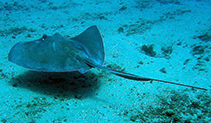 Hypanus berthalutzae
Photo de Carvalho Filho, A.
Images | Images Google
Photo de Carvalho Filho, A.
Classification / Noms Noms communs | Synonymes | Catalog of Fishes(Genre, Espèce) | ITIS | CoL | WoRMS | Cloffa
Élasmobranches (requins et raies) (sharks and rays) > Myliobatiformes (Stingrays) > Dasyatidae (Stingrays) > Dasyatinae
Etymology: berthalutzae: Named for Bertha Lutz, a pioneering Brazilian woman zoologist, who was also involved in feminist issues and created the Brazilian Federation for Feminine Progress; alluding to this species restricted to the Brazilian waters and since most known specimens are females, it represents the recent feminine empowering, including in sciences.
Eponymy: Bertha Maria Júlia Lutz (1894–1976) was a Brazilian zoologist, politician and pioneering feminist, who founded the Brazilian Federation for Feminine Progress (1922). [...] (Ref. 128868), visit book page.
Etymology: berthalutzae: Named for Bertha Lutz, a pioneering Brazilian woman zoologist, who was also involved in feminist issues and created the Brazilian Federation for Feminine Progress; alluding to this species restricted to the Brazilian waters and since most known specimens are females, it represents the recent feminine empowering, including in sciences.
Eponymy: Bertha Maria Júlia Lutz (1894–1976) was a Brazilian zoologist, politician and pioneering feminist, who founded the Brazilian Federation for Feminine Progress (1922). [...] (Ref. 128868), visit book page.
Environnement : milieu / zone climatique / profondeur / gamme de distribution Écologie
marin démersal. Tropical
Distribution Territoires | Zones FAO | Écosystèmes | Occurrences | Carte par point | Introductions | Faunafri
Atlantic: Brazil.
Taille / Poids / Âge
Maturité: Lm ? range ? - ? cm
Max length : 68.0 cm WD mâle / non sexé; (Ref. 123757); 61.8 cm WD (female)
Max length : 68.0 cm WD mâle / non sexé; (Ref. 123757); 61.8 cm WD (female)
Description synthétique Clés d'identification | Morphologie | Morphométrie
This species is distinguished from non-Hypanus species that occur in the western Atlantic by the presence of dorsal a caudal ridge (vs. absence in Bathytoshia centroura, a dorsal caudal fold in Dasyatis hypostigma); absence of a w-shaped notch in the central ventral disc (vs. presence in D. hypostigma); and with the anterior portion of the disc with angle varying from 125°-135° and a clear ventral disc (vs. 150° and dark ventral disc in Pteroplatytrygon violacea). It differs from most Hypanus species, except those from the H. americanus species group, it can be distinguished by the diamond-shaped body with a short snout (vs. long snout in H. guttatus, H. sabinus); presence of ventral caudal fold and dorsal caudal ridge (vs. ventral and dorsal caudal folds in H. marianae, H. dipterurus, H. say, H. sabinus); a white spot between the eyes anterior to the precerebral fontanelle (vs. absent in H. marianae, H. guttatus, H. dipterurus, H. say, H. sabinus); differs from the species of the H. americanus clade (H. americanus, H. longus, H. rudis) by the presence of sparse black spots on the dorsal disc of live specimens (vs. absent) and by 11 morphometric measurements, the most relevant being spiracle length or SPL [18.62% (16.21%-22.47%) of head length or HDL vs. 19.61% (15.85%-32.81%) in H. americanus, 18.37% (17.03%-21.89%) in H. longus and 24.79% (23.55%-26.11%) in H. rudis] and ventral caudal fold height or VFH [1.92% (1.37%-2.3%) of DW vs. 1.74% (0.83%-2.83%) in H. americanus, 1.39% (0.75%-2.71%) in H. longus and 1.55% (1.1%-1.81%) in H. rudis]. In male adults of H. berthalutzae and H. americanus, the pelvic fin length or P2L is smaller than the distance from apopyle to clasper tip (ap-tip), whereas it is larger in H. longus. The measurement P2L/ap-tip is 54.16% in H. berthalutzae [vs. 49.43% (41.78%-56.33%) in H. americanus and 119.44% (113.20%-124.15%) in H. longus] (Ref. 123757).
Cross section: flattened.
Cross section: flattened.
Mostly a coastal species, usually at the continental shelf, and reported to occur in localities up to 250 km off the coast (Ref. 123757).
Cycle de vie et comportement reproducteur Maturité | Reproduction | Frai | Œufs | Fécondité | Larves
Référence principale
Téléchargez vos références | Références | Coordinateur : McEachran, John | Collaborateurs
Petean, F.F., G.J.P. Naylor and S.M.Q. Lima, 2020. Integrative taxonomy identifies a new stingray species of the genus Hypanus Rafinesque, 1818 (Dasyatidae, Myliobatiformes) from the Tropical Southwestern Atlantic. J. Fish Biol. 97(4):1120-1142. (Ref. 123757)
Statut dans la liste rouge de l'IUCN (Ref. 130435: Version 2025-2 (Global))
Vulnérable (VU) (A2d); Date assessed: 08 August 2020
CITES
Not Evaluated
Menace pour l'homme
Harmless
Utilisations par l'homme
FAO - Publication: search | FishSource |
Plus d'informations
Écologie trophique
Aliments (proies)
Composition du régime alimentaire
Consommation alimentaire
Rations alimentaires
Prédateurs
Aliments (proies)
Composition du régime alimentaire
Consommation alimentaire
Rations alimentaires
Prédateurs
Écologie
Écologie
Écologie
Dynamique des populations
Paramètres de croissance
Âges / tailles maximales
Longueur-poids rel.
Rel. longueur-longueur.
Fréquences de longueurs
Conversion de masse
Recrutement
Abondance
Paramètres de croissance
Âges / tailles maximales
Longueur-poids rel.
Rel. longueur-longueur.
Fréquences de longueurs
Conversion de masse
Recrutement
Abondance
Cycle de vie
Reproduction
Maturité
Maturité/épines rel.
Fécondité
Frai
Agrégats de frai
Œufs
Développement de l'œuf
Larves
Dynamique des populations larvaires
Reproduction
Maturité
Maturité/épines rel.
Fécondité
Frai
Agrégats de frai
Œufs
Développement de l'œuf
Larves
Dynamique des populations larvaires
Anatomie
Surface branchiale
Cerveau
Otolithe
Surface branchiale
Cerveau
Otolithe
Physiologie
Composition corporelle
Nutriments
Consommation d'oxygène
Type de natation
Vitesse de nage
Pigments visuels
Son de poisson
Maladies et parasites
Toxicité (CL50)
Composition corporelle
Nutriments
Consommation d'oxygène
Type de natation
Vitesse de nage
Pigments visuels
Son de poisson
Maladies et parasites
Toxicité (CL50)
Génétique
génôme
Génétique
Hétérozygotie
Héritabilité
Diversité génétique
génôme
Génétique
Hétérozygotie
Héritabilité
Diversité génétique
Liées à l'homme
Systèmes d'aquaculture
Profils d'aquaculture
Souches
Cas de ciguatera
Timbres, pièces de monnaie, divers
Systèmes d'aquaculture
Profils d'aquaculture
Souches
Cas de ciguatera
Timbres, pièces de monnaie, divers
Outils
E-book | Guide de terrain | Générateur de fréquences de longueur | Outil de dynamique de population | Carte par point |
Capture-MSY |
Articles particuliers
Télécharger en XML
Sources Internet
AFORO (otoliths) | Aquatic Commons | BHL | Cloffa | Websites from users | FishWatcher | CISTI | Catalog of Fishes: Genre, Espèce | DiscoverLife | ECOTOX | FAO - Publication: search | Faunafri | Fishipedia | Fishtrace | GloBI | Google Books | Google Scholar | Google | IGFA World Record | OneZoom | Open Tree of Life | Otolith Atlas of Taiwan Fishes | PubMed | Reef Life Survey | Socotra Atlas | TreeBase | Arbre de Vie | Wikipedia: aller à, chercher | World Records Freshwater Fishing | Zoobank | Zoological Record
Estimations basées sur des modèles
Indice de diversité phylogénétique (Réf. 82804): PD50 = 0.5010 [Uniqueness, from 0.5 = low to 2.0 = high].
Bayesian length-weight: a=0.00447 (0.00189 - 0.01058), b=3.12 (2.92 - 3.32), in cm total length, based on LWR estimates for this (Sub)family-body shape (Ref. 93245).
Niveau trophique (Réf. 69278): 3.5 ±0.5 se; based on size and trophs of closest relatives