



Haplochromis aquila Vranken, Van Steenberge, Heylen, Decru & Snoeks, 2022
Uploaden van uw Foto's en video's
Google afbeelding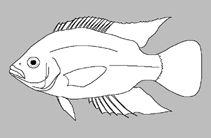 No image available for this species;
drawing shows typical species in Cichlidae.
Google afbeelding
drawing shows typical species in Cichlidae.
Classificatie / Namen Lokale namen | Synoniemen | Catalog of Fishes(Genus, Soort(en)) | ITIS | CoL | WoRMS | Cloffa
> Cichliformes (Cichlids, convict blennies) > Cichlidae (Cichlids) > Pseudocrenilabrinae
Etymology: Haplochromis: Greek, Haploos = single + Greek, chromis = a fish, perhaps a perch (Ref. 45335); aquila: Specific name from the Latin 'aquila' for 'eagle'; referring to predatory morphology and large eyes (Ref. 126312).
Etymology: Haplochromis: Greek, Haploos = single + Greek, chromis = a fish, perhaps a perch (Ref. 45335); aquila: Specific name from the Latin 'aquila' for 'eagle'; referring to predatory morphology and large eyes (Ref. 126312).
Milieu: milieu / Klimaatzone / Diepte / verspreidingsgebied Ecologie
; zoet water pelagisch. Tropical
Verspreiding Gebieden | FAO regio's | Ecosystemen | Voorkomen | Verspreidingskaart | Introducties | Faunafri
Africa: Lake Edward (Ref. 126312).
Grootte / Gewicht / Leeftijd
Maturiteit: Lm ? range ? - ? cm
Max length : 12.3 cm SL mannelijk / geslacht onbekend; (Ref. 126312)
Max length : 12.3 cm SL mannelijk / geslacht onbekend; (Ref. 126312)
Korte beschrijving Determinatiesleutels | Morfologie | Morfometrie
Dorsale stekels (totaal) : 14 - 16; Dorsale zachte stralen (totaal) : 9 - 10; Anale stekels: 3; Anale zachte stralen: 8 - 9; Wervels: 30. Diagnosis: Species with a piscivorous morphology; eye large, eye diameter 30.0-31.5% of head length; outer oral teeth few and large, 25-37; dominant males light grey with a black head and a bright red anal fin (Ref. 126312). Amongst piscivorous species from the Lake Edward system, H. aquila differs from H. latifrons, H. mentatus, H. rex, H. simba, and H. glaucus by a larger eye, eye diameter 30.0-31.5% of head length vs. 22.2-29.9%; it further differs from H. latifrons and H. mentatus by a shorter caudal peduncle, caudal peduncle length 14.6-15.4% of standard length vs. 15.7-18.0%; further from H. latifrons by the absence vs. presence of a well-defined mid-lateral band; further from H. mentatus by dominant males uniformly light grey vs. yellow-green with a red anterior part of flank; it further differs from H. rex by a shallower lacrimal, lacrimal depth 17.0-19.1% of head length vs. 18.9-22.5%; and dominant males light grey with black operculum and snout vs. cream-coloured with an orange operculum and a light blue snout; it further differs from H. simba by a larger number of scales between first anal-fin spine and upper lateral line, 12-15, raraely 11, vs. 9-11; an absent vs. strongly developed mental prominence; and dominant males light grey with a black head vs. uniformly yellow with an orange anterior part of flank; it further differs from H. glaucus by a broader head, head width 40.1-43.7% of head length vs. 38.9-40.9%; and dominant males light grey with bright red anal and caudal fins vs. light blue with crimson anal and caudal fins (Ref. 126312). It differs from H. kimondo, H. falcatus, H. curvidens, H. pardus, H. quasimodo and H. squamipinnis by the combination of large vs. small outer oral teeth and smaller number of outer upper jaw teeth, 25-37 vs. 39-79; it further differs from H. kimondo, H. falcatus and H. quasimodo by absence vs. mostly presence of a well-defined mid-lateral band and dominant males light grey with a black head vs. grey dorsally and yellow ventrally, olive-green with an orange-red anterior part of flank, or light grey dorsally and blue-black ventrally; further from H. kimondo by a narrower head, head width 40.1-43.7% of head length vs. 42.9-48.0%; it further differs from H. curvidens and H. pardus by a deeper cheek, cheek depth 26.8-30.8% of head length vs. 20.8-24.9%; further from H. pardus by dominant males light grey vs. speckled to uniformly black; it further differs from H. squamipinnis by larger eyes, eye diameter 30.0-31.5% of head length vs. 23.1-29.7%; and dominant males light grey vs. slate blue (Ref. 126312).
Found in inshore areas over muddy substrates (Ref. 126312). Based on its morphology, most probably a piscivorous species (Ref. 126312).
Levenscyclus en paargedrag Maturiteit | Voortplanting | Paaien | Eieren | Fecunditeit | Larven
Hoofdreferentie
Upload uw referenties | Referenties | Coördinator : Kullander, Sven O. | Medewerkers
Vranken, N., M. Van Steenberge, A. Heylen, E. Decru and J. Snoeks, 2022. From a pair to a dozen: the piscivorous species of Haplochromis (Cichlidae) from the Lake Edward system. Eur. J. Taxon. 815:1-94. (Ref. 126312)
CITES
Not Evaluated
Gevaar voor de mens
Harmless
Gebruik door de mens
FAO - Publication: search | FishSource |
Meer informatie
Trofische ecologie
Voedsel (prooien)
Dieetsamenstelling
Voedselconsumptie
Voedselrantsoenen
Predatoren
Voedsel (prooien)
Dieetsamenstelling
Voedselconsumptie
Voedselrantsoenen
Predatoren
Populatiedynamica
Groeiparameters
Max. leeftijden / maten
Lengte-gewicht rel.
Lengte-lengte rel.
Lengtefrequenties
Massaconversie
Rekrutering
Abundantie
Groeiparameters
Max. leeftijden / maten
Lengte-gewicht rel.
Lengte-lengte rel.
Lengtefrequenties
Massaconversie
Rekrutering
Abundantie
Levenscyclus
Voortplanting
Maturiteit
Rijpheid/kieuwen rel.
Fecunditeit
Paaien
Paaibestanden
Eieren
Ontwikkeling van de eieren
Larven
Larvale populatiedynamiek
Voortplanting
Maturiteit
Rijpheid/kieuwen rel.
Fecunditeit
Paaien
Paaibestanden
Eieren
Ontwikkeling van de eieren
Larven
Larvale populatiedynamiek
Anatomie
Kieuwoppervlak
Hersenen
Otoliet
Kieuwoppervlak
Hersenen
Otoliet
Fysiologie
Lichaamssamenstelling
Voedingsstoffen
Zuurstofverbruik
Type zwemmen
Zwemsnelheid
Visuele pigmenten
Vis geluid
Ziekten en parasieten
Toxiciteit (LC50)
Lichaamssamenstelling
Voedingsstoffen
Zuurstofverbruik
Type zwemmen
Zwemsnelheid
Visuele pigmenten
Vis geluid
Ziekten en parasieten
Toxiciteit (LC50)
Genetica
genoom
Genetica
Heterozygositeit
Erfelijkheid
Genetische diversiteit
genoom
Genetica
Heterozygositeit
Erfelijkheid
Genetische diversiteit
Menselijk gerelateerd
Aquacultuursystemen
Aquacultuurprofielen
Kweeklijnen
Ciguatera gevallen
Postzegels, munten, diversen.
Aquacultuursystemen
Aquacultuurprofielen
Kweeklijnen
Ciguatera gevallen
Postzegels, munten, diversen.
Tools
Speciale rapporten
Bekijk gegevens voor het houden in een aquarium | Bekijk Fact Sheets voor de soort | Bekijk Aquacultuur Fact Sheets
Download XML
Internetbronnen
AFORO (otoliths) | Aquatic Commons | BHL | Cloffa | Websites from users | Bekijk FishWatcher | CISTI | Catalog of Fishes: Genus, Soort(en) | DiscoverLife | ECOTOX | FAO - Publication: search | Faunafri | Fishipedia | Fishtrace | GloBI | Google Books | Google Scholar | Google | IGFA World Record | OneZoom | Open Tree of Life | Otolith Atlas of Taiwan Fishes | PubMed | Reef Life Survey | Socotra Atlas | TreeBase | Tree of Life | Wikipedia: ga naar, zoek | World Records Freshwater Fishing | Zoobank | Zoological Record
Schattingen op basis van modellen
Fylogenetische diversiteitsindex (Ref. 82804): PD50 = 0.5000 [Uniqueness, from 0.5 = low to 2.0 = high].
Bayesian length-weight: a=0.01445 (0.00671 - 0.03113), b=2.99 (2.82 - 3.16), in cm total length, based on LWR estimates for this (Sub)family-body shape (Ref. 93245).
Trofisch niveau (Ref. 69278): 3.4 ±0.4 se; based on size and trophs of closest relatives
Weerstandsvermogen (Ref. 120179): Hoog, minimale populatieverdubbelingstijd minder dan 15 maanden (Preliminary K or Fecundity.).