



Okamejei panayensis Misawa, Babaran & Motomura, 2022
Philippine skate
Hochladen Photos und videos
Bilder | Google Bild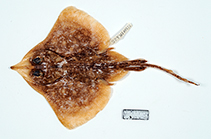 Okamejei panayensis
Male Photo von Misawa, R
Bilder | Google Bild
Male Photo von Misawa, R
Klassifizierung / Names Namen | Synonyme | Catalog of Fishes(Gattung, Arten) | ITIS | CoL | WoRMS | Cloffa
Elasmobranchii (Haie und Rochen) (sharks and rays) > Rajiformes (Skates and rays) > Rajidae (Skates)
Etymology: panayensis: Named for its type locality, Panay island.
Etymology: panayensis: Named for its type locality, Panay island.
Umwelt: Milieu / Klimazone / Tiefenbereich / Verbreitungsgebiet Ökologie
seewasser benthopelagisch. Tropical
Verbreitung Territorien | FAO Gebiete | Ökosysteme | Vorkommen | Punkt Karte | Einführungen | Faunafri
Western Central Pacific: the Philippines.
Größe / Gewicht / Alter
Kurzbeschreibung Bestimmungsschlüssel | Morphologie | Morphometrie
This species can be distinguished from its congeners by the following set of characters: tail moderately is long, slender and weakly tapering posteriorly, length 51.0% of TL; first dorsal fin (D1) origin to tail tip 21.2% of TL; interdorsal space is rather short, distance 67.0% of D1 base length; caudal-fn base length is moderate, 1.3 times D1 base length; snout is rather short, moderately acute and pointed, preorbital snout length 13.7% of TL, preoral snout length 14.3% of TL, prenarial snout length 11.3% of TL; dorsal head length 20.7% of TL, the ventral head length 28.6% of TL; orbits and eyeballs are large, orbit diameter 1.3 times interorbital width, eyeball length (horizontal diameter) 1.2 times interorbital width; tail thorns are distinct, three rows in adult male; single nuchal thorn; trunk vertebrae 28 while predorsal tail vertebrae 43. Colouration: dorsal surface of disc pale brown, margin yellowish to pale brown; numerous yellowish spots and black fecks sparsely scattered on the dorsal disc, but not forming patches; dorsal disc no ocellated markings; snout area translucent; ventral surface of disc broadly white, the margin pale brown, darkly pigmented at pectoral-fin bases, posterior insertions of pectoral fins, nasal curtain, around cloaca, and sensory pore openings; ventral disc sensory pores in a W-shaped” distribution pattern, absent on abdominal region and near pelvic-fn base; clasper with external boss, cleft, funnel, pseudorhipidion, rhipidion, shield, spike, sentinel, and terminal bridge; the clasper skeleton with three dorsal terminal cartilages, single ventral terminal cartilage, two accessory terminal cartilages (accessory terminal 1 “Y-shaped”) (Ref. 126270).
Cross section: flattened.
Cross section: flattened.
Lebenszyklus und Paarungsverhalten Geschlechtsreife | Fortpflanzung | Ablaichen | Eier | Fruchtbarkeit | Larven
Hauptreferenz
Laden Sie Ihre Referenzen hoch | Referenzen | Koordinator : McEachran, John | Partner
Misawa, R., R.P. Babaran and H. Motomura, 2022. Okamejei panayensis sp. nov., a new skate (Rajiformes: Rajidae) from the Philippines. Ichthyological Research (Ref. 126270)
IUCN Rote Liste Status (Ref. 130435: Version 2025-2 (Global))
Daten mangelhaft (DD) ; Date assessed: 18 August 2022
CITES
Not Evaluated
Bedrohung für Menschen
Harmless
Nutzung durch Menschen
FAO - Publication: search | FishSource |
Mehr Information
Trophische Ökologie
Lebensmittel (Beutetiere)
Nahrungszusammensetzung
Nahrungsaufnahme
Lebensmittelrationen
Räuber
Lebensmittel (Beutetiere)
Nahrungszusammensetzung
Nahrungsaufnahme
Lebensmittelrationen
Räuber
Ökologie
Ökologie
Ökologie
Populationsdynamik
Wachstumsparameter
Max. Alter/Größen
Länge-Gewicht-Rel.
Länge-Länge-Verhältnis.
Längenhäufigkeiten
Massenkonvertierung
Rekrutierung
Dichte
Wachstumsparameter
Max. Alter/Größen
Länge-Gewicht-Rel.
Länge-Länge-Verhältnis.
Längenhäufigkeiten
Massenkonvertierung
Rekrutierung
Dichte
Lebenszyklus
Fortpflanzung
Geschlechtsreife
Reifung/Kiemen rel.
Fruchtbarkeit
Ablaichen
Laichaggregationen
Eier
Eientwicklung
Larven
Larven Pop.Dyn.
Fortpflanzung
Geschlechtsreife
Reifung/Kiemen rel.
Fruchtbarkeit
Ablaichen
Laichaggregationen
Eier
Eientwicklung
Larven
Larven Pop.Dyn.
Anatomie
Kiemenoberfläche
Gehirn
Otolith
Kiemenoberfläche
Gehirn
Otolith
Physiologie
Körperliche Zusammensetzung
Nährstoffe
Sauerstoffverbrauch
Schwimmart
Schwimmgeschwindigkeit
Visuelle Pigmente
Fischgeräusche
Krankheiten und Parasiten
Toxizität (LC50s)
Körperliche Zusammensetzung
Nährstoffe
Sauerstoffverbrauch
Schwimmart
Schwimmgeschwindigkeit
Visuelle Pigmente
Fischgeräusche
Krankheiten und Parasiten
Toxizität (LC50s)
Genetik
Genom
Genetik
Heterozygotie
Vererbbarkeit
Genetische Vielfalt
Genom
Genetik
Heterozygotie
Vererbbarkeit
Genetische Vielfalt
Menschenbezogen
Aquakultur-Systeme
Aquakultur Profile
Zuchtlinien
Ciguatera-Fälle
Briefmarken, Münzen, Verschiedenes.
Aquakultur-Systeme
Aquakultur Profile
Zuchtlinien
Ciguatera-Fälle
Briefmarken, Münzen, Verschiedenes.
Tools
Zusatzinformationen
Download XML
Zusammenfassung | Punktdaten | Namen | Photos
Internet Quellen
AFORO (otoliths) | Aquatic Commons | BHL | Cloffa | Websites from users | FishWatcher Einträge suchen | CISTI | Catalog of Fishes: Gattung, Arten | DiscoverLife | ECOTOX | FAO - Publication: search | Faunafri | Fishipedia | Fishtrace | GloBI | Google Books | Google Scholar | Google | IGFA World Record | OneZoom | Open Tree of Life | Otolith Atlas of Taiwan Fishes | PubMed | Reef Life Survey | Socotra Atlas | TreeBase | Tree of Life | Wikipedia: Gehe zu, Suchen | World Records Freshwater Fishing | Zoobank | Zoologischer Rekord
Schätzungen auf der Grundlage von Modellen
Phylogenetischer Diversitätsindex (Ref. 82804): PD50 = 0.5001 [Uniqueness, from 0.5 = low to 2.0 = high].
Bayesian length-weight: a=0.00302 (0.00141 - 0.00645), b=3.24 (3.07 - 3.41), in cm total length, based on LWR estimates for this (Sub)family-body shape (Ref. 93245).
Trophische Ebene (Ref. 69278): 3.9 ±0.6 se; based on size and trophs of closest relatives
Widerstandsfähigkeit (Ref. 120179): mittel, Verdopplung der Population dauert 1,4 - 4,4 Jahre. (Preliminary K or Fecundity.).