



Carregue seu(sua) Fotos e vídeos
Imagem do Google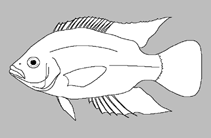 No image available for this species;
drawing shows typical species in Cichlidae.
Imagem do Google
drawing shows typical species in Cichlidae.
Classificação / Nomes Nomes comuns | Sinônimos | Catalog of Fishes(Gênero, Espécies) | ITIS | CoL | WoRMS | Cloffa
> Cichliformes (Cichlids, convict blennies) > Cichlidae (Cichlids) > Pseudocrenilabrinae
Etymology: Hemibates: Greek, hemi = the half + Greek, bates, baino = to go, to walk (Ref. 45335); koningsi: The species is named for the first person who recognized the new Hemibates species as a distinct phenotype, Ad Konings, in appreciation of the inspiration to many cichlidophiles that arose from his continued popular and scientific contributions (Ref. 117350).
Eponymy: Dr Adrianus Franciscus Johannes Marinus Maria ‘Ad’ Konings (d: 1956) is a Dutch ichthyologist, cichlid aquarist, photographer, writer and publisher who began collecting cichlids at the age of fourteen. [...] (Ref. 128868), visit book page.
Etymology: Hemibates: Greek, hemi = the half + Greek, bates, baino = to go, to walk (Ref. 45335); koningsi: The species is named for the first person who recognized the new Hemibates species as a distinct phenotype, Ad Konings, in appreciation of the inspiration to many cichlidophiles that arose from his continued popular and scientific contributions (Ref. 117350).
Eponymy: Dr Adrianus Franciscus Johannes Marinus Maria ‘Ad’ Konings (d: 1956) is a Dutch ichthyologist, cichlid aquarist, photographer, writer and publisher who began collecting cichlids at the age of fourteen. [...] (Ref. 128868), visit book page.
Meio ambiente: milieu / Zona climática / intervalo de profundidade / faixa de distribuição Ecologia
; Água doce pelágico(a,os,as); intervalo de profundidade 40 - 150 m (Ref. 117350), usually 40 - 60 m (Ref. 117350). Tropical
Distribuição Territórios | Áreas da FAO | Ecossistemas | Ocorrências | Mapa de pontos | Introduções | Faunafri
Africa: southern part of Lake Tanganyika from around Mpulungu and the Chituta Bay (Ref. 117350).
Tamanho / Peso / Idade
Descrição suscinta Chaves de identificação | Morfologia | Morfometria
Espinhos dorsais (total) : 14 - 15; Raios dorsais (total) : 13 - 15; Espinhos anais: 3; Raios anais : 12 - 14; Vértebras: 33 - 34. Diagnosis: Adult males of Hemibates koningsi can be distinguished from H. stenosoma, the only congener, by a flank colour pattern of four to seven black vertical bars, two to three flank-scales wide, on the anterior flank region and five horizontal bands, one to two, rarely three flank-scales high, on the posterior flank region vs. black blotches of variable number, size and shape at the anterior part of the flanks and five, rarely four, horizontal bands in H. stenosoma; they can further be distinguished by the fourth horizontal band, counted from dorsal to ventral, starting below pectoral fin base sometimes before and extending to caudal fin base in H. koningsi vs. normally ending well before caudal fin base in H. stenosoma; moreover, both species exhibit a black band on dorsal fin membrane along the dorsal-fin base, which is however wider and more pronounced in H. koningsi males (Ref. 117350). Females as well as males of H. koningsi can be unambiguously separated from H. stenosoma by their longer lower pharyngeal jaw, 37.6-38.2% of head length vs. 27.8-32.5%, with a characteristically curved keel, distinctive bulge ventrally of the keel, which contrasts with the more or less straight keel of H. stenosoma, which is only rounded towards the tip; meristics and measurements of Hemibates koningsi overlap with those of H. stenosoma, but H. koningsi on average has fewer gill rakers on the first gill arch, 33-37 vs. 35-43; it tend to have longer lower jaws, 44.0-47.1% of head length vs. 39.22-45.9%, longer upper lips, 32.6-36.7% of head length vs. 27.6-33.6%, and longer lower lips, 34.5-37.8% of head length vs. 30.1-36.0% (Ref. 117350).
This species appears to be epibenthic (Ref. 117350).
Ciclo de vida ou comportamento de acasalamento Maturidade | Reprodução | Desova | Ovos | Fecundidade | Larvas
Referência principal
Carregar suas referências | Referências | Coordenador : Kullander, Sven O. | Colaboradores
Schedel, F.D.B. and U.K. Schliewen, 2017. Hemibates koningsi spec. nov: a new deep-water cichlid (Teleostei: Cichlidae) from Lake Tanganyika. Zootaxa 4312(1):92-112. (Ref. 117350)
Status na Lista Vermelha da UICN (Ref. 130435: Version 2025-2 (Global))
Segura ou pouco preocupante (LC) ; Date assessed: 20 February 2025
CITES
Not Evaluated
Ameaça para os humanos
Harmless
Uso pelos humanos
FAO - Publication: search | FishSource |
Mais informação
Ecologia Trófica
Itens alimentares (presas)
Composição da dieta
Consumo alimentar
Rações alimentares
Predadores
Itens alimentares (presas)
Composição da dieta
Consumo alimentar
Rações alimentares
Predadores
Dinâmica populacional
Parâmetros de crescimento
Idade máxima / tamanhos
Relação comprimento-peso.
Relação comprimento-comprimento.
Frequências de comprimento
Conversão de massa
Recrutamento
Abundância
Parâmetros de crescimento
Idade máxima / tamanhos
Relação comprimento-peso.
Relação comprimento-comprimento.
Frequências de comprimento
Conversão de massa
Recrutamento
Abundância
Ciclo de vida
Reprodução
Maturidade
Maturidade/Rel. das guelras
Fecundidade
Desova
Agregações de desova
Ovos
Desenvolvimento dos ovos
Larvas
Dinâmica larval
Reprodução
Maturidade
Maturidade/Rel. das guelras
Fecundidade
Desova
Agregações de desova
Ovos
Desenvolvimento dos ovos
Larvas
Dinâmica larval
Anatomia
Área branquial
Cérebro
Otólito
Área branquial
Cérebro
Otólito
Fisiologia
Composição corporal
Nutrientes
Consumo de oxigênio
Tipo de natação
Velocidade de natação
Pigmentos visuais
Som de peixe
Doenças e Parasitas
Toxicidade (LC50s)
Composição corporal
Nutrientes
Consumo de oxigênio
Tipo de natação
Velocidade de natação
Pigmentos visuais
Som de peixe
Doenças e Parasitas
Toxicidade (LC50s)
Genética
genoma
Genética
Heterozigosidade
Hereditariedade
Diversidade genética
genoma
Genética
Heterozigosidade
Hereditariedade
Diversidade genética
Relacionado a humanos
Sistemas de aquicultura
Perfis para aquacultura
Estirpes
Casos de Ciguatera
Selos, moedas, diversos.
Sistemas de aquicultura
Perfis para aquacultura
Estirpes
Casos de Ciguatera
Selos, moedas, diversos.
Ferramentas
Livro eletrônico | Guia de campo | Ferramenta auxiliar de frequências de comprimento | Ferramenta sobre a história de vida | Mapa de pontos |
Catch-MSY |
Relatórios especiais
Checar Manutenção em Aquário | Checar Planilhas de Fatos sobre as Espécies | Checar Planilhas de Fatos sobre Aquicultura
Baixar XML
Fontes da internet
AFORO (otoliths) | Aquatic Commons | BHL | Cloffa | Websites from users | Checar Observador de Peixes (FishWatcher) | CISTI | Catalog of Fishes: Gênero, Espécies | DiscoverLife | ECOTOX | FAO - Publication: search | Faunafri | Fishipedia | Fishtrace | GloBI | Google Books | Google Scholar | Google | IGFA World Record | OneZoom | Open Tree of Life | Otolith Atlas of Taiwan Fishes | PubMed | Reef Life Survey | Socotra Atlas | TreeBase | Árvore da vida | Wikipedia: Ir para, procura | World Records Freshwater Fishing | Zoobank | Registro zoológico
Estimativas baseadas em modelos
Índice de diversidade filogenética (Ref. 82804): PD50 = 0.7500 [Uniqueness, from 0.5 = low to 2.0 = high].
Bayesian length-weight: a=0.01445 (0.00671 - 0.03113), b=2.99 (2.82 - 3.16), in cm total length, based on LWR estimates for this (Sub)family-body shape (Ref. 93245).
Nível Trófico (Ref. 69278): 3.5 ±0.5 se; based on size and trophs of closest relatives
Resiliência (Ref. 120179): Elevada, tempo mínimo de duplicação da população menor que 15 meses (Preliminary K or Fecundity.).