



Hochladen Photos und videos
Google Bild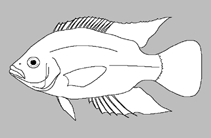 No image available for this species;
drawing shows typical species in Cichlidae.
Google Bild
drawing shows typical species in Cichlidae.
Klassifizierung / Names Namen | Synonyme | Catalog of Fishes(Gattung, Arten) | ITIS | CoL | WoRMS | Cloffa
> Cichliformes (Cichlids, convict blennies) > Cichlidae (Cichlids) > Pseudocrenilabrinae
Etymology: Hemibates: Greek, hemi = the half + Greek, bates, baino = to go, to walk (Ref. 45335); koningsi: The species is named for the first person who recognized the new Hemibates species as a distinct phenotype, Ad Konings, in appreciation of the inspiration to many cichlidophiles that arose from his continued popular and scientific contributions (Ref. 117350).
Eponymy: Dr Adrianus Franciscus Johannes Marinus Maria ‘Ad’ Konings (d: 1956) is a Dutch ichthyologist, cichlid aquarist, photographer, writer and publisher who began collecting cichlids at the age of fourteen. [...] (Ref. 128868), visit book page.
Etymology: Hemibates: Greek, hemi = the half + Greek, bates, baino = to go, to walk (Ref. 45335); koningsi: The species is named for the first person who recognized the new Hemibates species as a distinct phenotype, Ad Konings, in appreciation of the inspiration to many cichlidophiles that arose from his continued popular and scientific contributions (Ref. 117350).
Eponymy: Dr Adrianus Franciscus Johannes Marinus Maria ‘Ad’ Konings (d: 1956) is a Dutch ichthyologist, cichlid aquarist, photographer, writer and publisher who began collecting cichlids at the age of fourteen. [...] (Ref. 128868), visit book page.
Umwelt: Milieu / Klimazone / Tiefenbereich / Verbreitungsgebiet Ökologie
; süßwasser pelagisch; tiefenbereich 40 - 150 m (Ref. 117350), usually 40 - 60 m (Ref. 117350). Tropical
Verbreitung Territorien | FAO Gebiete | Ökosysteme | Vorkommen | Punkt Karte | Einführungen | Faunafri
Africa: southern part of Lake Tanganyika from around Mpulungu and the Chituta Bay (Ref. 117350).
Größe / Gewicht / Alter
Kurzbeschreibung Bestimmungsschlüssel | Morphologie | Morphometrie
Rückenflossenstacheln (insgesamt) : 14 - 15; Rückenflossenweichstrahlen (insgesamt) : 13 - 15; Afterflossenstacheln: 3; Afterflossenweichstrahlen: 12 - 14; Wirbelzahl: 33 - 34. Diagnosis: Adult males of Hemibates koningsi can be distinguished from H. stenosoma, the only congener, by a flank colour pattern of four to seven black vertical bars, two to three flank-scales wide, on the anterior flank region and five horizontal bands, one to two, rarely three flank-scales high, on the posterior flank region vs. black blotches of variable number, size and shape at the anterior part of the flanks and five, rarely four, horizontal bands in H. stenosoma; they can further be distinguished by the fourth horizontal band, counted from dorsal to ventral, starting below pectoral fin base sometimes before and extending to caudal fin base in H. koningsi vs. normally ending well before caudal fin base in H. stenosoma; moreover, both species exhibit a black band on dorsal fin membrane along the dorsal-fin base, which is however wider and more pronounced in H. koningsi males (Ref. 117350). Females as well as males of H. koningsi can be unambiguously separated from H. stenosoma by their longer lower pharyngeal jaw, 37.6-38.2% of head length vs. 27.8-32.5%, with a characteristically curved keel, distinctive bulge ventrally of the keel, which contrasts with the more or less straight keel of H. stenosoma, which is only rounded towards the tip; meristics and measurements of Hemibates koningsi overlap with those of H. stenosoma, but H. koningsi on average has fewer gill rakers on the first gill arch, 33-37 vs. 35-43; it tend to have longer lower jaws, 44.0-47.1% of head length vs. 39.22-45.9%, longer upper lips, 32.6-36.7% of head length vs. 27.6-33.6%, and longer lower lips, 34.5-37.8% of head length vs. 30.1-36.0% (Ref. 117350).
This species appears to be epibenthic (Ref. 117350).
Lebenszyklus und Paarungsverhalten Geschlechtsreife | Fortpflanzung | Ablaichen | Eier | Fruchtbarkeit | Larven
Hauptreferenz
Laden Sie Ihre Referenzen hoch | Referenzen | Koordinator : Kullander, Sven O. | Partner
Schedel, F.D.B. and U.K. Schliewen, 2017. Hemibates koningsi spec. nov: a new deep-water cichlid (Teleostei: Cichlidae) from Lake Tanganyika. Zootaxa 4312(1):92-112. (Ref. 117350)
IUCN Rote Liste Status (Ref. 130435: Version 2025-2 (Global))
nicht bedroht (LC) ; Date assessed: 20 February 2025
CITES
Not Evaluated
Bedrohung für Menschen
Harmless
Nutzung durch Menschen
FAO - Publication: search | FishSource |
Mehr Information
Trophische Ökologie
Lebensmittel (Beutetiere)
Nahrungszusammensetzung
Nahrungsaufnahme
Lebensmittelrationen
Räuber
Lebensmittel (Beutetiere)
Nahrungszusammensetzung
Nahrungsaufnahme
Lebensmittelrationen
Räuber
Populationsdynamik
Wachstumsparameter
Max. Alter/Größen
Länge-Gewicht-Rel.
Länge-Länge-Verhältnis.
Längenhäufigkeiten
Massenkonvertierung
Rekrutierung
Dichte
Wachstumsparameter
Max. Alter/Größen
Länge-Gewicht-Rel.
Länge-Länge-Verhältnis.
Längenhäufigkeiten
Massenkonvertierung
Rekrutierung
Dichte
Lebenszyklus
Fortpflanzung
Geschlechtsreife
Reifung/Kiemen rel.
Fruchtbarkeit
Ablaichen
Laichaggregationen
Eier
Eientwicklung
Larven
Larven Pop.Dyn.
Fortpflanzung
Geschlechtsreife
Reifung/Kiemen rel.
Fruchtbarkeit
Ablaichen
Laichaggregationen
Eier
Eientwicklung
Larven
Larven Pop.Dyn.
Anatomie
Kiemenoberfläche
Gehirn
Otolith
Kiemenoberfläche
Gehirn
Otolith
Physiologie
Körperliche Zusammensetzung
Nährstoffe
Sauerstoffverbrauch
Schwimmart
Schwimmgeschwindigkeit
Visuelle Pigmente
Fischgeräusche
Krankheiten und Parasiten
Toxizität (LC50s)
Körperliche Zusammensetzung
Nährstoffe
Sauerstoffverbrauch
Schwimmart
Schwimmgeschwindigkeit
Visuelle Pigmente
Fischgeräusche
Krankheiten und Parasiten
Toxizität (LC50s)
Genetik
Genom
Genetik
Heterozygotie
Vererbbarkeit
Genetische Vielfalt
Genom
Genetik
Heterozygotie
Vererbbarkeit
Genetische Vielfalt
Menschenbezogen
Aquakultur-Systeme
Aquakultur Profile
Zuchtlinien
Ciguatera-Fälle
Briefmarken, Münzen, Verschiedenes.
Aquakultur-Systeme
Aquakultur Profile
Zuchtlinien
Ciguatera-Fälle
Briefmarken, Münzen, Verschiedenes.
Tools
Zusatzinformationen
Download XML
Zusammenfassung | Punktdaten | Namen | Photos
Internet Quellen
AFORO (otoliths) | Aquatic Commons | BHL | Cloffa | Websites from users | FishWatcher Einträge suchen | CISTI | Catalog of Fishes: Gattung, Arten | DiscoverLife | ECOTOX | FAO - Publication: search | Faunafri | Fishipedia | Fishtrace | GloBI | Google Books | Google Scholar | Google | IGFA World Record | OneZoom | Open Tree of Life | Otolith Atlas of Taiwan Fishes | PubMed | Reef Life Survey | Socotra Atlas | TreeBase | Tree of Life | Wikipedia: Gehe zu, Suchen | World Records Freshwater Fishing | Zoobank | Zoologischer Rekord
Schätzungen auf der Grundlage von Modellen
Phylogenetischer Diversitätsindex (Ref. 82804): PD50 = 0.7500 [Uniqueness, from 0.5 = low to 2.0 = high].
Bayesian length-weight: a=0.01445 (0.00671 - 0.03113), b=2.99 (2.82 - 3.16), in cm total length, based on LWR estimates for this (Sub)family-body shape (Ref. 93245).
Trophische Ebene (Ref. 69278): 3.5 ±0.5 se; based on size and trophs of closest relatives
Widerstandsfähigkeit (Ref. 120179): hoch, Verdopplung der Population dauert weniger als 15 Monate. (Preliminary K or Fecundity.).