



Peltorhamphus kryptostomus Munroe, 2021
New Zealand gray sole
Hochladen Photos und videos
Google Bild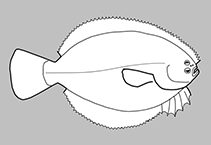 No image available for this species;
drawing shows typical species in Rhombosoleidae.
Google Bild
drawing shows typical species in Rhombosoleidae.
Klassifizierung / Names Namen | Synonyme | Catalog of Fishes(Gattung, Arten) | ITIS | CoL | WoRMS | Cloffa
> Pleuronectiformes (Flatfishes) > Rhombosoleidae (South Pacific flounders)
Etymology: Peltorhamphus: Greek, pelteos, peltes = a fish named as "korakinos"; when it was salted received the name of "pelte" + Greek, rhamphos = bill (Ref. 45335); kryptostomus: Name from Greek 'krypto' meaning hidden and 'stomus' for mouth, referring to the mouth on the ocular side being mostly hidden by the broad rostral flap.
Etymology: Peltorhamphus: Greek, pelteos, peltes = a fish named as "korakinos"; when it was salted received the name of "pelte" + Greek, rhamphos = bill (Ref. 45335); kryptostomus: Name from Greek 'krypto' meaning hidden and 'stomus' for mouth, referring to the mouth on the ocular side being mostly hidden by the broad rostral flap.
Umwelt: Milieu / Klimazone / Tiefenbereich / Verbreitungsgebiet Ökologie
seewasser demersal; tiefenbereich 2 - 40 m (Ref. 123823), usually 11 - 20 m (Ref. 123823). Subtropical; 43°S - 47°S (Ref. 123823)
Verbreitung Territorien | FAO Gebiete | Ökosysteme | Vorkommen | Punkt Karte | Einführungen | Faunafri
Southwest Pacific: New Zealand.
Länge bei der ersten Reifung / Größe / Gewicht / Alter
Geschlechtsreife: Lm ?, range 9 - 10 cm
Max length : 14.5 cm SL Männchen/unbestimmt; (Ref. 123823); 14.5 cm SL (female)
Max length : 14.5 cm SL Männchen/unbestimmt; (Ref. 123823); 14.5 cm SL (female)
Kurzbeschreibung Bestimmungsschlüssel | Morphologie | Morphometrie
Rückenflossenweichstrahlen (insgesamt) : 86 - 97; Afterflossenweichstrahlen: 59 - 67; Wirbelzahl: 37 - 38. This species is distinguished from its congeners by the following set of characters: deep body, with greatest depth anterior to midpoint and with moderately rapid posterior taper; anterior profile of snout is smoothly rounded; second ocular-side pectoral-fin ray is filamentous and shorter than greatest body depth; conspicuous, finger-like filaments 1-5 on inner anteroventral margin of fleshy skinfold on ocular-side lower jaw; no scales on blind sides of dorsal- and anal-fin rays; eyes relatively large with well-developed pupillary operculum; interorbital space relatively narrow (usually < diameter of lower eye) with 2-4 scales; often with 4-6 scales in diagonal row between anteroventral margin of lower (non-migrated) eye and dorsal margin of rostral flap above mouth; gillrakers on first arch long, pointed, robust, with first and sometimes second raker on upper limb overlapping dorsalmost raker(s) on lower limb of first arch; meristic values relatively low (37-38 total vertebrae, 86-97 dorsal- and 59-67 anal-fin rays, 64-82 lateral-line pores, usually 23-24 supracranial pterygiophores, 14-20 total gillrakers on first gill arch, 4-6 on upper limb of first arch); head relatively large and wide; caudal peduncle wide. Colouration: light-brown to light gray ocular-side background with numerous, minute, pinkish spots over entire surface, and with many scales on ocular side of head and body with black pigment on bases of ctenii; the dorsal and anal fins in both sexes with either a pattern of a single darkly pigmented ray alternating with 4-8 lighter-pigmented rays, or with rays uniformly pigmented; black pigmentation on inner lining of ocular-side opercle and entire roof of mouth (Ref. 123823).
Cross section: flattened.
Cross section: flattened.
This is a shallow-water species that occurs in 1.5-40 m, with majority of specimens (70 of 81) examined were caught between 11 m and 20 m (8 of 81 collected in 1.5-5.0 m, 2 of 81 taken at 21 m; and only 1 was taken at 40 m. Little else is known about the ecology of this species (Ref. 123823).
Lebenszyklus und Paarungsverhalten Geschlechtsreife | Fortpflanzung | Ablaichen | Eier | Fruchtbarkeit | Larven
Hauptreferenz
Laden Sie Ihre Referenzen hoch | Referenzen | Koordinator | Partner
Munroe, T.A., 2021. Systematic revision of the flatfish genus Peltorhamphus Günther, 1862 (Teleostei: Pleuronectiformes: Rhombosoleidae), including description of a new species from Southeastern New Zealand, with biological and ecological summaries for the species. Zootaxa 4905(1):1-104. (Ref. 123823)
CITES
Not Evaluated
Bedrohung für Menschen
Harmless
Nutzung durch Menschen
FAO - Publication: search | FishSource |
Mehr Information
Trophische Ökologie
Lebensmittel (Beutetiere)
Nahrungszusammensetzung
Nahrungsaufnahme
Lebensmittelrationen
Räuber
Lebensmittel (Beutetiere)
Nahrungszusammensetzung
Nahrungsaufnahme
Lebensmittelrationen
Räuber
Ökologie
Ökologie
Ökologie
Populationsdynamik
Wachstumsparameter
Max. Alter/Größen
Länge-Gewicht-Rel.
Länge-Länge-Verhältnis.
Längenhäufigkeiten
Massenkonvertierung
Rekrutierung
Dichte
Wachstumsparameter
Max. Alter/Größen
Länge-Gewicht-Rel.
Länge-Länge-Verhältnis.
Längenhäufigkeiten
Massenkonvertierung
Rekrutierung
Dichte
Lebenszyklus
Fortpflanzung
Geschlechtsreife
Reifung/Kiemen rel.
Fruchtbarkeit
Ablaichen
Laichaggregationen
Eier
Eientwicklung
Larven
Larven Pop.Dyn.
Fortpflanzung
Geschlechtsreife
Reifung/Kiemen rel.
Fruchtbarkeit
Ablaichen
Laichaggregationen
Eier
Eientwicklung
Larven
Larven Pop.Dyn.
Anatomie
Kiemenoberfläche
Gehirn
Otolith
Kiemenoberfläche
Gehirn
Otolith
Physiologie
Körperliche Zusammensetzung
Nährstoffe
Sauerstoffverbrauch
Schwimmart
Schwimmgeschwindigkeit
Visuelle Pigmente
Fischgeräusche
Krankheiten und Parasiten
Toxizität (LC50s)
Körperliche Zusammensetzung
Nährstoffe
Sauerstoffverbrauch
Schwimmart
Schwimmgeschwindigkeit
Visuelle Pigmente
Fischgeräusche
Krankheiten und Parasiten
Toxizität (LC50s)
Genetik
Genom
Genetik
Heterozygotie
Vererbbarkeit
Genetische Vielfalt
Genom
Genetik
Heterozygotie
Vererbbarkeit
Genetische Vielfalt
Menschenbezogen
Aquakultur-Systeme
Aquakultur Profile
Zuchtlinien
Ciguatera-Fälle
Briefmarken, Münzen, Verschiedenes.
Aquakultur-Systeme
Aquakultur Profile
Zuchtlinien
Ciguatera-Fälle
Briefmarken, Münzen, Verschiedenes.
Tools
E-Book | Feldführer | Bestimmungsschlüssel | Längenhäufigkeits Tool | Lebensdaten Tool | Punkt Karte |
Catch-MSY |
Zusatzinformationen
Download XML
Zusammenfassung | Punktdaten | Namen | Photos
Internet Quellen
AFORO (otoliths) | Aquatic Commons | BHL | Cloffa | Websites from users | FishWatcher Einträge suchen | CISTI | Catalog of Fishes: Gattung, Arten | DiscoverLife | ECOTOX | FAO - Publication: search | Faunafri | Fishipedia | Fishtrace | GloBI | Google Books | Google Scholar | Google | IGFA World Record | OneZoom | Open Tree of Life | Otolith Atlas of Taiwan Fishes | PubMed | Reef Life Survey | Socotra Atlas | TreeBase | Tree of Life | Wikipedia: Gehe zu, Suchen | World Records Freshwater Fishing | Zoobank | Zoologischer Rekord
Schätzungen auf der Grundlage von Modellen
Phylogenetischer Diversitätsindex (Ref. 82804): PD50 = 0.5625 [Uniqueness, from 0.5 = low to 2.0 = high].
Bayesian length-weight: a=0.00389 (0.00180 - 0.00842), b=3.12 (2.94 - 3.30), in cm total length, based on all LWR estimates for this body shape (Ref. 93245).
Trophische Ebene (Ref. 69278): 3.1 ±0.2 se; based on size and trophs of closest relatives
Widerstandsfähigkeit (Ref. 120179): hoch, Verdopplung der Population dauert weniger als 15 Monate. (Preliminary K or Fecundity.).