



Scyliorhinus hachijoensis Ito, Fujii, Nohara & Tanaka, 2022
Cinder cloudy catshark
Hochladen Photos und videos
Google Bild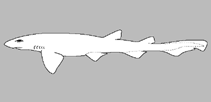 No image available for this species;
drawing shows typical species in Scyliorhinidae.
Google Bild
drawing shows typical species in Scyliorhinidae.
Klassifizierung / Names Namen | Synonyme | Catalog of Fishes(Gattung, Arten) | ITIS | CoL | WoRMS | Cloffa
Elasmobranchii (Haie und Rochen) (sharks and rays) > Carcharhiniformes (Ground sharks) > Scyliorhinidae (Cat sharks) > Scyliorhininae
Etymology: Scyliorhinus: skylion, Greek for dogfish or small shark; rhinus, from rhine (Gr.), rasp, alluding to a shark’s jagged, rasp-like skin (See ETYFish); hachijoensis: Named for the species’ main collection area, Hachijojima Island.
Etymology: Scyliorhinus: skylion, Greek for dogfish or small shark; rhinus, from rhine (Gr.), rasp, alluding to a shark’s jagged, rasp-like skin (See ETYFish); hachijoensis: Named for the species’ main collection area, Hachijojima Island.
Umwelt: Milieu / Klimazone / Tiefenbereich / Verbreitungsgebiet Ökologie
seewasser demersal(Ref. 125694). Temperate
Verbreitung Territorien | FAO Gebiete | Ökosysteme | Vorkommen | Punkt Karte | Einführungen | Faunafri
Northwest Pacific: Japan.
Größe / Gewicht / Alter
Geschlechtsreife: Lm ? range ? - ? cm
Max length : 41.6 cm TL Männchen/unbestimmt; (Ref. 125694); 38.6 cm TL (female)
Max length : 41.6 cm TL Männchen/unbestimmt; (Ref. 125694); 38.6 cm TL (female)
Kurzbeschreibung Bestimmungsschlüssel | Morphologie | Morphometrie
This species is distinguished from its congeners by the following characters: anterior nasal flaps not reaching the upper lip (vs. flaps reaching upper lip, and sometimes covering it, in canicula, cervigoni, comoroensis, duhamelii, garmani, stellaris); absence of nasoral grooves and posterior nasal flaps situated posterior to excurrent apertures (vs. present and posterior nasal flaps laterally situated in canicula, duhamelii); mouth length less than half of mouth width (vs. mouth length more than or equal half of mouth width except in torazame, ugoi); anal fin height more than caudal peduncle height (vs. less in boa, duhamelii, torazame, torrei), and greater than or equal to half of mouth width (vs. less than half of mouth width in boa, capensis, duhamelii, haeckelii, hesperius, meadi, torazame, torrei, ugoi); saddles darker than the background color (vs. inconspicuous or absent in boa, cabofriensis, cervigoni, duhamelii, garmani, torrei, and dark lines in retifer). Colouration: body grayish brown to dark brown with well-defined light spots and small dark spots (vs. no spots in retifer, yellow to golden spots in capensis, no light spots in cervigoni, garmani, meadi, retifer, and no dark spots in capensis, comoroensis, hesperius, meadi, torazame, torrei); light spots spiracle-sized or larger (vs. predominantly smaller than spiracles in boa, cabofriensis, canicula, duhamelii, stellaris, ugoi); dark spots smaller than spiracles (vs. predominantly larger than spiracles in cervigoni, duhamelii, garmani, haeckelii, stellaris); number of monospondylous vertebrae 34-36 (vs. counts higher except in duhamelii, torazame, torrei); clasper with hooks (vs. none inn other pecies except torazame); accessory terminal cartilage present (vs. absent in cabofriensis, cervigoni, comoroensis, duhamelii, haeckelii, stellaris, torrei, ugoi); egg case surface with irregularities (vs. smooth in all other species) (Ref. 125694).
Cross section: angular.
Cross section: angular.
The size of males ranged from 29.4-41.6 cm TL (n = 6) and females from 30.1-38.6 cm TL (n = 22); size at first maturity is not precisely defined, but males had well-developed claspers at 34.6 cm TL and females had egg cases at 34.2 cm TL. Reproduction is by single oviparity, one egg case for each oviduct. The egg cases are amber in color, with tendrils and surface irregularities that resemble wrinkles. Maximum case length without tendrils (ML) was 44.6–56.25 mm, and maximum case width was 19.45–22.5 mm (33.4–42.1 %ML) (n = 7). Stomachs contents have small crustaceans, small bony fishes, and polychaets (Ref. 125694),
Lebenszyklus und Paarungsverhalten Geschlechtsreife | Fortpflanzung | Ablaichen | Eier | Fruchtbarkeit | Larven
Hauptreferenz
Laden Sie Ihre Referenzen hoch | Referenzen | Koordinator : Compagno, Leonard J.V. | Partner
Ito, N., M. Fujii, K. Nohara and S. Tanaka, 2022. Scyliorhinus hachijoensis, a new species of catshark from the Izu Islands, Japan (Carcharhiniformes: Scyliorhinidae). Zootaxa 5092(3):331-349. (Ref. 125694)
IUCN Rote Liste Status (Ref. 130435: Version 2025-2 (Global))
nicht bedroht (LC) ; Date assessed: 06 May 2022
CITES
Not Evaluated
Bedrohung für Menschen
Harmless
Nutzung durch Menschen
FAO - Publication: search | FishSource |
Mehr Information
Trophische Ökologie
Lebensmittel (Beutetiere)
Nahrungszusammensetzung
Nahrungsaufnahme
Lebensmittelrationen
Räuber
Lebensmittel (Beutetiere)
Nahrungszusammensetzung
Nahrungsaufnahme
Lebensmittelrationen
Räuber
Ökologie
Ökologie
Ökologie
Populationsdynamik
Wachstumsparameter
Max. Alter/Größen
Länge-Gewicht-Rel.
Länge-Länge-Verhältnis.
Längenhäufigkeiten
Massenkonvertierung
Rekrutierung
Dichte
Wachstumsparameter
Max. Alter/Größen
Länge-Gewicht-Rel.
Länge-Länge-Verhältnis.
Längenhäufigkeiten
Massenkonvertierung
Rekrutierung
Dichte
Lebenszyklus
Fortpflanzung
Geschlechtsreife
Reifung/Kiemen rel.
Fruchtbarkeit
Ablaichen
Laichaggregationen
Eier
Eientwicklung
Larven
Larven Pop.Dyn.
Fortpflanzung
Geschlechtsreife
Reifung/Kiemen rel.
Fruchtbarkeit
Ablaichen
Laichaggregationen
Eier
Eientwicklung
Larven
Larven Pop.Dyn.
Anatomie
Kiemenoberfläche
Gehirn
Otolith
Kiemenoberfläche
Gehirn
Otolith
Physiologie
Körperliche Zusammensetzung
Nährstoffe
Sauerstoffverbrauch
Schwimmart
Schwimmgeschwindigkeit
Visuelle Pigmente
Fischgeräusche
Krankheiten und Parasiten
Toxizität (LC50s)
Körperliche Zusammensetzung
Nährstoffe
Sauerstoffverbrauch
Schwimmart
Schwimmgeschwindigkeit
Visuelle Pigmente
Fischgeräusche
Krankheiten und Parasiten
Toxizität (LC50s)
Genetik
Genom
Genetik
Heterozygotie
Vererbbarkeit
Genetische Vielfalt
Genom
Genetik
Heterozygotie
Vererbbarkeit
Genetische Vielfalt
Menschenbezogen
Aquakultur-Systeme
Aquakultur Profile
Zuchtlinien
Ciguatera-Fälle
Briefmarken, Münzen, Verschiedenes.
Aquakultur-Systeme
Aquakultur Profile
Zuchtlinien
Ciguatera-Fälle
Briefmarken, Münzen, Verschiedenes.
Tools
Zusatzinformationen
Download XML
Zusammenfassung | Punktdaten | Namen | Photos
Internet Quellen
AFORO (otoliths) | Aquatic Commons | BHL | Cloffa | Websites from users | FishWatcher Einträge suchen | CISTI | Catalog of Fishes: Gattung, Arten | DiscoverLife | ECOTOX | FAO - Publication: search | Faunafri | Fishipedia | Fishtrace | GloBI | Google Books | Google Scholar | Google | IGFA World Record | OneZoom | Open Tree of Life | Otolith Atlas of Taiwan Fishes | PubMed | Reef Life Survey | Socotra Atlas | TreeBase | Tree of Life | Wikipedia: Gehe zu, Suchen | World Records Freshwater Fishing | Zoobank | Zoologischer Rekord
Schätzungen auf der Grundlage von Modellen
Phylogenetischer Diversitätsindex (Ref. 82804): PD50 = 0.5000 [Uniqueness, from 0.5 = low to 2.0 = high].
Bayesian length-weight: a=0.00269 (0.00140 - 0.00518), b=3.21 (3.04 - 3.38), in cm total length, based on LWR estimates for this (Sub)family-body shape (Ref. 93245).
Trophische Ebene (Ref. 69278): 3.8 ±0.5 se; based on size and trophs of closest relatives
Widerstandsfähigkeit (Ref. 120179): mittel, Verdopplung der Population dauert 1,4 - 4,4 Jahre. (Preliminary K or Fecundity.).