



Parmaturus angelae Soares, Carvalho, Schwingel & Gadig, 2019
Brazilian filetail catshark
Ανεβάστε το φωτογραφίες και Βίντεο
Google image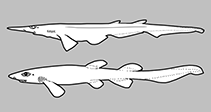 No image available for this species;
drawing shows typical species in Pentanchidae.
Google image
drawing shows typical species in Pentanchidae.
Ταξινόμηση / Ονόματα Κοινά ονόματα | Συνώνυμα | Catalog of Fishes(Γένος, Είδη) | ITIS | CoL | WoRMS | Cloffa
Ελασμοβράγχιοι (καρχαρίες και σαλάχια) (sharks and rays) > Carcharhiniformes (Ground sharks) > Pentanchidae (Deepwater catsharks)
Etymology: Parmaturus: parma (L.), from parme (Gr.), small shield; oura (Gr.), tail, presumably referring to upper edge of caudal fin “armed with modified” scales (per Garman 1913) (See ETYFish); angelae: In honor of the fourth author’s granddaughter, Angela (See ETYFish).
Eponymy: The etymology says the fish was “… dedicated to the last author’s granddaughter, Ângela.” (Ref. 128868), visit book page.
Etymology: Parmaturus: parma (L.), from parme (Gr.), small shield; oura (Gr.), tail, presumably referring to upper edge of caudal fin “armed with modified” scales (per Garman 1913) (See ETYFish); angelae: In honor of the fourth author’s granddaughter, Angela (See ETYFish).
Eponymy: The etymology says the fish was “… dedicated to the last author’s granddaughter, Ângela.” (Ref. 128868), visit book page.
Περιβάλλον: περιβάλλον / κλιματική ζώνη / εύρος βάθους / εύρος διανομής Οικολογία
Θαλασσινό(ά) βενθικό(ς); εύρος βάθους 500 - 600 m (Ref. 125615). Deep-water
Κατανομή Εδάφη | Περιοχές FAO | Οικοσυστήματα | Παρουσίες | Σημειακός χάρτης | Εισαγωγές | Faunafri
Southwestern Atlantic: Brazil.
Μέγεθος / Βάρος / Ηλικία
Γεννητική Ωρίμανση: Lm ? range ? - ? cm
Max length : 42.5 cm TL (female)
Max length : 42.5 cm TL (female)
Σύντομη περιγραφή Κλείδες προσδιορισμού | Μορφολογία | Μορφομετρία
Σπόνδυλοι: 121 - 122. Thie species is distinguished from its congeners by the following set of of characters: first dorsal-fin origin slightly anterior to pelvic-fin origin (vs. well anterior in P. campechiensis); dorsal fins subequal (vs. first dorsal fin smaller in P. campechiensis and first dorsal fin slightly larger in P. xaniurus); upper caudal crest of denticles separated from lateral denticles by naked strip (vs. barely separated in P. xaniurus); lower caudal crest of denticles well developed and extending until last third of ventral caudal-fin lobe (vs. extending until the end of ventral caudal-fin lobe in P. campechiensis and reduced or absent in P. xaniurus; labial furrows discontinuous (vs. continuous in P. campechiensis and P. xaniurus); anal-fin base 1.6 times anal-fin height (vs. 3 times in P. campechiensis and 2.2-2.5 in P. xaniurus); pre-first dorsal-fin length 4.3 times interdorsal space (vs. 4.9 times in P. xaniurus); prenarial length 0.8-1.1 times in prepectoral length (vs. 0.3 times in P. campechiensis); mouth width 2.6 times mouth length (vs. 1.9 times in P. campechiensis); monospondylous precaudal centra 38 (vs. 39 in P. campechiensis), and total vertebrae counts 121-122 (vs. 111 in P. campechiensis and 109-121 in P. xaniurus) (Ref. 125615).
Cross section: angular.
Cross section: angular.
Probably a demersal-benthic dwelling shark. The stomach (8.5 cm in length) of the paratype was almost empty, except for one fish eye lens, but an analysis of the intestine (9.0 cm) revealed small pieces of teleostean musculature and a fin spine, a crustacean appendage (pleopod or pereopod), a well-digested 5.0 cm long polychaete body piece, and five dark 22 mm long chaetae, possibly from this same annelid specimen. Reproductive mode oviparous, with just one functional ovary, the right, with four follicles (between 5 and 17 mm diameter), a well-developed nidamental gland, 18 mm (right) and 15 mm (left) in width and fully developed oviducts. Two completely formed slender vase-like dark brown (after fixation) egg cases, one in each oviduct, and both measuring 73 mm in length and 24 mm in width, narrowing at about 1/4 of its length from the anterior border. The surface seems to be smooth in macro view, but with numerous delicate longitudinal ridges and lateral keel along the entire both sides. Both small lateral keel-associated respiratory fissures not reaching to the borders, the anterior measuring 8 mm and the posterior 6 mm in length. Anterior border slightly convex, measuring 1.81 cm in width, pointed in each corner. Posterior margin very small, not measured, with two horn tendrils 3 mm in length in each tip and very small fringed fibrous hair-like filaments between the horns (Ref. 125615).
Κύκλος ζωής και συμπεριφορά ζευγαρώματος Γεννητική Ωρίμανση | Αναπαραγωγή | Γεννοβολία | Αβγά | Γονιμότητα | Προνύμφες
Κύρια αναφορά
Ανεβάστε τις αναφορές σας | Αναφορές | Συντονιστής | Συνεργάτες
Soares, K.D.D.A., M.R. De Carvalho, P.R. Schwingel and O.B.F. Gadig, 2019. A new species of Parmaturus (Chondrichthyes: Carcharhiniformes: Scyliorhinidae) from Brazil, Southwestern Atlantic. Copeia, 107(2):314-322. (Ref. 125615)
Κατάσταση Κόκκινου Καταλόγου IUCN (Ref. 130435: Version 2025-2 (Global))
Ευάλωτο (VU) (A2d); Date assessed: 08 August 2019
CITES
Not Evaluated
Απειλή για τον άνθρωπο
Harmless
Ανθρώπινες χρήσεις
FAO - Publication: search | FishSource |
Περισσότερες πληροφορίες
Τροφική Οικολογία
Τρόφιμα (θηράματα)
Σύσταση δίαιτας
Κατανάλωση τροφής
Μερίδες τροφίμων
Θηρευτές
Τρόφιμα (θηράματα)
Σύσταση δίαιτας
Κατανάλωση τροφής
Μερίδες τροφίμων
Θηρευτές
Οικολογία
Οικολογία
Οικολογία
Πληθυσμιακή δυναμική
Παράμετροι Αύξησης
Μέγιστες ηλικίες / μεγέθη
Μήκος-βάρος σχετ.
Μήκος-μήκος rel.
Μήκος-συχνότητες
Μετατροπή μάζας
Στρατολόγηση
Αφθονία
Παράμετροι Αύξησης
Μέγιστες ηλικίες / μεγέθη
Μήκος-βάρος σχετ.
Μήκος-μήκος rel.
Μήκος-συχνότητες
Μετατροπή μάζας
Στρατολόγηση
Αφθονία
Κύκλος ζωής
Αναπαραγωγή
Γεννητική Ωρίμανση
Ωριμότητα / Gills rel.
Γονιμότητα
Γεννοβολία
Συγκεντρώσεις αναπαραγωγής
Αβγά
Ανάπτυξη αυγών
Προνύμφες
Δυναμική προνυμφών
Αναπαραγωγή
Γεννητική Ωρίμανση
Ωριμότητα / Gills rel.
Γονιμότητα
Γεννοβολία
Συγκεντρώσεις αναπαραγωγής
Αβγά
Ανάπτυξη αυγών
Προνύμφες
Δυναμική προνυμφών
Ανατομία
Επιφάνεια βραγχίων
Εγκέφαλος
Ωτόλιθος
Επιφάνεια βραγχίων
Εγκέφαλος
Ωτόλιθος
Φυσιολογία
Σύνθεση σώματος
Θρεπτικά συστατικά
Κατανάλωση οξυγόνου
Τύπος κολύμβησης
Ταχύτητα κολύμβησης
Οπτικές χρωστικές ουσίες
Ήχος ψαριών
Ασθένειες & παράσιτα
Τοξικότητα (LC50)
Σύνθεση σώματος
Θρεπτικά συστατικά
Κατανάλωση οξυγόνου
Τύπος κολύμβησης
Ταχύτητα κολύμβησης
Οπτικές χρωστικές ουσίες
Ήχος ψαριών
Ασθένειες & παράσιτα
Τοξικότητα (LC50)
Γενετική
Γονιδίωμα
Γενετική
Ετεροζυγωτία
Κληρονομικότητα
Γενετική ποικιλομορφία
Γονιδίωμα
Γενετική
Ετεροζυγωτία
Κληρονομικότητα
Γενετική ποικιλομορφία
Ανθρώπινη σχέση
Συστήματα υδατοκαλλιέργειας
Προφίλ υδατοκαλλιεργειών
Στελέχοι
Περιπτώσεις Ciguatera
Γραμματόσημα, νομίσματα, διάφορα.
Συστήματα υδατοκαλλιέργειας
Προφίλ υδατοκαλλιεργειών
Στελέχοι
Περιπτώσεις Ciguatera
Γραμματόσημα, νομίσματα, διάφορα.
Εργαλεία
Ηλεκτρονικό βιβλίο | Οδηγός πεδίου | Ανάλυση κατά μήκος συνθέσεων | Εργαλείο ιστορίας ζωής | Σημειακός χάρτης |
Catch-MSY |
Ειδικές εκθέσεις
Έλεγχος για συντήρηση ενυδρείου | Ελέγξτε για ενημερωτικά δελτία ειδών | Ελέγξτε για ενημερωτικά δελτία υδατοκαλλιέργειας
Λήψη XML
Διαδικτυακές πηγές
AFORO (otoliths) | Aquatic Commons | BHL | Cloffa | Websites from users | Check FishWatcher | CISTI | Catalog of Fishes: Γένος, Είδη | DiscoverLife | ECOTOX | FAO - Publication: search | Faunafri | Fishipedia | Fishtrace | GloBI | Google Books | Google Scholar | Google | IGFA World Record | OneZoom | Open Tree of Life | Otolith Atlas of Taiwan Fishes | PubMed | Reef Life Survey | Socotra Atlas | TreeBase | Δέντρο Ζωής | Wikipedia: Go, αναζήτηση | | Zoobank | Zoological Record
Εκτιμήσεις βάσει μοντέλων
|
Δείκτης φυλογενετικής ποικιλότητας (Αναφ. 82804) |
PD50 = 0.5078 [Uniqueness, from 0.5 = low to 2.0 = high]. |
| Bayesian length-weight | a=0.00347 (0.00171 - 0.00701), b=3.09 (2.91 - 3.27), in cm total length, based on LWR estimates for this (Sub)family-body shape (Ref. 93245). |
|
Τροφικό Επίπεδο (Αναφ. 69278) |
4.0 ±0.5 se; based on size and trophs of closest relatives |
|
Ελαστικότητα (Αναφ. 120179) |
Υψηλό, ελάχιστος χρόνος για διπλασιασμό πληθυσμού < 15 μήνες (Preliminary K or Fecundity.). |
|
Ευπάθεια στην αλιεία (Ref. 59153) |
Low to moderate vulnerability (26 of 100). 🛈 |