



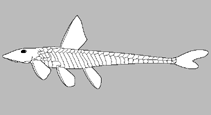
Hypostomus robertsoni Dias & Zawadzki, 2021
分類 / 名前 共通名の | 類義語 | Catalog of Fishes(部類, 種) | ITIS | CoL | WoRMS | Cloffa
> Siluriformes (Catfishes) > Loricariidae (Armored catfishes) > Hypostominae
Etymology: Hypostomus: Greek, hypo = under + Greek, stoma = mouth (Ref. 45335); robertsoni: Named for Robertson Fonseca de Azevedo for his large and constant efforts to preserve natural landscapes in the Paraná State, Brazil and who fought to prevent unnecessary small hydroelectric power plants in the high gradient stretches along two main Upper Paraná River left tributaries, the Ivaí and Piquiri Rivers.
Eponymy: Robertson Fonseca de Azevedo is a Brazilian environmental attorney, honoured for his efforts to preserve natural landscapes in Paraná State, Brazil. [...] (Ref. 128868), visit book page.
Etymology: Hypostomus: Greek, hypo = under + Greek, stoma = mouth (Ref. 45335); robertsoni: Named for Robertson Fonseca de Azevedo for his large and constant efforts to preserve natural landscapes in the Paraná State, Brazil and who fought to prevent unnecessary small hydroelectric power plants in the high gradient stretches along two main Upper Paraná River left tributaries, the Ivaí and Piquiri Rivers.
Eponymy: Robertson Fonseca de Azevedo is a Brazilian environmental attorney, honoured for his efforts to preserve natural landscapes in Paraná State, Brazil. [...] (Ref. 128868), visit book page.
環境:環境 / 気候帯 / 深さの範囲 / 分布範囲 生態学
; 新鮮な水 底生の. Tropical
分布 領土 | 国連食糧農業機関の区域 | エコシステム | 事件 | 目的のマップ | 導入 | Faunafri
South America: Brazil.
サイズ / 重さ / 年齢
簡単な記述 検索表 | 形態学 | 形態計測学
This species is distinguished from the species of the super-group H. cochliodon by having viliform teeth and dentaries usually angled more than 100° (vs. spoon- or shovel-shaped teeth and dentary rami angled to each other up to 80°); differs from the species of the super-group H. hemiurus by having round dark blotches (vs. somewhat horizontally elongate dark spots); differs from the species of the super-group H. plecostomus by lacking rows of odontodes on keels along lateral series of plates (vs. with moderate to well-developed rows of odontodes on keels); differs from H. nematopterus by lacking elongate dorsal-fin ray (vs. extremely elongate dorsal-fin ray); differs from its congeners of the H. auroguttatus super-group alatus, albopunctatus, arecuta, faveolus, francisci, krishnamurtii, luteus, luteomaculatus, margaritifer, meleagris, microstomus, multidens, regani, roseopunctatus, scabriceps, strigaticeps, tietensis, variipictus by having dark blotches on a clear background (vs. pale spots or vermiculations on a darker background), from asperatus, brevicauda, johnii, melanephelis, nigropunctatus, uruguayensis by having faded dark blotches similar to or slightly larger than eye diameter on trunk and fins (vs. similar to eye pupil), from denticulatus, iheringii, macrops, latirostris, ternetzi by having parieto-supraoccipital and predorsal region flat (vs. parieto-supraoccipital medially raised and with raised parallel keels on predorsal region), from brevis, fluviatilis, goyazensis, topavae by having parieto-supraoccipital and predorsal region flat (vs. predorsal region high and convex in frontal view), from denticulatus, freirei, kuarup, latirostris, mutucae, paulinus, ternetzi by having tooth number less than 46 on each premaxillary or dentary (vs. more than 50), from agna, isbrueckeri, luetkeni by having a single predorsal plate bordering parieto-supraoccipital (vs. 2-3 plates in luetkeni and 3 agna, isbrueckeri), from guajupia by having conspicuous blotches or marks on body and fins (vs. lacking conspicuous blotches or marks), from heraldoi by having pectoral-fin spine length smaller than pelvic-fin unbranched ray (vs. larger than), from nigromaculatus by having pectoral-fin spine slightly curved, with diameter almost homogeneous along its length (vs. curved club-shaped pectoral-fin spine), from wuchereri by having abdomen plated in specimens about 100 mm SL (vs. abdomen mostly naked in specimens up to 150 mm SL), from garmani, lima by having triangular-shaped caudal peduncle, its lateral surface straigth (vs. oval-shaped caudal peduncle, its lateral surface convex), from guajupia by having abdominal area mostly naked, larger specimens with transverse row of platelets in cleithral region and medially along abdomen (vs. abdominal area densely plated, from
pectoral girdle to anus), from hermanni by lacking or with inconspicuous dark (faded brown) blotches on body and fins (vs. usually having conspicuous black blotches), and by having truncate caudal fin (vs. emarginate) (Ref. 124595).
Body shape (shape guide): elongated.
Body shape (shape guide): elongated.
Facultative air-breathing in the genus (Ref. 126274)
ライフサイクルと交尾行動 成熟 | 繁殖 | 放精 | 卵 | 生産力 | 幼生
主な参考文献
参考文献のアップロード | 参考文献 | コーディネーター : Fisch-Muller, Sonia | 協力者
Dias, A.C. and C.H. Zawadzki, 2021. Hypostomus hermanni redescription and a new species of Hypostomus (Siluriformes: Loricariidae) from Upper Paraná River basin, Brazil. Neotrop. Ichthyol. 19(2). (Ref. 124595)
CITES
Not Evaluated
人間に対する脅威
Harmless
人間の用途
水産業: 興味がない
FAO - Publication: search | FishSource |
より多くの情報
養殖生態
食料品(獲物)
餌の構成
摂食量
食料配給
捕食動物
食料品(獲物)
餌の構成
摂食量
食料配給
捕食動物
生態学
生態学
生態学
人口動態
成長のパラメーター
最大年齢/サイズ
長さ-重量比。
長短関係。
体長組成
質量変換
補充
豊度
成長のパラメーター
最大年齢/サイズ
長さ-重量比。
長短関係。
体長組成
質量変換
補充
豊度
ライフサイクル
繁殖
成熟
成熟度/エラ
生産力
放精
産卵群
卵
卵の開発
幼生
幼生の動力
繁殖
成熟
成熟度/エラ
生産力
放精
産卵群
卵
卵の開発
幼生
幼生の動力
解剖学
カマ
脳
オトリス
カマ
脳
オトリス
生理学
体組成
栄養素
酸素消費
水泳タイプ
泳ぐ速さ
視覚色素
フィッシュ・サウンド
病気と寄生虫
毒性(LC50)
体組成
栄養素
酸素消費
水泳タイプ
泳ぐ速さ
視覚色素
フィッシュ・サウンド
病気と寄生虫
毒性(LC50)
遺伝子の
ゲノム
遺伝子の
ヘテロ接合性
遺伝
遺伝的多様性
ゲノム
遺伝子の
ヘテロ接合性
遺伝
遺伝的多様性
用具
特記事項
XMLをダウンロードして下さい
インターネットの情報源
AFORO (otoliths) | Aquatic Commons | BHL | Cloffa | Websites from users | Check FishWatcher | CISTI | Catalog of Fishes: 部類, 種 | DiscoverLife | ECOTOX | FAO - Publication: search | Faunafri | Fishipedia | Fishtrace | GloBI | Google Books | Google Scholar | Google | IGFA World Record | OneZoom | Open Tree of Life | Otolith Atlas of Taiwan Fishes | PubMed | Reef Life Survey | Socotra Atlas | TreeBase | 生命の木 | Wikipedia: 行く, 検索する | World Records Freshwater Fishing | Zoobank | 動物に関する記録
モデルに基づく推定値
系統多様性指数 (参照 82804): PD50 = 0.5000 [Uniqueness, from 0.5 = low to 2.0 = high].
Bayesian length-weight: a=0.01585 (0.00726 - 0.03460), b=2.95 (2.78 - 3.12), in cm total length, based on LWR estimates for this Genus-body shape (Ref. 93245).
回復力 (参照 120179): 手段, 1.4年~4.4年の倍増期間の最小個体群 (Preliminary K or Fecundity.).