



Barbus samniticus Lorenzoni, Carosi, Quadroni, De Santis, Vanetti, Delmastro & Zaccara, 2021
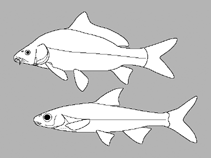
分類 / 名前 共通名の | 類義語 | Catalog of Fishes(部類, 種) | ITIS | CoL | WoRMS | Cloffa
> Cypriniformes (Carps) > Cyprinidae (Minnows or carps) > Barbinae
Etymology: Barbus: Latin, barbus = barbel (Ref. 45335); samniticus: Named for Samnites, ancient Italic people who settled in the type locality.
Eponymy: Sir Charles Alfred Payton (1843–1926) was a British adventurer, writer, fisherman and diplomat who was British Consul to Morocco, where this barb is found. [...] (Ref. 128868), visit book page.
Etymology: Barbus: Latin, barbus = barbel (Ref. 45335); samniticus: Named for Samnites, ancient Italic people who settled in the type locality.
Eponymy: Sir Charles Alfred Payton (1843–1926) was a British adventurer, writer, fisherman and diplomat who was British Consul to Morocco, where this barb is found. [...] (Ref. 128868), visit book page.
環境:環境 / 気候帯 / 深さの範囲 / 分布範囲 生態学
; 新鮮な水 底生の漂泳性. Subtropical
分布 領土 | 国連食糧農業機関の区域 | エコシステム | 事件 | 目的のマップ | 導入 | Faunafri
Europe: Italy.
サイズ / 重さ / 年齢
簡単な記述 検索表 | 形態学 | 形態計測学
This species is distinguished by the following characters: last unbranched dorsal-fin ray weakly ossified; superior margin of the dorsal fin is straight or slightly concave like other Italian fluviolacustrine barbels (some profile slightly convex); numerous small irregular-shaped black or dark-brown dots, smaller than scales that often form large, black or dark-brown spots on the back and flanks in juveniles and adults and this pigmentation is more evident in specimens living in clear water, whereas it tends to disappear in turbid environments; differs from all the other species by its greatest maximum height 20.4-25.1% SL (vs. 18.8%-24.9% SL in B. fucini, 19.0%-22.7% SL in B. tyberinus, 17.9%-22.7% SL in B. plebejus); differs from B. fucini by the shorter pre-orbital distance 8.2%-9.7% SL (vs. 7.9%-11.0% SL); differs from B. tyberinus and B. plebejus by having longer pectoral fins 17.1% - 20.6% (vs. 16.7%-19.8% and 15.7%-20.4% SL, respectively); longer ventral fin 12.4%-16.8% (vs. 11.0%-15.7% and 11.6%-15.3% SL) and caudal fins 12.5%16.4% (vs. 12.1%-14.7% and 12.1%-15.1% SL); differs from B. tyberinus in that it has longer lobes of the caudal fin upper: 21.2%-26.2% (vs. 19.1%-23.7% SL) and lower:19.8%-26.1% (vs. 19.5%-23.4% SL), a greater dorsal fin 14.6%-19.0% (vs. 13.7%-16.3% SL), a major presence of pigmentation and dots on scales and fins and a different dominant (orange) colour of the anal, dorsal and ventral fins; differs from B. plebejus by having fewer scales on 51-67 (vs. 58-71), above 10-13 (vs. 11-15) and under 7-9 (vs. 8-11) the lateral line, greater minimum height 10.2%-12.5% (vs. 9.3%-11.1%% SL), smaller fork depth 8.8% - 11.3% (vs. 9.1%-12.5% SL) and greater amount of body spots (Ref. 123793),
Cross section: compressed.
Cross section: compressed.
This species populates intermediate and hilly stretches of Apennine rivers together with other Italian species typical of the barbel zone: Sarmarutilus rubilio, Telestes muticellus and Squalius squalus (Ref. 123793).
ライフサイクルと交尾行動 成熟 | 繁殖 | 放精 | 卵 | 生産力 | 幼生
主な参考文献
参考文献のアップロード | 参考文献 | コーディネーター | 協力者
Lorenzoni, M., A. Carosi, S. Quadroni, V. De Santis, I. Vanetti, G.B. Delmastro and S. Zaccara, 2021. Cryptic diversity within endemic Italian barbels: revalidation and description of new Barbus species (Teleostei: Cyprinidae). J. Fish Biol. 98(5):1433-1449. (Ref. 123793)
IUCNのレッドリストの状況は (Ref. 130435: Version 2025-2 (Global))
脆弱 (VU) (B1ab(iii)); Date assessed: 19 October 2023
CITES
Not Evaluated
人間に対する脅威
Harmless
人間の用途
FAO - Publication: search | FishSource |
より多くの情報
ライフサイクル
繁殖
成熟
成熟度/エラ
生産力
放精
産卵群
卵
卵の開発
幼生
幼生の動力
繁殖
成熟
成熟度/エラ
生産力
放精
産卵群
卵
卵の開発
幼生
幼生の動力
解剖学
カマ
脳
オトリス
カマ
脳
オトリス
生理学
体組成
栄養素
酸素消費
水泳タイプ
泳ぐ速さ
視覚色素
フィッシュ・サウンド
病気と寄生虫
毒性(LC50)
体組成
栄養素
酸素消費
水泳タイプ
泳ぐ速さ
視覚色素
フィッシュ・サウンド
病気と寄生虫
毒性(LC50)
遺伝子の
ゲノム
遺伝子の
ヘテロ接合性
遺伝
遺伝的多様性
ゲノム
遺伝子の
ヘテロ接合性
遺伝
遺伝的多様性
用具
特記事項
XMLをダウンロードして下さい
インターネットの情報源
AFORO (otoliths) | Aquatic Commons | BHL | Cloffa | Websites from users | Check FishWatcher | CISTI | Catalog of Fishes: 部類, 種 | DiscoverLife | ECOTOX | FAO - Publication: search | Faunafri | Fishipedia | Fishtrace | GloBI | Google Books | Google Scholar | Google | IGFA World Record | 国のデーターベース | OneZoom | Open Tree of Life | Otolith Atlas of Taiwan Fishes | PubMed | Reef Life Survey | Socotra Atlas | TreeBase | 生命の木 | Wikipedia: 行く, 検索する | World Records Freshwater Fishing | Zoobank | 動物に関する記録
モデルに基づく推定値
系統多様性指数 (参照 82804): PD50 = 0.5000 [Uniqueness, from 0.5 = low to 2.0 = high].
Bayesian length-weight: a=0.00794 (0.00367 - 0.01719), b=3.05 (2.88 - 3.22), in cm total length, based on LWR estimates for this Genus-body shape (Ref. 93245).
栄養段階 (参照 69278): 3.1 ±0.4 se; based on size and trophs of closest relatives
回復力 (参照 120179): 手段, 1.4年~4.4年の倍増期間の最小個体群 (Preliminary K or Fecundity.).