



Barbus samniticus Lorenzoni, Carosi, Quadroni, De Santis, Vanetti, Delmastro & Zaccara, 2021
Ανεβάστε το φωτογραφίες και Βίντεο
Google image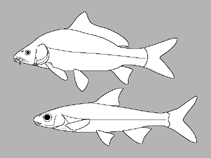 No image available for this species;
drawing shows typical species in Cyprinidae.
Google image
drawing shows typical species in Cyprinidae.
Ταξινόμηση / Ονόματα Κοινά ονόματα | Συνώνυμα | Catalog of Fishes(Γένος, Είδη) | ITIS | CoL | WoRMS | Cloffa
> Cypriniformes (Carps) > Cyprinidae (Minnows or carps) > Barbinae
Etymology: Barbus: Latin, barbus = barbel (Ref. 45335); samniticus: Named for Samnites, ancient Italic people who settled in the type locality.
Eponymy: Sir Charles Alfred Payton (1843–1926) was a British adventurer, writer, fisherman and diplomat who was British Consul to Morocco, where this barb is found. [...] (Ref. 128868), visit book page.
Etymology: Barbus: Latin, barbus = barbel (Ref. 45335); samniticus: Named for Samnites, ancient Italic people who settled in the type locality.
Eponymy: Sir Charles Alfred Payton (1843–1926) was a British adventurer, writer, fisherman and diplomat who was British Consul to Morocco, where this barb is found. [...] (Ref. 128868), visit book page.
Περιβάλλον: περιβάλλον / κλιματική ζώνη / εύρος βάθους / εύρος διανομής Οικολογία
; Γλυκού νερού βενθοπελαγικό. Subtropical
Κατανομή Εδάφη | Περιοχές FAO | Οικοσυστήματα | Παρουσίες | Σημειακός χάρτης | Εισαγωγές | Faunafri
Europe: Italy.
Μέγεθος / Βάρος / Ηλικία
Γεννητική Ωρίμανση: Lm ? range ? - ? cm
Max length : 18.8 cm SL αρσενικό/απροσδιόριστο; (Ref. 123793)
Max length : 18.8 cm SL αρσενικό/απροσδιόριστο; (Ref. 123793)
Σύντομη περιγραφή Κλείδες προσδιορισμού | Μορφολογία | Μορφομετρία
This species is distinguished by the following characters: last unbranched dorsal-fin ray weakly ossified; superior margin of the dorsal fin is straight or slightly concave like other Italian fluviolacustrine barbels (some profile slightly convex); numerous small irregular-shaped black or dark-brown dots, smaller than scales that often form large, black or dark-brown spots on the back and flanks in juveniles and adults and this pigmentation is more evident in specimens living in clear water, whereas it tends to disappear in turbid environments; differs from all the other species by its greatest maximum height 20.4-25.1% SL (vs. 18.8%-24.9% SL in B. fucini, 19.0%-22.7% SL in B. tyberinus, 17.9%-22.7% SL in B. plebejus); differs from B. fucini by the shorter pre-orbital distance 8.2%-9.7% SL (vs. 7.9%-11.0% SL); differs from B. tyberinus and B. plebejus by having longer pectoral fins 17.1% - 20.6% (vs. 16.7%-19.8% and 15.7%-20.4% SL, respectively); longer ventral fin 12.4%-16.8% (vs. 11.0%-15.7% and 11.6%-15.3% SL) and caudal fins 12.5%16.4% (vs. 12.1%-14.7% and 12.1%-15.1% SL); differs from B. tyberinus in that it has longer lobes of the caudal fin upper: 21.2%-26.2% (vs. 19.1%-23.7% SL) and lower:19.8%-26.1% (vs. 19.5%-23.4% SL), a greater dorsal fin 14.6%-19.0% (vs. 13.7%-16.3% SL), a major presence of pigmentation and dots on scales and fins and a different dominant (orange) colour of the anal, dorsal and ventral fins; differs from B. plebejus by having fewer scales on 51-67 (vs. 58-71), above 10-13 (vs. 11-15) and under 7-9 (vs. 8-11) the lateral line, greater minimum height 10.2%-12.5% (vs. 9.3%-11.1%% SL), smaller fork depth 8.8% - 11.3% (vs. 9.1%-12.5% SL) and greater amount of body spots (Ref. 123793),
Cross section: compressed.
Cross section: compressed.
This species populates intermediate and hilly stretches of Apennine rivers together with other Italian species typical of the barbel zone: Sarmarutilus rubilio, Telestes muticellus and Squalius squalus (Ref. 123793).
Κύκλος ζωής και συμπεριφορά ζευγαρώματος Γεννητική Ωρίμανση | Αναπαραγωγή | Γεννοβολία | Αβγά | Γονιμότητα | Προνύμφες
Κύρια αναφορά
Ανεβάστε τις αναφορές σας | Αναφορές | Συντονιστής | Συνεργάτες
Lorenzoni, M., A. Carosi, S. Quadroni, V. De Santis, I. Vanetti, G.B. Delmastro and S. Zaccara, 2021. Cryptic diversity within endemic Italian barbels: revalidation and description of new Barbus species (Teleostei: Cyprinidae). J. Fish Biol. 98(5):1433-1449. (Ref. 123793)
Κατάσταση Κόκκινου Καταλόγου IUCN (Ref. 130435: Version 2025-2 (Global))
Ευάλωτο (VU) (B1ab(iii)); Date assessed: 19 October 2023
CITES
Not Evaluated
Απειλή για τον άνθρωπο
Harmless
Ανθρώπινες χρήσεις
FAO - Publication: search | FishSource |
Περισσότερες πληροφορίες
Τροφική Οικολογία
Τρόφιμα (θηράματα)
Σύσταση δίαιτας
Κατανάλωση τροφής
Μερίδες τροφίμων
Θηρευτές
Τρόφιμα (θηράματα)
Σύσταση δίαιτας
Κατανάλωση τροφής
Μερίδες τροφίμων
Θηρευτές
Πληθυσμιακή δυναμική
Παράμετροι Αύξησης
Μέγιστες ηλικίες / μεγέθη
Μήκος-βάρος σχετ.
Μήκος-μήκος rel.
Μήκος-συχνότητες
Μετατροπή μάζας
Στρατολόγηση
Αφθονία
Παράμετροι Αύξησης
Μέγιστες ηλικίες / μεγέθη
Μήκος-βάρος σχετ.
Μήκος-μήκος rel.
Μήκος-συχνότητες
Μετατροπή μάζας
Στρατολόγηση
Αφθονία
Κύκλος ζωής
Αναπαραγωγή
Γεννητική Ωρίμανση
Ωριμότητα / Gills rel.
Γονιμότητα
Γεννοβολία
Συγκεντρώσεις αναπαραγωγής
Αβγά
Ανάπτυξη αυγών
Προνύμφες
Δυναμική προνυμφών
Αναπαραγωγή
Γεννητική Ωρίμανση
Ωριμότητα / Gills rel.
Γονιμότητα
Γεννοβολία
Συγκεντρώσεις αναπαραγωγής
Αβγά
Ανάπτυξη αυγών
Προνύμφες
Δυναμική προνυμφών
Ανατομία
Επιφάνεια βραγχίων
Εγκέφαλος
Ωτόλιθος
Επιφάνεια βραγχίων
Εγκέφαλος
Ωτόλιθος
Φυσιολογία
Σύνθεση σώματος
Θρεπτικά συστατικά
Κατανάλωση οξυγόνου
Τύπος κολύμβησης
Ταχύτητα κολύμβησης
Οπτικές χρωστικές ουσίες
Ήχος ψαριών
Ασθένειες & παράσιτα
Τοξικότητα (LC50)
Σύνθεση σώματος
Θρεπτικά συστατικά
Κατανάλωση οξυγόνου
Τύπος κολύμβησης
Ταχύτητα κολύμβησης
Οπτικές χρωστικές ουσίες
Ήχος ψαριών
Ασθένειες & παράσιτα
Τοξικότητα (LC50)
Γενετική
Γονιδίωμα
Γενετική
Ετεροζυγωτία
Κληρονομικότητα
Γενετική ποικιλομορφία
Γονιδίωμα
Γενετική
Ετεροζυγωτία
Κληρονομικότητα
Γενετική ποικιλομορφία
Ανθρώπινη σχέση
Συστήματα υδατοκαλλιέργειας
Προφίλ υδατοκαλλιεργειών
Στελέχοι
Περιπτώσεις Ciguatera
Γραμματόσημα, νομίσματα, διάφορα.
Συστήματα υδατοκαλλιέργειας
Προφίλ υδατοκαλλιεργειών
Στελέχοι
Περιπτώσεις Ciguatera
Γραμματόσημα, νομίσματα, διάφορα.
Εργαλεία
Ηλεκτρονικό βιβλίο | Οδηγός πεδίου | Ανάλυση κατά μήκος συνθέσεων | Εργαλείο ιστορίας ζωής | Σημειακός χάρτης |
Catch-MSY |
Ειδικές εκθέσεις
Έλεγχος για συντήρηση ενυδρείου | Ελέγξτε για ενημερωτικά δελτία ειδών | Ελέγξτε για ενημερωτικά δελτία υδατοκαλλιέργειας
Λήψη XML
Διαδικτυακές πηγές
AFORO (otoliths) | Aquatic Commons | BHL | Cloffa | Websites from users | Check FishWatcher | CISTI | Catalog of Fishes: Γένος, Είδη | DiscoverLife | ECOTOX | FAO - Publication: search | Faunafri | Fishipedia | Fishtrace | GloBI | Google Books | Google Scholar | Google | IGFA World Record | Εθνικές βάσεις δεδομένων | OneZoom | Open Tree of Life | Otolith Atlas of Taiwan Fishes | PubMed | Reef Life Survey | Socotra Atlas | TreeBase | Δέντρο Ζωής | Wikipedia: Go, αναζήτηση | | Zoobank | Zoological Record
Εκτιμήσεις βάσει μοντέλων
|
Δείκτης φυλογενετικής ποικιλότητας (Αναφ. 82804) |
PD50 = 0.5000 [Uniqueness, from 0.5 = low to 2.0 = high]. |
| Bayesian length-weight | a=0.00794 (0.00365 - 0.01726), b=3.05 (2.88 - 3.22), in cm total length, based on LWR estimates for this Genus-body shape (Ref. 93245). |
|
Τροφικό Επίπεδο (Αναφ. 69278) |
3.1 ±0.4 se; based on size and trophs of closest relatives |
|
Ελαστικότητα (Αναφ. 120179) |
Μεσαίο(α), ελάχιστος χρόνος για διπλασιασμό πληθυσμού 1,4 - 4,4 έτη (Preliminary K or Fecundity.). |
|
Ευπάθεια στην αλιεία (Ref. 59153) |
Low to moderate vulnerability (31 of 100). 🛈 |