Plectorhinchus lineatus, Yellowbanded sweetlips : fisheries, aquarium

Plectorhinchus lineatus (Linnaeus, 1758)

Yellowbanded sweetlips
Masukkan pemerhatian anda di Fish Watcher
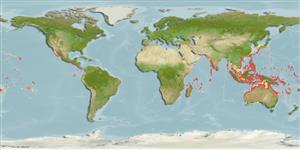
Native range | All suitable habitat | Point map | Year 2050
This map was computer-generated and has not yet been reviewed.
Plectorhinchus lineatus   AquaMaps   Data sources: GBIF OBIS
muatnaik fotos/gambar dan video
Gambar | video | imej Google
  • Image of Plectorhinchus lineatus (Yellowbanded sweetlips)
    Plectorhinchus lineatus
    foto/gambar oleh Patzner, R.
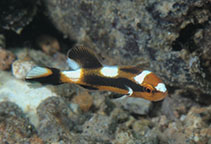
  • Image of Plectorhinchus lineatus (Yellowbanded sweetlips)
    Plectorhinchus lineatus
    Juvenile foto/gambar oleh Hazes, B.

klasifikasi / Nama Nama-nama umum | Sinonim (persamaan) | Catalog of Fishes(Marga, Jenis) | ITIS | CoL | WoRMS | Cloffa

> Eupercaria/misc (Various families in series Eupercaria) > Haemulidae (Grunts) > Plectorhinchinae
Etymology: Plectorhinchus: Greek, plektos = plaited + Greek, rhyngchos = snout (Ref. 45335).
More on author: Linnaeus.

Lingkungan: lingkungan / zona iklim / kisaran kedalaman / jangkauan distribusi Ekologi

laut berasosiasi dengan karang; kisaran kedalaman 1 - 50 m (Ref. 9710). Tropical

Penyebaran Wilayah | Daerah-daerah FAO | Ekosistem | Kemunculan | peta titik | Introduksi | Faunafri

Western Pacific: from Ryukyu Islands to Ogasawara Islands to the Great Barrier Reef and New Caledonia.

Ukuran / Berat / umur

Kematangan: Lm ?  range ? - ? cm
Max length : 72.0 cm TL jantan/; (Ref. 9710)

deskripsi pendek Kunci identifiaksi (pengenalan) | Morfologi | Morfometrik

Duri punggung (Keseluruhan (total)) : 12 - 13; duri punggung lunak (Keseluruhan (total)) : 18 - 20; Duri dubur: 3; Sirip dubur lunak: 7 - 8. This species is distinguished by the following characters: chin with 6 pores, no median pit; gill rakers on first gill arch 7-11 + 1 + 17-19 = 26-30; D XIII,18-20, 3rd to 5th spines longest; lips fleshy, moderately swollen with age; scales ctenoid (rough to touch); lateral line tubed scales about 54-58; body depth 2.6-2.9 in SL; caudal fin slightly rounded in juveniles, truncate in adults. Colour of juveniles with few horizontal to slightly oblique dark brown bands which subdivide with age until the body appears to be dark chocolate brown above, with a network of fine white lines running up and back, the broad brown bars breaking up into smaller and smaller spots on lower sides; belly white; lips and fins bright yellow, anal and caudal fins dotted with black; pectoral fins with a splash of bright crimson or scarlet red at the base (Ref. 47695, 90102).
Body shape (shape guide): fusiform / normal; Cross section: compressed.

Biologi     Daftar kata (contoh epibenthic)

Found in deep inner to outer reef habitats (Ref. 48635). Occurs singly or in aggregations along coral slopes of clear lagoon and seaward reefs. Juveniles solitary on shallow protected reefs (Ref. 48635). Generally nocturnal, feeding on benthic invertebrates in open sand flats and seagrass beds at night and conspicuously rests during the day (Ref. 9710, 90102). At Palau, it aggregates to spawn around new moon (Ref. 37816). Taken by handline and spear. Marketed fresh, a small quantity is salted (Ref. 47695). Maximum depth reported taken from Ref. 128797.

Siklus hidup dan perilaku kawin Kematangan | Reproduksi, perkembang biakan | Pemijahan | telur-telur | Fekunditas | Larva

Oviparous, distinct pairing during breeding (Ref. 205).

rujukan utama Unggah referensi Anda | Acuan | Koordinator | mitra

Conlu, P.V., 1986. Guide to Philippine flora and fauna. Fishes. Volume IX. Natural Resources Management Center, Quezon City. 495 p. (Ref. 2858)

Status IUCN Red List (Ref. 130435: Version 2025-2 (Global))

  kurang bimbang (LC) ; Date assessed: 12 April 2023

CITES

Not Evaluated

CMS (Ref. 116361)

Not Evaluated

ancaman kepada manusia

  Harmless


penggunaan manusia

Perikanan: nilai komersial kecil; Akuarium: Komersial
FAO - Publication: search | FishSource | Laut di Sekitar Kita

informasi lanjut

Ekologi trofik
Item makanan (mangsa)
Komposisi makanan
Konsumsi makanan
Ransum makanan
Pemangsa
Ekologi
Ekologi
Dinamika populasi
Parameter pertumbuhan
Maks. usia / ukuran
Panjang-berat rel.
Panjang-panjang rel.
ukuran frekuensi
Konversi massa
pemulihan
Kelimpahan
Siklus hidup
Reproduksi, perkembang biakan
Kematangan
Kedewasaan / insang rel.
Fekunditas
Pemijahan
Agregasi pemijahan
telur-telur
pekembangan telor
Larva
Dinamika larva
Penyebaran
Wilayah
Daerah-daerah FAO
Ekosistem
Kemunculan
Introduksi
BRUVS - Video
Anatomi
Area insang
Otak
Otolith
Fisiologi
Komposisi tubuh
Nutrisi
Konsumsi oksigen
Jenis renang
Kecepatan berenang
Pigmen visual
Suara ikan
Penyakit & Parasit
Toksisitas (LC50)
Genetika
genom
Genetika
Heterozigositas
Diturunkan
Keanekaragaman Genetik
Yang berhubungan dengan manusia
Sistem akuakultur
profil budidaya air
Strain
Kasus Ciguatera
Perangko, koin, dll.
Penjangkauan
mitra
Acuan
Acuan

Alat, peralatan

laporan khas

muat turun XML

Sumber internet

Estimasi berdasarkan model

Suhu yang disukai (Acuan 123201): 24.4 - 29.3, mean 28.4 °C (based on 3196 cells).
Indeks keanekaragaman filogenetik (Acuan 82804):  PD50 = 0.5000   [Uniqueness, from 0.5 = low to 2.0 = high].
Bayesian length-weight: a=0.01175 (0.00765 - 0.01804), b=3.02 (2.89 - 3.15), in cm total length, based on LWR estimates for this species & Genus-body shape (Ref. 93245).
Tingkat Trofik (Acuan 69278):  3.9   ±0.59 se; based on food items.
Generation time: 3.7 ( na - na) years. Estimated as median ln(3)/K based on 1 growth studies.
Daya lenting (Acuan 120179):  sedang, Waktu penggandaan populasi minimum 1.4 - 4.4 tahun (K=0.3;).
Kerentanan Penangkapan Ikan (Ref. 59153):  Moderate vulnerability (37 of 100). 🛈
kategori harga (Ref. 80766):   Medium.
Nutrisi (Ref. 124155):  Calcium = 30.2 [10.9, 56.4] mg/100g; Iron = 0.515 [0.274, 0.968] mg/100g; Protein = 19.7 [17.8, 21.5] %; Omega3 = 0.125 [0.070, 0.204] g/100g; Selenium = 34.1 [20.8, 58.2] μg/100g; VitaminA = 55.5 [23.3, 131.6] μg/100g; Zinc = 0.892 [0.623, 1.361] mg/100g (wet weight);