



Nothobranchius attenboroughi Nagy, Watters & Bellstedt, 2020
Carica il tuo foto e Video
Google image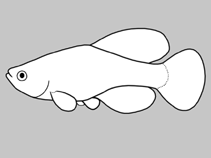 No image available for this species;
drawing shows typical species in Nothobranchiidae.
Google image
drawing shows typical species in Nothobranchiidae.
Classificazione / Nomi Nomi Comuni | Sinonimi | Catalog of Fishes(Genere, Specie) | ITIS | CoL | WoRMS | Cloffa
> Cyprinodontiformes (Rivulines, killifishes and live bearers) > Nothobranchiidae (African rivulines)
Etymology: Nothobranchius: Greek, nothos = false + Greek, brangchia = gill (Ref. 45335); attenboroughi: The specific name is given in honour of Sir David F. Attenborough, in recognition of his dedicated efforts to promote biophilia: raising awareness of the wonders and beauties of nature for so many people worldwide, promoting awareness of the importance of biodiversity conservation, and above all, inspiring so many researchers in the field of natural history, including the authors; a noun in genitive case (Ref. 123150).
Eponymy: Sir David Frederick Attenborough (d: 1926) is famous as a maker of wildlife television programmes. [...] (Ref. 128868), visit book page.
Etymology: Nothobranchius: Greek, nothos = false + Greek, brangchia = gill (Ref. 45335); attenboroughi: The specific name is given in honour of Sir David F. Attenborough, in recognition of his dedicated efforts to promote biophilia: raising awareness of the wonders and beauties of nature for so many people worldwide, promoting awareness of the importance of biodiversity conservation, and above all, inspiring so many researchers in the field of natural history, including the authors; a noun in genitive case (Ref. 123150).
Eponymy: Sir David Frederick Attenborough (d: 1926) is famous as a maker of wildlife television programmes. [...] (Ref. 128868), visit book page.
Ambiente: milieu / zona climatica / distribuzione batimetrica / gamma di distribuzione Ecologia
; acqua dolce benthopelagico; pH range: 6.7 - 8.0. Tropical; 22°C - 27°C (Ref. 123150)
Distribuzione Territories | Aree FAO | Ecosistemi | Presenze | Mappa dei ritrovamenti | Introduzioni | Faunafri
Africa: ephemeral pools and marshes associated with Grumeti River and other small systems draining into Lake Victoria in northern Tanzania (Ref. 123150).
Dimensione / Peso / Età
Breve descrizione Chiavi di identificazione | Morfologia | Morfometria
Spine dorsali (totale) : 0; Raggi dorsali molli (totale) : 14 - 17; Spine anali: 0; Raggi anali molli: 16 - 17. Diagnosis: Nothobranchius attenboroughi belongs to the N. ugandensis species group presenting the following combination of characters in males: body colouration light blue with red or red-brown scale margins; frontal part of head red-brown, throat light blue or red; caudal fin uniform red; and anal fin light blue or yellow with red-brown spotted pattern (Ref. 123150). Nothobranchius attenboroughi differs from all other members of the N. ugandensis species group by a light blue anal fin with red-brown dots proximally and medially; becoming yellow distally with red-brown narrow stripes parallel to fin rays; and caudal peduncle length 122-129% of its depth vs. 96-121% or 130-157% (Ref. 123150). Furthermore, it differs from N. moameensis, by a smaller body depth, 25.7-31.0% of standard length vs. 31.6-33.2%; a smaller head depth, 80.1-86.2% of head length vs. 87.1-94.3%; and a dorsal fin that is positioned posterior to anal fin, preanal length mean 59.8% of standard length and predorsal length mean 60.6% of standard length vs. anteriorly positioned with mean values of 62.2% and 60.9% respectively, in N. moameensis (Ref. 123150).
Body shape (shape guide): fusiform / normal; Cross section: compressed.
Body shape (shape guide): fusiform / normal; Cross section: compressed.
The distribution area of Nothobranchius attenboroughi overlaps with those of N. sagittae and N. serengetiensis, but syntopic occurrences are rare (Ref. 123150). Found in isolated temporary pools in a seasonal stream system; in turbid water, the bottom of the pool, less than a meter at the deepest point, not visible (Ref. 123150).
Ciclo vitale e comportamento di accoppiamento Maturità | Riproduzione | Deposizione | Uova | Fecondità | Larve
Riferimento principale
Caricare le referenze | Bibliografia | Coordinatore | Collaboratori
Nagy, B., B.R. Watters, P.D.W. van der Merwe, F.P.D. Cotterill and D.U. Bellstedt, 2020. Review of the Nothobranchius ugandensis species group from the inland plateau of eastern Africa with descriptions of six new species (Teleostei: Nothobranchiidae). Ichthyol. Explor. Freshwat. 30(1):21-73. (Ref. 123150)
Stato della Lista Rossa IUCN (Ref. 130435: Version 2025-2 (Global))
Vulnerabile (VU) (B1ab(iii)+2ab(iii)); Date assessed: 18 May 2020
CITES
Not Evaluated
Minaccia per l'uomo
Harmless
Usi umani
FAO - Publication: search | FishSource |
Informazioni ulteriori
Ecologia trofica
Articoli alimentari (prede)
Alimentazione
Consumo di cibo
Razioni alimentari
Predatori
Articoli alimentari (prede)
Alimentazione
Consumo di cibo
Razioni alimentari
Predatori
Dinamica della popolazione
Parametri di crescita
Età massima / dimensioni massime
Rapporto lunghezza-peso.
Lunghezza-lunghezza rel.
Lunghezza-frequenze
Conversione di massa
Reclutamento
Abbondanza
Parametri di crescita
Età massima / dimensioni massime
Rapporto lunghezza-peso.
Lunghezza-lunghezza rel.
Lunghezza-frequenze
Conversione di massa
Reclutamento
Abbondanza
Ciclo di vita
Riproduzione
Maturità
Maturità/Gli occhielli sono relativi.
Fecondità
Deposizione
Aggregazioni riproduttive
Uova
Sviluppo delle uova
Larve
Dinamica popolazioni larvali
Riproduzione
Maturità
Maturità/Gli occhielli sono relativi.
Fecondità
Deposizione
Aggregazioni riproduttive
Uova
Sviluppo delle uova
Larve
Dinamica popolazioni larvali
Anatomia
Area branchiale
Cervello
Otolite
Area branchiale
Cervello
Otolite
Fisiologia
Composizione corporea
Nutrienti
Consumo di ossigeno
Tipo di nuoto
Velocità di nuoto
Pigmenti visivi
Suono del pesce
Malattie e parassiti
Tossicità (LC50)
Composizione corporea
Nutrienti
Consumo di ossigeno
Tipo di nuoto
Velocità di nuoto
Pigmenti visivi
Suono del pesce
Malattie e parassiti
Tossicità (LC50)
Genetica
Genome
Genetica
Eterozigosi
Ereditarietà
Diversità genetica
Genome
Genetica
Eterozigosi
Ereditarietà
Diversità genetica
Legato all'uomo
Sistemi di acquacoltura
Profili di acquacoltura
Varietà
Casi di Ciguatera
Francobolli, monete, materiale vario.
Sistemi di acquacoltura
Profili di acquacoltura
Varietà
Casi di Ciguatera
Francobolli, monete, materiale vario.
Strumenti
Libro elettronico | Giuda pratica | Generatore frequenze di lunghezza | Strumento Parametri Biologici | Mappa dei ritrovamenti |
Cattura-MSY |
Rapporti speciali
Controllo della manutenzione dell'acquario | Verificare la presenza di schede informative sulle specie | Verifica delle schede informative sull'acquacoltura
Scarica XML
Fonti Internet
AFORO (otoliths) | Aquatic Commons | BHL | Cloffa | Websites from users | Check FishWatcher | CISTI | Catalog of Fishes: Genere, Specie | DiscoverLife | ECOTOX | FAO - Publication: search | Faunafri | Fishipedia | Fishtrace | GloBI | Google Books | Google Scholar | Google | IGFA World Record | OneZoom | Open Tree of Life | Otolith Atlas of Taiwan Fishes | PubMed | Reef Life Survey | Socotra Atlas | TreeBase | Tree of Life | Wikipedia: Go, ricerca | World Records Freshwater Fishing | Zoobank | Record zoologico
Stime basate su modelli
Indice di diversità filogenetica (Fonte Biblio. 82804): PD50 = 0.5000 [Uniqueness, from 0.5 = low to 2.0 = high].
Bayesian length-weight: a=0.00603 (0.00250 - 0.01453), b=3.13 (2.93 - 3.33), in cm total length, based on LWR estimates for this (Sub)family-body shape (Ref. 93245).
Livello trofico (Fonte Biblio. 69278): 3.2 ±0.4 se; based on size and trophs of closest relatives