



Glossogobius macrocephalus Hoese & Allen, 2015
Carregue seu(sua) Fotos e vídeos
Imagem do Google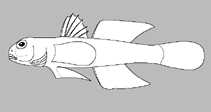 No image available for this species;
drawing shows typical species in Gobiidae.
Imagem do Google
drawing shows typical species in Gobiidae.
Classificação / Nomes Nomes comuns | Sinônimos | Catalog of Fishes(Gênero, Espécies) | ITIS | CoL | WoRMS | Cloffa
> Gobiiformes (Gobies) > Gobiidae (Gobies) > Gobiinae
Etymology: Glossogobius: Greek, glossa = tongue + Latin, gobius = gudgeon (Ref. 45335); macrocephalus: From the Greek makros = large and kephale = head, treated as a noun in apposition, relating to the large head of the species (Ref. 103536).
Etymology: Glossogobius: Greek, glossa = tongue + Latin, gobius = gudgeon (Ref. 45335); macrocephalus: From the Greek makros = large and kephale = head, treated as a noun in apposition, relating to the large head of the species (Ref. 103536).
Meio ambiente: milieu / Zona climática / intervalo de profundidade / faixa de distribuição Ecologia
; Água doce bentopelágico. Tropical
Distribuição Territórios | Áreas da FAO | Ecossistemas | Ocorrências | Mapa de pontos | Introduções | Faunafri
Oceania: Papua New Guinea
Tamanho / Peso / Idade
Descrição suscinta Chaves de identificação | Morfologia | Morfometria
Espinhos dorsais (total) : 6 - 7; Raios dorsais (total) : 9 - 10; Espinhos anais: 1; Raios anais : 8; Vértebras: 28. Diagnosis: Preoperculum without a spine, but with small flat projection adjacent to lower preopercular pore; mental fraenum low with short lateral lobes; mouth small; reaching to below anterior margin of eyes; jaws forming an angle of 40–50° with body axis; upper margin of upper jaw in line with lower margin of pupil; head robust and large, cheeks slightly bulbose and tapering; interorbital narrow, less than eye length; predorsal area scaled forward to just behind eye, with a narrow naked patch between and behind eyes; cheek naked; operculum naked; pectoral base with 1–3 vertical rows of scales; prepelvic area about 3/4 scaled in 7–8 rows, naked anteriorly; belly largely scaled, with a very small naked patch behind pelvic insertion; 1st dorsal fin spine 3–5 extending beyond other spines when fin depressed; 1st dorsal fin with black spot posteriorly on membrane surrounding 6th dorsal spine, spot faint in female; pelvic fin thin, length much greater than width, reaching anus; 2nd dorsal rays I,9–10; anal rays I,8; pectoral rays 17–18; longitudinal scale count 30–31; predorsal scale count 15–18; transverse scale count (TRB) 9.5–10.5; gill rakers on outer face of 1st arch 1+1+6–8=8–10; lower gill rakers on outer face of 2nd arch 6–7; branched caudal rays 14–15; vertebrae 12+16=28; papillae, Line 1 (before nasal pore) composed of 2 rows of papillae (sometimes incomplete); line 2 (between nasal pores) composed of a single row of papillae usually continuous across snout; line 5 (suborbital) composed of single row of papillae (double in 1 specimens on 1 side of head below infraorbital pore), joining line 7 below posterior nostril; line 6 (suborbital branch) absent; lines 7, 9, 10 (LL cheek rows) composed of a single row of papillae, but irregular anteriorly appearing double, reaching to posterior preopercular margin; lines 8 and 11 (LT row) reaching just short of posterior preopercular margin; line 12 (outer POP–mandibular) composed of single row of papillae, appearing double along lips, without gap at end of lips; line 13 (inner POP–mandibular)
composed of 2–3 rows of papillae; line 20 (opercular VT row) composed of single row of papillae dorsally, and double ventrally; line 21 (upper opercular OT) composed of single row of papillae, strongly curved ventrally meeting or almost meeting line 22; line 22 (lower opercular OT) composed of single row of papillae, curving upward along posterior opercular margin; several vertical papillae rows on belly; a single curved line anteriorly on most body scales (often obscure dorsally and posteriorly); chin with an oval patch of papillae behind mental fraenum, with a notch posteromedially without papillae (Ref. 103536).
Body shape (shape guide): elongated.
Body shape (shape guide): elongated.
Ciclo de vida ou comportamento de acasalamento Maturidade | Reprodução | Desova | Ovos | Fecundidade | Larvas
Referência principal
Carregar suas referências | Referências | Coordenador | Colaboradores
Hoese, D.F. and G.R. Allen, 2015. Descriptions of three new species of Glossogobius (Teleostei: Gobiidae) from New Guinea. Zootaxa 3986(2):201-216. (Ref. 103536)
Status na Lista Vermelha da UICN (Ref. 130435: Version 2025-2 (Global))
Vulnerável (VU) (D2); Date assessed: 05 December 2019
CITES
Not Evaluated
Ameaça para os humanos
Harmless
Uso pelos humanos
FAO - Publication: search | FishSource |
Mais informação
Ecologia Trófica
Itens alimentares (presas)
Composição da dieta
Consumo alimentar
Rações alimentares
Predadores
Itens alimentares (presas)
Composição da dieta
Consumo alimentar
Rações alimentares
Predadores
Dinâmica populacional
Parâmetros de crescimento
Idade máxima / tamanhos
Relação comprimento-peso.
Relação comprimento-comprimento.
Frequências de comprimento
Conversão de massa
Recrutamento
Abundância
Parâmetros de crescimento
Idade máxima / tamanhos
Relação comprimento-peso.
Relação comprimento-comprimento.
Frequências de comprimento
Conversão de massa
Recrutamento
Abundância
Ciclo de vida
Reprodução
Maturidade
Maturidade/Rel. das guelras
Fecundidade
Desova
Agregações de desova
Ovos
Desenvolvimento dos ovos
Larvas
Dinâmica larval
Reprodução
Maturidade
Maturidade/Rel. das guelras
Fecundidade
Desova
Agregações de desova
Ovos
Desenvolvimento dos ovos
Larvas
Dinâmica larval
Anatomia
Área branquial
Cérebro
Otólito
Área branquial
Cérebro
Otólito
Fisiologia
Composição corporal
Nutrientes
Consumo de oxigênio
Tipo de natação
Velocidade de natação
Pigmentos visuais
Som de peixe
Doenças e Parasitas
Toxicidade (LC50s)
Composição corporal
Nutrientes
Consumo de oxigênio
Tipo de natação
Velocidade de natação
Pigmentos visuais
Som de peixe
Doenças e Parasitas
Toxicidade (LC50s)
Genética
genoma
Genética
Heterozigosidade
Hereditariedade
Diversidade genética
genoma
Genética
Heterozigosidade
Hereditariedade
Diversidade genética
Relacionado a humanos
Sistemas de aquicultura
Perfis para aquacultura
Estirpes
Casos de Ciguatera
Selos, moedas, diversos.
Sistemas de aquicultura
Perfis para aquacultura
Estirpes
Casos de Ciguatera
Selos, moedas, diversos.
Ferramentas
Livro eletrônico | Guia de campo | Ferramenta auxiliar de frequências de comprimento | Ferramenta sobre a história de vida | Mapa de pontos |
Catch-MSY |
Relatórios especiais
Checar Manutenção em Aquário | Checar Planilhas de Fatos sobre as Espécies | Checar Planilhas de Fatos sobre Aquicultura
Baixar XML
Fontes da internet
AFORO (otoliths) | Aquatic Commons | BHL | Cloffa | Websites from users | Checar Observador de Peixes (FishWatcher) | CISTI | Catalog of Fishes: Gênero, Espécies | DiscoverLife | ECOTOX | FAO - Publication: search | Faunafri | Fishipedia | Fishtrace | GloBI | Google Books | Google Scholar | Google | IGFA World Record | OneZoom | Open Tree of Life | Otolith Atlas of Taiwan Fishes | PubMed | Reef Life Survey | Socotra Atlas | TreeBase | Árvore da vida | Wikipedia: Ir para, procura | World Records Freshwater Fishing | Zoobank | Registro zoológico
Estimativas baseadas em modelos
Índice de diversidade filogenética (Ref. 82804): PD50 = 0.5000 [Uniqueness, from 0.5 = low to 2.0 = high].
Bayesian length-weight: a=0.00741 (0.00347 - 0.01582), b=3.09 (2.91 - 3.27), in cm total length, based on LWR estimates for this (Sub)family-body shape (Ref. 93245).
Nível Trófico (Ref. 69278): 3.5 ±0.4 se; based on size and trophs of closest relatives
Resiliência (Ref. 120179): Elevada, tempo mínimo de duplicação da população menor que 15 meses (Preliminary K or Fecundity.).