



Carica il tuo foto e Video
Google image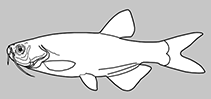 No image available for this species;
drawing shows typical species in Danionidae.
Google image
drawing shows typical species in Danionidae.
Classificazione / Nomi Nomi Comuni | Sinonimi | Catalog of Fishes(Genere, Specie) | ITIS | CoL | WoRMS | Cloffa
> Cypriniformes (Carps) > Danionidae (Danios) > Danioninae
Etymology: Devario: Bangla/Bengali:‘debari’, local name for these fishes; also meaning ‘brother in law’ (Ref. 2031); fangae: Named for Fang Fang (1962-2010), who singled out this species for description as new including separation of the holotype, as the proper discoverer, and also for recognizing her deep personal interest in the freshwater fishes of Myanmar. A noun in the genitive case.
Eponymy: Dr Fang Kullander née Fang (1962–2010) was a Chinese ichthyologist. [...] (Ref. 128868), visit book page.
Etymology: Devario: Bangla/Bengali:‘debari’, local name for these fishes; also meaning ‘brother in law’ (Ref. 2031); fangae: Named for Fang Fang (1962-2010), who singled out this species for description as new including separation of the holotype, as the proper discoverer, and also for recognizing her deep personal interest in the freshwater fishes of Myanmar. A noun in the genitive case.
Eponymy: Dr Fang Kullander née Fang (1962–2010) was a Chinese ichthyologist. [...] (Ref. 128868), visit book page.
Ambiente: milieu / zona climatica / distribuzione batimetrica / gamma di distribuzione Ecologia
; acqua dolce benthopelagico. Tropical
Distribuzione Territories | Aree FAO | Ecosistemi | Presenze | Mappa dei ritrovamenti | Introduzioni | Faunafri
Asia: Ayeyarwaddy River drainage in Myanmar.
Dimensione / Peso / Età
Maturità: Lm ? range ? - ? cm
Max length : 5.9 cm SL maschio/sesso non determinato; (Ref. 117334); 6.1 cm SL (female)
Max length : 5.9 cm SL maschio/sesso non determinato; (Ref. 117334); 6.1 cm SL (female)
Breve descrizione Chiavi di identificazione | Morfologia | Morfometria
Raggi dorsali molli (totale) : 12 - 14; Raggi anali molli: 12 - 14; Vertebre: 31 - 34. Devario fangae shares uniquely with D. browni and D. kakhienensis in having an anterior expansion in width of the P stripe. It is distinguished from both species in having a broad P stripe, wider than adjacent interstripes (vs. narrow, as wide as or narrower than interstripes). It is further similar to species of Devario characterized by three dark stripes (P, P+1, P-1) along the side, but can be differentiated from these in having all three stripes wide and of similar width (vs. P stripe wide and P+1 and P-1 stripes much narrower as in D. aequipinnatus, D. acrostomus, D. deruptotalea, D. fangfangae, D. fraseri, and D. gibber). Both D. regina and D. malabaricus possess stripes that are relatively wide but not wider than interspaces and the P stripe is split anteriorly by a short light interspace.
Both D. assamensis (Barman, 1984) from the Brahmaputra River in southern Assam, and D. ostreographus (M’Clelland, 1839), without locality, are extremely deep-bodied, and thus can be easily distinguished from D. fangae. D. fangae differs from D. devario by having infraorbital process and rostral barbell (vs. absent); distinct danionine notch (vs. very shallow); dorsal fin rays with 9½-11½ rays (vs. 15½-17½ rays); lateral line with 30-32 scales (vs. 42-47); and 12 circumpeduncular scales (vs. 16). D. fangae can be differentiated from nominal species D. affinis, D. annandalei, D. strigillifer, D. spinosus and D. yuensis in Myanmar by having fewer scales in the lateral line (30-32, vs. 35-53); fewer circumpeduncular scales (12 vs. 14-20); and absence of a supraorbital process. It can be separated from D. xyrops in having a continuous P stripe (vs. P stripe separated into two blotches); and from D. myitkyinae by the color pattern consisting of three dark, straight horizontal stripes on the middle of the side (vs. up to five irregular stripes), branched dorsal-fin rays 9½-10½, exceptionally 11½, vs. 11½-13½, exceptionally 10½, and branched anal-fin rays 9½-11½ vs. 12½-13½, exceptionally 11½ or 14½. Devario fangae can be distinguished from all remaining species of Devario also by the striped color pattern (vs. a pattern of large blotches as in D. kysonensis, D. pathirana, or smaller blotches as in D. quangbinhensis; a very narrow posterior P stripe as in D. chrysotaeniatus, D. laoensis, D. leptos, D. micronema, D. neilgherriensis; vertical bars as in D. apogon, D. apopyris, D. auropurpureus, D. interruptus, D. jayarami, D. maetaengensis, D. salmonatus, D. shanensis; uniform, with or without a thin dark stripe posteriorly on the side as in D. acuticephala and D. sondhii; P stripe separated into two blotches as in D. anomalus; or wide P stripe posteriorly on side, but no other dark stripes as in D. naganensis). D. fangae differs further from barred devarios, D. fraseri, and D. malabaricus, by having infraorbital process (vs. absent) (Ref. 117334).
Body shape (shape guide): fusiform / normal.
Body shape (shape guide): fusiform / normal.
Found in small hillstreams. During the time of sampling in the low water season, the streams were shallow with depth mostly less than 0.5 m, width rarely more than 3 m, clear water running over gravel, rocks or sand, and relatively fast velocity, including frequent riffles. Syntopic with the following fishes: Amblyceps murraystuarti (Amblycipitidae), Barilius barnoides, Danio flagrans, Garra sp., Pethia tiantian, Puntius compressus (Cyprinidae), Badis pyema (Badidae), Batasio procerus (Bagridae), Heteropneustes fossilis (Clariidae), Mastacembelus armatus (Mastacembelidae), Acanthocobitis sp., Schistura sp. (Nemacheilidae), and Psilorhynchus brachyrhynchus (Psilorhynchidae) (Ref. 117334).
Ciclo vitale e comportamento di accoppiamento Maturità | Riproduzione | Deposizione | Uova | Fecondità | Larve
Riferimento principale
Caricare le referenze | Bibliografia | Coordinatore | Collaboratori
Kullander, S.O., 2017. Devario fangae and Devario myitkyinae, two new species of danionin cyprinids from northern Myanmar (Teleostei: Cyprinidae: Danioninae). Zootaxa 4227(3):407-421. (Ref. 117334)
CITES
Not Evaluated
Minaccia per l'uomo
Harmless
Usi umani
FAO - Publication: search | FishSource |
Informazioni ulteriori
Ecologia trofica
Articoli alimentari (prede)
Alimentazione
Consumo di cibo
Razioni alimentari
Predatori
Articoli alimentari (prede)
Alimentazione
Consumo di cibo
Razioni alimentari
Predatori
Dinamica della popolazione
Parametri di crescita
Età massima / dimensioni massime
Rapporto lunghezza-peso.
Lunghezza-lunghezza rel.
Lunghezza-frequenze
Conversione di massa
Reclutamento
Abbondanza
Parametri di crescita
Età massima / dimensioni massime
Rapporto lunghezza-peso.
Lunghezza-lunghezza rel.
Lunghezza-frequenze
Conversione di massa
Reclutamento
Abbondanza
Ciclo di vita
Riproduzione
Maturità
Maturità/Gli occhielli sono relativi.
Fecondità
Deposizione
Aggregazioni riproduttive
Uova
Sviluppo delle uova
Larve
Dinamica popolazioni larvali
Riproduzione
Maturità
Maturità/Gli occhielli sono relativi.
Fecondità
Deposizione
Aggregazioni riproduttive
Uova
Sviluppo delle uova
Larve
Dinamica popolazioni larvali
Anatomia
Area branchiale
Cervello
Otolite
Area branchiale
Cervello
Otolite
Fisiologia
Composizione corporea
Nutrienti
Consumo di ossigeno
Tipo di nuoto
Velocità di nuoto
Pigmenti visivi
Suono del pesce
Malattie e parassiti
Tossicità (LC50)
Composizione corporea
Nutrienti
Consumo di ossigeno
Tipo di nuoto
Velocità di nuoto
Pigmenti visivi
Suono del pesce
Malattie e parassiti
Tossicità (LC50)
Genetica
Genome
Genetica
Eterozigosi
Ereditarietà
Diversità genetica
Genome
Genetica
Eterozigosi
Ereditarietà
Diversità genetica
Legato all'uomo
Sistemi di acquacoltura
Profili di acquacoltura
Varietà
Casi di Ciguatera
Francobolli, monete, materiale vario.
Sistemi di acquacoltura
Profili di acquacoltura
Varietà
Casi di Ciguatera
Francobolli, monete, materiale vario.
Strumenti
Libro elettronico | Giuda pratica | Generatore frequenze di lunghezza | Strumento Parametri Biologici | Mappa dei ritrovamenti |
Cattura-MSY |
Rapporti speciali
Controllo della manutenzione dell'acquario | Verificare la presenza di schede informative sulle specie | Verifica delle schede informative sull'acquacoltura
Scarica XML
Fonti Internet
AFORO (otoliths) | Aquatic Commons | BHL | Cloffa | Websites from users | Check FishWatcher | CISTI | Catalog of Fishes: Genere, Specie | DiscoverLife | ECOTOX | FAO - Publication: search | Faunafri | Fishipedia | Fishtrace | GloBI | Google Books | Google Scholar | Google | IGFA World Record | OneZoom | Open Tree of Life | Otolith Atlas of Taiwan Fishes | PubMed | Reef Life Survey | Socotra Atlas | TreeBase | Tree of Life | Wikipedia: Go, ricerca | World Records Freshwater Fishing | Zoobank | Record zoologico
Stime basate su modelli
Indice di diversità filogenetica (Fonte Biblio. 82804): PD50 = 0.5000 [Uniqueness, from 0.5 = low to 2.0 = high].
Bayesian length-weight: a=0.00977 (0.00422 - 0.02262), b=3.04 (2.84 - 3.24), in cm total length, based on LWR estimates for this (Sub)family-body shape (Ref. 93245).
Livello trofico (Fonte Biblio. 69278): 3.0 ±0.4 se; based on size and trophs of closest relatives
Resilienza (Fonte Biblio. 120179): Alto, tempo minimo di raddoppiamento della popolazione meno di 15 mesi (Preliminary K or Fecundity.).