



Ανεβάστε το φωτογραφίες και Βίντεο
Google image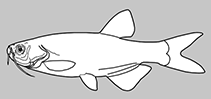 No image available for this species;
drawing shows typical species in Danionidae.
Google image
drawing shows typical species in Danionidae.
Ταξινόμηση / Ονόματα Κοινά ονόματα | Συνώνυμα | Catalog of Fishes(Γένος, Είδη) | ITIS | CoL | WoRMS | Cloffa
> Cypriniformes (Carps) > Danionidae (Danios) > Danioninae
Etymology: Devario: Bangla/Bengali:‘debari’, local name for these fishes; also meaning ‘brother in law’ (Ref. 2031); fangae: Named for Fang Fang (1962-2010), who singled out this species for description as new including separation of the holotype, as the proper discoverer, and also for recognizing her deep personal interest in the freshwater fishes of Myanmar. A noun in the genitive case.
Eponymy: Dr Fang Kullander née Fang (1962–2010) was a Chinese ichthyologist. [...] (Ref. 128868), visit book page.
Etymology: Devario: Bangla/Bengali:‘debari’, local name for these fishes; also meaning ‘brother in law’ (Ref. 2031); fangae: Named for Fang Fang (1962-2010), who singled out this species for description as new including separation of the holotype, as the proper discoverer, and also for recognizing her deep personal interest in the freshwater fishes of Myanmar. A noun in the genitive case.
Eponymy: Dr Fang Kullander née Fang (1962–2010) was a Chinese ichthyologist. [...] (Ref. 128868), visit book page.
Περιβάλλον: περιβάλλον / κλιματική ζώνη / εύρος βάθους / εύρος διανομής Οικολογία
; Γλυκού νερού βενθοπελαγικό. Tropical
Κατανομή Εδάφη | Περιοχές FAO | Οικοσυστήματα | Παρουσίες | Σημειακός χάρτης | Εισαγωγές | Faunafri
Asia: Ayeyarwaddy River drainage in Myanmar.
Μέγεθος / Βάρος / Ηλικία
Γεννητική Ωρίμανση: Lm ? range ? - ? cm
Max length : 5.9 cm SL αρσενικό/απροσδιόριστο; (Ref. 117334); 6.1 cm SL (female)
Max length : 5.9 cm SL αρσενικό/απροσδιόριστο; (Ref. 117334); 6.1 cm SL (female)
Σύντομη περιγραφή Κλείδες προσδιορισμού | Μορφολογία | Μορφομετρία
Μαλακές ραχιαίες ακτίνες (συνολικά) : 12 - 14; Μαλακές εδρικές ακτίνες: 12 - 14; Σπόνδυλοι: 31 - 34. Devario fangae shares uniquely with D. browni and D. kakhienensis in having an anterior expansion in width of the P stripe. It is distinguished from both species in having a broad P stripe, wider than adjacent interstripes (vs. narrow, as wide as or narrower than interstripes). It is further similar to species of Devario characterized by three dark stripes (P, P+1, P-1) along the side, but can be differentiated from these in having all three stripes wide and of similar width (vs. P stripe wide and P+1 and P-1 stripes much narrower as in D. aequipinnatus, D. acrostomus, D. deruptotalea, D. fangfangae, D. fraseri, and D. gibber). Both D. regina and D. malabaricus possess stripes that are relatively wide but not wider than interspaces and the P stripe is split anteriorly by a short light interspace.
Both D. assamensis (Barman, 1984) from the Brahmaputra River in southern Assam, and D. ostreographus (M’Clelland, 1839), without locality, are extremely deep-bodied, and thus can be easily distinguished from D. fangae. D. fangae differs from D. devario by having infraorbital process and rostral barbell (vs. absent); distinct danionine notch (vs. very shallow); dorsal fin rays with 9½-11½ rays (vs. 15½-17½ rays); lateral line with 30-32 scales (vs. 42-47); and 12 circumpeduncular scales (vs. 16). D. fangae can be differentiated from nominal species D. affinis, D. annandalei, D. strigillifer, D. spinosus and D. yuensis in Myanmar by having fewer scales in the lateral line (30-32, vs. 35-53); fewer circumpeduncular scales (12 vs. 14-20); and absence of a supraorbital process. It can be separated from D. xyrops in having a continuous P stripe (vs. P stripe separated into two blotches); and from D. myitkyinae by the color pattern consisting of three dark, straight horizontal stripes on the middle of the side (vs. up to five irregular stripes), branched dorsal-fin rays 9½-10½, exceptionally 11½, vs. 11½-13½, exceptionally 10½, and branched anal-fin rays 9½-11½ vs. 12½-13½, exceptionally 11½ or 14½. Devario fangae can be distinguished from all remaining species of Devario also by the striped color pattern (vs. a pattern of large blotches as in D. kysonensis, D. pathirana, or smaller blotches as in D. quangbinhensis; a very narrow posterior P stripe as in D. chrysotaeniatus, D. laoensis, D. leptos, D. micronema, D. neilgherriensis; vertical bars as in D. apogon, D. apopyris, D. auropurpureus, D. interruptus, D. jayarami, D. maetaengensis, D. salmonatus, D. shanensis; uniform, with or without a thin dark stripe posteriorly on the side as in D. acuticephala and D. sondhii; P stripe separated into two blotches as in D. anomalus; or wide P stripe posteriorly on side, but no other dark stripes as in D. naganensis). D. fangae differs further from barred devarios, D. fraseri, and D. malabaricus, by having infraorbital process (vs. absent) (Ref. 117334).
Body shape (shape guide): fusiform / normal.
Body shape (shape guide): fusiform / normal.
Found in small hillstreams. During the time of sampling in the low water season, the streams were shallow with depth mostly less than 0.5 m, width rarely more than 3 m, clear water running over gravel, rocks or sand, and relatively fast velocity, including frequent riffles. Syntopic with the following fishes: Amblyceps murraystuarti (Amblycipitidae), Barilius barnoides, Danio flagrans, Garra sp., Pethia tiantian, Puntius compressus (Cyprinidae), Badis pyema (Badidae), Batasio procerus (Bagridae), Heteropneustes fossilis (Clariidae), Mastacembelus armatus (Mastacembelidae), Acanthocobitis sp., Schistura sp. (Nemacheilidae), and Psilorhynchus brachyrhynchus (Psilorhynchidae) (Ref. 117334).
Κύκλος ζωής και συμπεριφορά ζευγαρώματος Γεννητική Ωρίμανση | Αναπαραγωγή | Γεννοβολία | Αβγά | Γονιμότητα | Προνύμφες
Κύρια αναφορά
Ανεβάστε τις αναφορές σας | Αναφορές | Συντονιστής | Συνεργάτες
Kullander, S.O., 2017. Devario fangae and Devario myitkyinae, two new species of danionin cyprinids from northern Myanmar (Teleostei: Cyprinidae: Danioninae). Zootaxa 4227(3):407-421. (Ref. 117334)
CITES
Not Evaluated
Απειλή για τον άνθρωπο
Harmless
Ανθρώπινες χρήσεις
FAO - Publication: search | FishSource |
Περισσότερες πληροφορίες
Τροφική Οικολογία
Τρόφιμα (θηράματα)
Σύσταση δίαιτας
Κατανάλωση τροφής
Μερίδες τροφίμων
Θηρευτές
Τρόφιμα (θηράματα)
Σύσταση δίαιτας
Κατανάλωση τροφής
Μερίδες τροφίμων
Θηρευτές
Πληθυσμιακή δυναμική
Παράμετροι Αύξησης
Μέγιστες ηλικίες / μεγέθη
Μήκος-βάρος σχετ.
Μήκος-μήκος rel.
Μήκος-συχνότητες
Μετατροπή μάζας
Στρατολόγηση
Αφθονία
Παράμετροι Αύξησης
Μέγιστες ηλικίες / μεγέθη
Μήκος-βάρος σχετ.
Μήκος-μήκος rel.
Μήκος-συχνότητες
Μετατροπή μάζας
Στρατολόγηση
Αφθονία
Κύκλος ζωής
Αναπαραγωγή
Γεννητική Ωρίμανση
Ωριμότητα / Gills rel.
Γονιμότητα
Γεννοβολία
Συγκεντρώσεις αναπαραγωγής
Αβγά
Ανάπτυξη αυγών
Προνύμφες
Δυναμική προνυμφών
Αναπαραγωγή
Γεννητική Ωρίμανση
Ωριμότητα / Gills rel.
Γονιμότητα
Γεννοβολία
Συγκεντρώσεις αναπαραγωγής
Αβγά
Ανάπτυξη αυγών
Προνύμφες
Δυναμική προνυμφών
Ανατομία
Επιφάνεια βραγχίων
Εγκέφαλος
Ωτόλιθος
Επιφάνεια βραγχίων
Εγκέφαλος
Ωτόλιθος
Φυσιολογία
Σύνθεση σώματος
Θρεπτικά συστατικά
Κατανάλωση οξυγόνου
Τύπος κολύμβησης
Ταχύτητα κολύμβησης
Οπτικές χρωστικές ουσίες
Ήχος ψαριών
Ασθένειες & παράσιτα
Τοξικότητα (LC50)
Σύνθεση σώματος
Θρεπτικά συστατικά
Κατανάλωση οξυγόνου
Τύπος κολύμβησης
Ταχύτητα κολύμβησης
Οπτικές χρωστικές ουσίες
Ήχος ψαριών
Ασθένειες & παράσιτα
Τοξικότητα (LC50)
Γενετική
Γονιδίωμα
Γενετική
Ετεροζυγωτία
Κληρονομικότητα
Γενετική ποικιλομορφία
Γονιδίωμα
Γενετική
Ετεροζυγωτία
Κληρονομικότητα
Γενετική ποικιλομορφία
Ανθρώπινη σχέση
Συστήματα υδατοκαλλιέργειας
Προφίλ υδατοκαλλιεργειών
Στελέχοι
Περιπτώσεις Ciguatera
Γραμματόσημα, νομίσματα, διάφορα.
Συστήματα υδατοκαλλιέργειας
Προφίλ υδατοκαλλιεργειών
Στελέχοι
Περιπτώσεις Ciguatera
Γραμματόσημα, νομίσματα, διάφορα.
Εργαλεία
Ηλεκτρονικό βιβλίο | Οδηγός πεδίου | Ανάλυση κατά μήκος συνθέσεων | Εργαλείο ιστορίας ζωής | Σημειακός χάρτης |
Catch-MSY |
Ειδικές εκθέσεις
Έλεγχος για συντήρηση ενυδρείου | Ελέγξτε για ενημερωτικά δελτία ειδών | Ελέγξτε για ενημερωτικά δελτία υδατοκαλλιέργειας
Λήψη XML
Διαδικτυακές πηγές
AFORO (otoliths) | Aquatic Commons | BHL | Cloffa | Websites from users | Check FishWatcher | CISTI | Catalog of Fishes: Γένος, Είδη | DiscoverLife | ECOTOX | FAO - Publication: search | Faunafri | Fishipedia | Fishtrace | GloBI | Google Books | Google Scholar | Google | IGFA World Record | OneZoom | Open Tree of Life | Otolith Atlas of Taiwan Fishes | PubMed | Reef Life Survey | Socotra Atlas | TreeBase | Δέντρο Ζωής | Wikipedia: Go, αναζήτηση | World Records Freshwater Fishing | Zoobank | Zoological Record
Εκτιμήσεις βάσει μοντέλων
Δείκτης φυλογενετικής ποικιλότητας (Αναφ. 82804): PD50 = 0.5000 [Uniqueness, from 0.5 = low to 2.0 = high].
Bayesian length-weight: a=0.00977 (0.00422 - 0.02262), b=3.04 (2.84 - 3.24), in cm total length, based on LWR estimates for this (Sub)family-body shape (Ref. 93245).
Τροφικό Επίπεδο (Αναφ. 69278): 3.0 ±0.4 se; based on size and trophs of closest relatives
Ελαστικότητα (Αναφ. 120179): Υψηλό, ελάχιστος χρόνος για διπλασιασμό πληθυσμού < 15 μήνες (Preliminary K or Fecundity.).