



अपना अपलोड करें तस्वीरें और वीडियो
Google image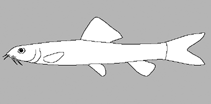 No image available for this species;
drawing shows typical species in Cobitidae.
Google image
drawing shows typical species in Cobitidae.
वर्गीकरण / नाम आम नाम | उपशब्द | Catalog of Fishes(वर्ग, प्रजाति) | ITIS | CoL | WoRMS | Cloffa
> Cypriniformes (Carps) > Cobitidae (Spined loaches)
Etymology: Cobitis: Greek, kobitis, -idos = a kind of sardine; also related with the voice Greek, kobios, Latin gobius = gudgeon (Ref. 45335); sakahoko: The specific epithet is derived from the legendary weapon Ama-no-sakahoko, meaning inverted halberd of heaven, which was thrust into the Takachiho Peak of Mt. Kirishima, one of the sources of the Takazaki River, the type locality of this new species. The lamina circularis of this species is a distinctive rectangular plate that resembles a halberd.
Etymology: Cobitis: Greek, kobitis, -idos = a kind of sardine; also related with the voice Greek, kobios, Latin gobius = gudgeon (Ref. 45335); sakahoko: The specific epithet is derived from the legendary weapon Ama-no-sakahoko, meaning inverted halberd of heaven, which was thrust into the Takachiho Peak of Mt. Kirishima, one of the sources of the Takazaki River, the type locality of this new species. The lamina circularis of this species is a distinctive rectangular plate that resembles a halberd.
पर्यावरण: पर्यावरण / जलवायु क्षेत्र / गहराई सीमा / वितरण सीमा पारिस्थितिकी
; स्वच्छ जल, अलवण जल बेनथोपिलाजिक. Subtropical
वितरण प्रदेशों | ऐफ ऐ ओ क्षेत्र | पारिस्थितिकी प्रणालियों | संयोग | बिन्दु नक्शा | भूमिका | Faunafri
Asia: Oyodo River system, Kyushu Island, Japan.
आकार / वज़न / आयु
परिपक्व अवधि: Lm ? range ? - ? cm
Max length : 7.3 cm SL पुल्लिंग / अलिंग; (Ref. 117925); 8.9 cm SL (female)
Max length : 7.3 cm SL पुल्लिंग / अलिंग; (Ref. 117925); 8.9 cm SL (female)
संक्षिप्त वर्णन पहचान कुंजी | आकृति विज्ञान | मौरफोमैटरिक्स
पृष्ठीय सौफट रेज़ (सम्पूर्ण) : 10; ऐनल सौफट रेज़: 8 - 9; जानवरों की रीड़ का जोड़: 41 - 42. Cobitis sakahoko can be diagnosed from its congeners from Japan by the combination of the following characters: lamina circularis at the base of the pectoral fin in adult males, rectangular plate with a neck in the mid-lower part (vs. beak shape or narrow in C. biwae; roundish in C. magnostriata, C. striata, C. minamorii, C. kaibarai and C. matsubarae; ambiguous inC. takatsuensis and C. shikokuensis); broad upper segments of the first branched soft ray (vs. narrow in C. striata, C. minamorii, and C. kaibarai); maxillary barbel length longer than the eye diameter (vs. same as the eye diameter in C. magnostriata, C. striata, C. minamorii and C. kaibarai); 14 segmented muscle plates between the base of the pectoral fin and the origin of the pelvic fin (vs. usually 13 in C. striata and C. kaibarai; usually 12 in C. minamorii); snout rather short, about 35% in HL (vs. rather long, ca. 40% in C. biwae, C. minamorii and C. matsubarae; long, over ca. 40% in C. magnostriata, C. striata, C, kaibarai, C. takatsuensis and C. shikokuensis); body pigmentation consisting of 1 mid-dorsal and 4 lateral rows of blotches with line L4 broad fine mesh-like line in adult females (vs. jagged or dotted line in C. biwae and C. matsubarae; jagged line in C. kaibarai; absent or irregular dotted line in C. magnostriata, C. takatsuensis and C. shikokuensis) and line L5 arranged into 8-13 oblong or ovoid blotches in both males and females (vs. striated in C. magnostriata; marbled streak in C. takatsuensis); upper spot at caudal-fin base jet black and size greater than the eye diameter (vs. comparable to the eye diameter in C. striata, C. kaibarai and C. takatsuensis; smaller than the eye diameter in C. minamorii and C. shikokuensis); lower spot at caudal-fin base black and size comparable or smaller than the upper spot (vs. ambiguous in C. striata, C. kaibarai, C. takatsuensis and C. shikokuensis). Cobitis sakahoko can be distinguishable based on the mtDNA cytb sequences (Ref. 117925).
Body shape (shape guide): elongated.
Body shape (shape guide): elongated.
Occurs in the middle reaches of rivers with sandy bottom (Ref. 117925).
जीवन चक्र और संभोग व्यवहार परिपक्व अवधि | पुनरुत्पत्ति | मछलीऔ का अंडे देना | अंडे | उपजाऊपन | लार्वा
मुख्य संदर्भ
अपने संदर्भ अपलोड करें | संदर्भ | संयोजक | सहयोगीयो
Nakajima, J. and Y. Suzawa, 2016. Cobitis sakahoko, a new species of spined loach (Cypriniformes: Cobitidae) from southern Kyushu Island, Japan. Ichthyol. Res. 63:68-78. (Ref. 117925)
आईयूसीएन रेड लिस्ट स्थिति (Ref. 130435: Version 2025-2 (Global))
Endangered (EN) (B1ab(iii,v)+2ab(iii,v)); Date assessed: 08 December 2017
CITES
Not Evaluated
मनुष्यों के लिए ख़तरा
Harmless
मानव उपयोग
FAO - Publication: search | FishSource |
अधिक जानकारी
ट्रॉफिक पारिस्थितिकी
खाद्य पदार्थ (शिकार)
संघटक आहार
आहार खपत
खाद्यान्न राशन
परभक्षी
खाद्य पदार्थ (शिकार)
संघटक आहार
आहार खपत
खाद्यान्न राशन
परभक्षी
जनसंख्या गतिशीलता
विकास मापदंड
अधिकतम आयु/आकार
लंबाई-वजन संबंध
लंबाई-लंबाई संबंध
लंबाई-आवृत्तियाँ
सामूहिक रूपांतरण
भर्ती
बहुतायत
विकास मापदंड
अधिकतम आयु/आकार
लंबाई-वजन संबंध
लंबाई-लंबाई संबंध
लंबाई-आवृत्तियाँ
सामूहिक रूपांतरण
भर्ती
बहुतायत
जीवन चक्र
पुनरुत्पत्ति
परिपक्व अवधि
परिपक्वता/गिल्स संबंध
उपजाऊपन
मछलीऔ का अंडे देना
स्पॉनिंग एकत्रीकरण
अंडे
अंडे का विकास
लार्वा
लारवल गतिकी
पुनरुत्पत्ति
परिपक्व अवधि
परिपक्वता/गिल्स संबंध
उपजाऊपन
मछलीऔ का अंडे देना
स्पॉनिंग एकत्रीकरण
अंडे
अंडे का विकास
लार्वा
लारवल गतिकी
शरीर रचना
गिल क्षेत्र
दिमाग
ओटोलिथ
गिल क्षेत्र
दिमाग
ओटोलिथ
फिजियोलॉजी
शारीरिक संरचना
पोषक तत्व
प्राणवायु की खपत
तैराकी का प्रकार
तैराकी की गति
दृश्य वर्णक
मछली की आवाज
रोग एवं परजीवी
विषाक्तता (LC50s)
शारीरिक संरचना
पोषक तत्व
प्राणवायु की खपत
तैराकी का प्रकार
तैराकी की गति
दृश्य वर्णक
मछली की आवाज
रोग एवं परजीवी
विषाक्तता (LC50s)
आनुवंशिकी
जीनोम
आनुवंशिकी
विषमयुग्मजी
हैरेटिबिलटी
आनुवंशिक विविधता
जीनोम
आनुवंशिकी
विषमयुग्मजी
हैरेटिबिलटी
आनुवंशिक विविधता
मानव संबंधी
जलकृषि प्रणालियाँ
जलीयकृषि रूपरेखाऐ
खींच
सिगुएटेरा के मामले
टिकट, सिक्के, विविध.
जलकृषि प्रणालियाँ
जलीयकृषि रूपरेखाऐ
खींच
सिगुएटेरा के मामले
टिकट, सिक्के, विविध.
साधन
ई-पुस्तक | कार्यक्षेत्र पथप्रदर्शक | लंबाई आवृति इंद्रजालिक | जीवन-इतिहास उपकरण | बिन्दु नक्शा |
कैच-एमएसवाई |
विशेष रिपोर्ट
एक्वेरियम के रखरखाव की जांच करें | प्रजातियों के तथ्य पत्रक की जाँच करें | जलीय कृषि तथ्य पत्रक की जाँच करें
XML डाउनलोड करें
सारांश पृष्ठ | बिंदु डेटा | आम नाम | तस्वीरें
इंटरनेट स्रोत
AFORO (otoliths) | Aquatic Commons | BHL | Cloffa | Websites from users | Check FishWatcher | CISTI | Catalog of Fishes: वर्ग, प्रजाति | DiscoverLife | ECOTOX | FAO - Publication: search | Faunafri | Fishipedia | Fishtrace | GloBI | Google Books | Google Scholar | Google | IGFA World Record | OneZoom | Open Tree of Life | Otolith Atlas of Taiwan Fishes | PubMed | Reef Life Survey | Socotra Atlas | TreeBase | Tree of Life | Wikipedia: Go, खोज | World Records Freshwater Fishing | Zoobank | प्राणीशास्त्रीय अभिलेख
मॉडल पर आधारित अनुमान
जातिवृति विविधता सूचकांक (संदर्भ 82804): PD50 = 0.5000 [Uniqueness, from 0.5 = low to 2.0 = high].
Bayesian length-weight: a=0.00513 (0.00231 - 0.01140), b=3.09 (2.92 - 3.26), in cm total length, based on LWR estimates for this Genus-body shape (Ref. 93245).
ट्रॉफिक स्तर (संदर्भ 69278): 3.2 ±0.4 se; based on size and trophs of closest relatives
लौटाव (संदर्भ 120179): ऊंचा, न्यूनतम जनसंख्या दुगनी समय अवलागत 15 महीने। (Preliminary K or Fecundity.).