



Curculionichthys tukana Roxo, Dias, Silva & Oliveira, 2017
分類 / 名前 共通名の | 類義語 | Catalog of Fishes(部類, 種) | ITIS | CoL | WoRMS | Cloffa
> Siluriformes (Catfishes) > Loricariidae (Armored catfishes) > Hypoptopomatinae
Etymology: Curculionichthys: Derived from the from the Latin 'curculionem' (elongated snout) and from the Greek 'ichthys' (fishes), in reference to the relatively elongated snouts of the fish species included in this genus; tukana: The specific name, tukana, is derived from the Tupi-Guarani language, and it is related to the name of the rio Tocantins, where this new species occurs. Tocantins came from Tupi-Guarani language and means 'Tucano beak' with the junction of the two words tukana (Tucano) and tim (beak). A noun in apposition.
Etymology: Curculionichthys: Derived from the from the Latin 'curculionem' (elongated snout) and from the Greek 'ichthys' (fishes), in reference to the relatively elongated snouts of the fish species included in this genus; tukana: The specific name, tukana, is derived from the Tupi-Guarani language, and it is related to the name of the rio Tocantins, where this new species occurs. Tocantins came from Tupi-Guarani language and means 'Tucano beak' with the junction of the two words tukana (Tucano) and tim (beak). A noun in apposition.
環境:環境 / 気候帯 / 深さの範囲 / 分布範囲 生態学
; 新鮮な水 底生の. Tropical
分布 領土 | 国連食糧農業機関の区域 | エコシステム | 事件 | 目的のマップ | 導入 | Faunafri
South America: Rio Tocantins basin, Brazil.
サイズ / 重さ / 年齢
簡単な記述 検索表 | 形態学 | 形態計測学
背鰭 (合計) : 9; 臀鰭: 6. Curculionichthys tukana is distinguished from its all congeners, with the exception of C. karipuna and C. oliveirai, by having one abdominal median plate series (vs. three or more abdominal medial plates series); from C. karipuna by the lack of an irregular concentration of chromatophores that entirely cover the anal-fin origin and adjacent region, and distal portion of the first unbranched anal-fin ray (vs. such pigmentation pattern present); from C. oliveirai, and also from C. insperatus, C. paresi and C. sagarana, by having seven to eight plates in abdominal lateral plates series (vs. four to six plates in abdominal lateral plates series); from C. itaim, C. luteofrenatus and C. piracanjuba by having papillae aligned in series that extends from the distal portion of lower lip to dentary (vs. all papillae randomly distributed throughout lower lip). Furthermore, Curculionichthys tukana can be separated from C. insperatus and C. oliveirai by lacking large conspicuous odontodes forming rows on head and trunk (vs. large, conspicuous odontodes forming rows on the head present); from C. oliveirai and C. coxipone by having the anterior profile of the head pointed (vs. anterior profile of head rounded); from C. paresi by having 12-18 premaxillary teeth (vs. 6-10) and 10-16 dentary teeth (vs. 4-7); from C. sabaji by the absence of dark-brown spots scattered over the body (vs. the presence of dark-brown spots); from C. paresi by absence of contrasting dark spots at the anterodorsal region of body (vs. the presence of such pigmentation pattern). In addition, Curculionichthys tukana can be differentiated from C. piracanjuba by having odontodes forming aligned rows, more evident in the dorsal portion of head and in the lateral portion of caudal peduncle (vs. odontodes not forming rows on the supraoccipital, on the compound pterotic, and on the lateral plates series) (Ref. 118146).
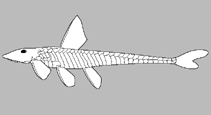
Body shape (shape guide): elongated.
Body shape (shape guide): elongated.
ライフサイクルと交尾行動 成熟 | 繁殖 | 放精 | 卵 | 生産力 | 幼生
主な参考文献
参考文献のアップロード | 参考文献 | コーディネーター : Fisch-Muller, Sonia | 協力者
Roxo, F.F., A.C. Dias, G.S.C. Silva and C. Oliveira, 2017. Two new species of Curculionichthys (Siluriformes: Loricariidae) from the rio Amazonas basin, Brazil. Zootaxa 4341(2):258-270. (Ref. 118146)
CITES
Not Evaluated
人間に対する脅威
Harmless
人間の用途
水産業: 興味がない
FAO - Publication: search | FishSource |
より多くの情報
ライフサイクル
繁殖
成熟
成熟度/エラ
生産力
放精
産卵群
卵
卵の開発
幼生
幼生の動力
繁殖
成熟
成熟度/エラ
生産力
放精
産卵群
卵
卵の開発
幼生
幼生の動力
解剖学
カマ
脳
オトリス
カマ
脳
オトリス
生理学
体組成
栄養素
酸素消費
水泳タイプ
泳ぐ速さ
視覚色素
フィッシュ・サウンド
病気と寄生虫
毒性(LC50)
体組成
栄養素
酸素消費
水泳タイプ
泳ぐ速さ
視覚色素
フィッシュ・サウンド
病気と寄生虫
毒性(LC50)
遺伝子の
ゲノム
遺伝子の
ヘテロ接合性
遺伝
遺伝的多様性
ゲノム
遺伝子の
ヘテロ接合性
遺伝
遺伝的多様性
用具
特記事項
XMLをダウンロードして下さい
インターネットの情報源
AFORO (otoliths) | Aquatic Commons | BHL | Cloffa | Websites from users | Check FishWatcher | CISTI | Catalog of Fishes: 部類, 種 | DiscoverLife | ECOTOX | FAO - Publication: search | Faunafri | Fishipedia | Fishtrace | GloBI | Google Books | Google Scholar | Google | IGFA World Record | OneZoom | Open Tree of Life | Otolith Atlas of Taiwan Fishes | PubMed | Reef Life Survey | Socotra Atlas | TreeBase | 生命の木 | Wikipedia: 行く, 検索する | World Records Freshwater Fishing | Zoobank | 動物に関する記録
モデルに基づく推定値
系統多様性指数 (参照 82804): PD50 = 0.5001 [Uniqueness, from 0.5 = low to 2.0 = high].
Bayesian length-weight: a=0.00977 (0.00434 - 0.02202), b=3.06 (2.87 - 3.25), in cm total length, based on LWR estimates for this (Sub)family-body shape (Ref. 93245).
栄養段階 (参照 69278): 2.7 ±0.1 se; based on size and trophs of closest relatives
回復力 (参照 120179): 高い, 15か月以下の倍増期間の最小個体群 (Preliminary K or Fecundity.).