This website uses cookies to enhance your browsing experience and ensure the functionality of our site. For more detailed information about the types of cookies we use and how we protect your privacy, please visit our Privacy Information page.
×
Cookie Settings
This website uses different types of cookies to enhance your experience. Please select your preferences below:
> Gobiiformes (Gobies) > Gobiidae (Gobies) > Gobiinae
Etymology: Acentrogobius:Greek, a = without + Greek, kentron = sting + Latin gobius = gudgeon (Ref. 45335); vanderloosi:Named for Robert Vanderloos, owner and operator of the live-aboard dive vessel 'Chertan', and based at Alotau, Papua New Guinea. Eponymy: Robert ‘Rob’ Van der Loos is the owner and operator of the live-aboard dive vessel ‘Chertan’, based at Alotau, Papua New Guinea. [...] (Ref. 128868), visit book page.
Milieu: milieu / Klimaatzone / Diepte / verspreidingsgebied Ecologie
marien demersaal; diepte 15 - 18 m (Ref. 100513). Tropical
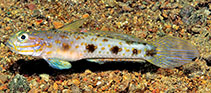
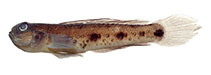
This species is distinguished by the following characters: D VI + I,10, dorsal spines thin and flexible, first two with long filamentous tips, that of second spine longest 2.3-3.2 in SL, reaching to base of about sixth soft ray of second dorsal fin when laid back; A I,10; pectoral-fin rays 20; lanceolate caudal fin which is slightly longer than head length in adult; scales 30 in longitudinal series; 9-10 transverse-scales; 12-13 predorsal-scales; finely ctenoid scales cover the body, becoming cycloid on the breast, pectoral-fin base, nape, and head; 3 scale rows on uppermost portion of opercle; cheek fully scaled; colour in life pale grey with numerous widely scattered dark-edged, orange spots on body, 5 horizontally-elongate dark brown blotches on side of body at level of pectoral-fin base, (including one at middle of caudal-fin base), a pair of orange stripes on cheek (Ref. 100513). Body shape (shape guide): elongated; Cross section: compressed.
The collection area consists of moderately sloped (about 20 degrees) mud substratum (the slope begins in approximately 1.5 m depth and flattens out at about 18 m). The featureless bottom has numerous burrows occupied by a variety of fishes and invertebrates, including Acentrogobius vanderloosi. About eight individuals were observed on the lower section of the slope (15-18 m ) and only widely scattered, solitary individuals were seen, each of which was invariably associated with a muddy burrow, into which it retreated when approached (Ref. 100513).
Allen, G.R., 2015. Descriptions of two new gobies (Gobiidae: Acentrogobius) from Milne Bay Province, Papua New Guinea. J. Ocean Sci. Found. 14:1-13. (Ref. 100513)
Status op de Rode Lijst van het IUCN (Ref. 130435: Version 2025-2 (Global))
Fylogenetische diversiteitsindex (Ref. 82804): PD50 = 0.5000 [Uniqueness, from 0.5 = low to 2.0 = high].
Bayesian length-weight: a=0.00794 (0.00340 - 0.01856), b=3.09 (2.91 - 3.27), in cm total length, based on LWR estimates for this Genus-body shape (Ref. 93245).
Trofisch niveau (Ref. 69278): 3.2 ±0.4 se; based on size and trophs of closest relatives
Weerstandsvermogen (Ref. 120179): Hoog, minimale populatieverdubbelingstijd minder dan 15 maanden (Preliminary K or Fecundity.).
Kwetsbaarheid van de visserij (Ref. 59153): Low vulnerability (10 of 100). 🛈