



Lepidocephalichthys eleios Kottelat, 2017
Hochladen Photos und videos
Google Bild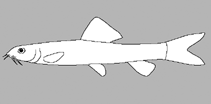 No image available for this species;
drawing shows typical species in Cobitidae.
Google Bild
drawing shows typical species in Cobitidae.
Klassifizierung / Names Namen | Synonyme | Catalog of Fishes(Gattung, Arten) | ITIS | CoL | WoRMS | Cloffa
> Cypriniformes (Carps) > Cobitidae (Spined loaches)
Etymology: Lepidocephalichthys: Greek, lepas = limpet + Greek, ichtys = fish (Ref. 45335); eleios: From the classical Greek έλειος heleios, el eleios, which h means 'of the marsh', 'dwelling in the marsh'. A noun in apposition.
Etymology: Lepidocephalichthys: Greek, lepas = limpet + Greek, ichtys = fish (Ref. 45335); eleios: From the classical Greek έλειος heleios, el eleios, which h means 'of the marsh', 'dwelling in the marsh'. A noun in apposition.
Umwelt: Milieu / Klimazone / Tiefenbereich / Verbreitungsgebiet Ökologie
; süßwasser demersal. Tropical
Verbreitung Territorien | FAO Gebiete | Ökosysteme | Vorkommen | Punkt Karte | Einführungen | Faunafri
Asia: Lake Indawgyi basin, Kachin State, Myanmar.
Größe / Gewicht / Alter
Kurzbeschreibung Bestimmungsschlüssel | Morphologie | Morphometrie
Rückenflossenweichstrahlen (insgesamt) : 10; Afterflossenweichstrahlen: 8. Lepidocephalichthys eleios differs from all its congeners by lacking any modifications of the pectoral-fin rays in males. Pectoral fin has 7-8 rays which are adjacent with narrow or without membrane between them and in males, these are separate, not fused and have no dorsal or ventral projections. This species is also distinguished from congeners by the following characters, but not unique to it: body with irregular midlateral row of irregularly set small spots, sometimes forming a stripe; body with middorsal row of 9-12 saddles, reaching downwards to about ¼ of body depth, sometimes regular, sometimes irregularly shaped and of unequal density, wider than interspaces; arched black band at base of principal caudal-fin rays (no ocellus or black spot at caudal-fin base); caudal fin with pigments on rays and membranes forming 2-3 very irregular bars, posterior one along distal margin, bars irregularly in contact or fused, leaving variously shaped unpigmented patches; postlabial flange very long and narrow; head scaleless; caudal fin truncate to slightly emarginate (Ref. 117200).
Body shape (shape guide): elongated.
Body shape (shape guide): elongated.
Facultative air-breathing in the genus (Ref. 126274); Three sampling sites of this species are characterized by deep water, very slow current, dense shore vegetation, large extents of floating mats of plants, and bottom composed of mud or clay covered with a layer of vegetal debris. Collected from leaf litter, from among the dense vegetation or by scraping the underside of the 'floating' vegetation using a tray net . The following fish species were collected in the same micro-habitat: Oreichthys sp., Pethia erythromycter, Heteropneustes fossilis, Chaudhuria sp., Mastacembelus pantherinus, Monopterus cuchia, Indostomus paradoxus, Badis corycaeus, Dario hysginon (Ref. 117200).
Lebenszyklus und Paarungsverhalten Geschlechtsreife | Fortpflanzung | Ablaichen | Eier | Fruchtbarkeit | Larven
Hauptreferenz
Laden Sie Ihre Referenzen hoch | Referenzen | Koordinator | Partner
Kottelat, M., 2017. Lepidocephalichthys eleios, a new loach from Lake Indawgyi basin, Kachin State, Myanmar (Teleostei: Cobitidae). Raffles Bulletin of Zoology 65:707-714. (Ref. 117200)
CITES
Not Evaluated
Bedrohung für Menschen
Harmless
Nutzung durch Menschen
FAO - Publication: search | FishSource |
Mehr Information
Trophische Ökologie
Lebensmittel (Beutetiere)
Nahrungszusammensetzung
Nahrungsaufnahme
Lebensmittelrationen
Räuber
Lebensmittel (Beutetiere)
Nahrungszusammensetzung
Nahrungsaufnahme
Lebensmittelrationen
Räuber
Ökologie
Ökologie
Ökologie
Populationsdynamik
Wachstumsparameter
Max. Alter/Größen
Länge-Gewicht-Rel.
Länge-Länge-Verhältnis.
Längenhäufigkeiten
Massenkonvertierung
Rekrutierung
Dichte
Wachstumsparameter
Max. Alter/Größen
Länge-Gewicht-Rel.
Länge-Länge-Verhältnis.
Längenhäufigkeiten
Massenkonvertierung
Rekrutierung
Dichte
Lebenszyklus
Fortpflanzung
Geschlechtsreife
Reifung/Kiemen rel.
Fruchtbarkeit
Ablaichen
Laichaggregationen
Eier
Eientwicklung
Larven
Larven Pop.Dyn.
Fortpflanzung
Geschlechtsreife
Reifung/Kiemen rel.
Fruchtbarkeit
Ablaichen
Laichaggregationen
Eier
Eientwicklung
Larven
Larven Pop.Dyn.
Anatomie
Kiemenoberfläche
Gehirn
Otolith
Kiemenoberfläche
Gehirn
Otolith
Physiologie
Körperliche Zusammensetzung
Nährstoffe
Sauerstoffverbrauch
Schwimmart
Schwimmgeschwindigkeit
Visuelle Pigmente
Fischgeräusche
Krankheiten und Parasiten
Toxizität (LC50s)
Körperliche Zusammensetzung
Nährstoffe
Sauerstoffverbrauch
Schwimmart
Schwimmgeschwindigkeit
Visuelle Pigmente
Fischgeräusche
Krankheiten und Parasiten
Toxizität (LC50s)
Genetik
Genom
Genetik
Heterozygotie
Vererbbarkeit
Genetische Vielfalt
Genom
Genetik
Heterozygotie
Vererbbarkeit
Genetische Vielfalt
Menschenbezogen
Aquakultur-Systeme
Aquakultur Profile
Zuchtlinien
Ciguatera-Fälle
Briefmarken, Münzen, Verschiedenes.
Aquakultur-Systeme
Aquakultur Profile
Zuchtlinien
Ciguatera-Fälle
Briefmarken, Münzen, Verschiedenes.
Tools
Zusatzinformationen
Download XML
Zusammenfassung | Punktdaten | Namen | Photos
Internet Quellen
AFORO (otoliths) | Aquatic Commons | BHL | Cloffa | Websites from users | FishWatcher Einträge suchen | CISTI | Catalog of Fishes: Gattung, Arten | DiscoverLife | ECOTOX | FAO - Publication: search | Faunafri | Fishipedia | Fishtrace | GloBI | Google Books | Google Scholar | Google | IGFA World Record | OneZoom | Open Tree of Life | Otolith Atlas of Taiwan Fishes | PubMed | Reef Life Survey | Socotra Atlas | TreeBase | Tree of Life | Wikipedia: Gehe zu, Suchen | World Records Freshwater Fishing | Zoobank | Zoologischer Rekord
Schätzungen auf der Grundlage von Modellen
Phylogenetischer Diversitätsindex (Ref. 82804): PD50 = 0.5000 [Uniqueness, from 0.5 = low to 2.0 = high].
Bayesian length-weight: a=0.00617 (0.00276 - 0.01377), b=3.08 (2.91 - 3.25), in cm total length, based on LWR estimates for this Genus-body shape (Ref. 93245).
Trophische Ebene (Ref. 69278): 3.0 ±0.3 se; based on size and trophs of closest relatives
Widerstandsfähigkeit (Ref. 120179): hoch, Verdopplung der Population dauert weniger als 15 Monate. (Preliminary K or Fecundity.).