



Kelloggella avaiki Tornabene, Deis & Erdmann, 2017
Star-spangled goby
Carregue seu(sua) Fotos e vídeos
Fotos | Imagem do Google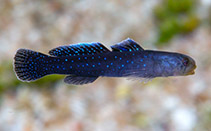 Kelloggella avaiki
Foto de Erdmann, M.V.
Fotos | Imagem do Google
Foto de Erdmann, M.V.
Classificação / Nomes Nomes comuns | Sinônimos | Catalog of Fishes(Gênero, Espécies) | ITIS | CoL | WoRMS | Cloffa
> Gobiiformes (Gobies) > Gobiidae (Gobies) > Gobiinae
Etymology: avaiki: Named ‘Avaiki’ which refers to an area of tidepools and coastal caverns near the type locality of this species that are revered as the sacred bathing pools of kings; noun in apposition.
Eponymy: Vernon Lyman Kellogg (1867–1937) was an entomologist, evolutionary biologist and science administrator at Stanford University. [...] Avaiki is not an eponym but a toponym – a Polynesian word referring to the sacred homeland of ancestors, and specifically on the island of Nuie (where this goby is endemic) referring to an area of tide pools and coastal caverns near the type [...] (Ref. 128868), visit book page.
Etymology: avaiki: Named ‘Avaiki’ which refers to an area of tidepools and coastal caverns near the type locality of this species that are revered as the sacred bathing pools of kings; noun in apposition.
Eponymy: Vernon Lyman Kellogg (1867–1937) was an entomologist, evolutionary biologist and science administrator at Stanford University. [...] Avaiki is not an eponym but a toponym – a Polynesian word referring to the sacred homeland of ancestors, and specifically on the island of Nuie (where this goby is endemic) referring to an area of tide pools and coastal caverns near the type [...] (Ref. 128868), visit book page.
Meio ambiente: milieu / Zona climática / intervalo de profundidade / faixa de distribuição Ecologia
marinhas pelagic-neritic; intervalo de profundidade 0 - 20 m (Ref. 116852). Tropical
Distribuição Territórios | Áreas da FAO | Ecossistemas | Ocorrências | Mapa de pontos | Introduções | Faunafri
Eastern Central Pacific: Niue.
Tamanho / Peso / Idade
Maturidade: Lm ? range ? - ? cm
Max length : 2.1 cm SL macho/indeterminado; (Ref. 116852); 2.0 cm SL (female)
Max length : 2.1 cm SL macho/indeterminado; (Ref. 116852); 2.0 cm SL (female)
Descrição suscinta Chaves de identificação | Morfologia | Morfometria
Espinhos dorsais (total) : 7; Raios dorsais (total) : 11 - 13; Espinhos anais: 1; Raios anais : 8 - 9. This species is distinguished by the following characters: body lacking vertical bars; in life, body and fins possess small bright iridescent blue spots and speckles on a dark greyish-blue to black background; jaws and tip of snout light yellow; D2 I,11-13; A I, 8; pectoral-fin rays 14 (Ref. 116852).
Body shape (shape guide): elongated; Cross section: compressed.
Body shape (shape guide): elongated; Cross section: compressed.
Specimens were collected from the lower intertidal zone on a narrow reef flat exposed to strong wave energy and were found living in small water-filled crevices in the reef pavement. Observed to be fairly abundant on the reef flat where it was collected, with an estimated
five to 10 individuals per m2 in the lower intertidal zone (
Ref. 116852).
Ciclo de vida ou comportamento de acasalamento Maturidade | Reprodução | Desova | Ovos | Fecundidade | Larvas
Referência principal
Carregar suas referências | Referências | Coordenador | Colaboradores
Tornabene, L., B. Deis and M.V. Erdmann, 2017. Evaluating the phylogenetic position of the goby genus Kelloggella (Teleostei: Gobiidae), with notes on osteology of the genus and description of a new species from Niue in the South Central Pacific Ocean. Zoological Journal of the Linnean Society, 1-20. (Ref. 116852)
Status na Lista Vermelha da UICN (Ref. 130435: Version 2025-2 (Global))
Dados insuficientes (DD) ; Date assessed: 19 March 2024
CITES
Not Evaluated
Ameaça para os humanos
Harmless
Uso pelos humanos
FAO - Publication: search | FishSource |
Mais informação
Ecologia Trófica
Itens alimentares (presas)
Composição da dieta
Consumo alimentar
Rações alimentares
Predadores
Itens alimentares (presas)
Composição da dieta
Consumo alimentar
Rações alimentares
Predadores
Ecologia
Ecologia
Ecologia
Dinâmica populacional
Parâmetros de crescimento
Idade máxima / tamanhos
Relação comprimento-peso.
Relação comprimento-comprimento.
Frequências de comprimento
Conversão de massa
Recrutamento
Abundância
Parâmetros de crescimento
Idade máxima / tamanhos
Relação comprimento-peso.
Relação comprimento-comprimento.
Frequências de comprimento
Conversão de massa
Recrutamento
Abundância
Ciclo de vida
Reprodução
Maturidade
Maturidade/Rel. das guelras
Fecundidade
Desova
Agregações de desova
Ovos
Desenvolvimento dos ovos
Larvas
Dinâmica larval
Reprodução
Maturidade
Maturidade/Rel. das guelras
Fecundidade
Desova
Agregações de desova
Ovos
Desenvolvimento dos ovos
Larvas
Dinâmica larval
Anatomia
Área branquial
Cérebro
Otólito
Área branquial
Cérebro
Otólito
Fisiologia
Composição corporal
Nutrientes
Consumo de oxigênio
Tipo de natação
Velocidade de natação
Pigmentos visuais
Som de peixe
Doenças e Parasitas
Toxicidade (LC50s)
Composição corporal
Nutrientes
Consumo de oxigênio
Tipo de natação
Velocidade de natação
Pigmentos visuais
Som de peixe
Doenças e Parasitas
Toxicidade (LC50s)
Genética
genoma
Genética
Heterozigosidade
Hereditariedade
Diversidade genética
genoma
Genética
Heterozigosidade
Hereditariedade
Diversidade genética
Relacionado a humanos
Sistemas de aquicultura
Perfis para aquacultura
Estirpes
Casos de Ciguatera
Selos, moedas, diversos.
Sistemas de aquicultura
Perfis para aquacultura
Estirpes
Casos de Ciguatera
Selos, moedas, diversos.
Ferramentas
Livro eletrônico | Guia de campo | Ferramenta auxiliar de frequências de comprimento | Ferramenta sobre a história de vida | Mapa de pontos |
Catch-MSY |
Relatórios especiais
Checar Manutenção em Aquário | Checar Planilhas de Fatos sobre as Espécies | Checar Planilhas de Fatos sobre Aquicultura
Baixar XML
Fontes da internet
AFORO (otoliths) | Aquatic Commons | BHL | Cloffa | Websites from users | Checar Observador de Peixes (FishWatcher) | CISTI | Catalog of Fishes: Gênero, Espécies | DiscoverLife | ECOTOX | FAO - Publication: search | Faunafri | Fishipedia | Fishtrace | GloBI | Google Books | Google Scholar | Google | IGFA World Record | OneZoom | Open Tree of Life | Otolith Atlas of Taiwan Fishes | PubMed | Reef Life Survey | Socotra Atlas | TreeBase | Árvore da vida | Wikipedia: Ir para, procura | World Records Freshwater Fishing | Zoobank | Registro zoológico
Estimativas baseadas em modelos
Índice de diversidade filogenética (Ref. 82804): PD50 = 0.5156 [Uniqueness, from 0.5 = low to 2.0 = high].
Bayesian length-weight: a=0.00741 (0.00347 - 0.01582), b=3.09 (2.91 - 3.27), in cm total length, based on LWR estimates for this (Sub)family-body shape (Ref. 93245).
Nível Trófico (Ref. 69278): 3.1 ±0.3 se; based on size and trophs of closest relatives
Resiliência (Ref. 120179): Elevada, tempo mínimo de duplicação da população menor que 15 meses (Preliminary K or Fecundity.).