



Paramormyrops ntotom Rich, Sullivan & Hopkins, 2017
อัพโหลดของคุณ ภาพถ่าย และ วิดีโอ
Google image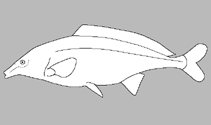 No image available for this species;
drawing shows typical species in Mormyridae.
Google image
drawing shows typical species in Mormyridae.
การจำแนกประเภท / ชื่อ ชื่อสามัญ | ชื่อพ้อง | Catalog of Fishes(สกุล, ชนิด) | ITIS | CoL | WoRMS | Cloffa
> Osteoglossiformes (Bony tongues) > Mormyridae (Elephantfishes)
Etymology: Paramormyrops: Greek, para = near + Greek, mormyros = a fish (Sparus sp) (Ref. 45335); ntotom: The species name, ntotom, is the word for mormyrid fish in the language of the Fang people from northern Gabon, Equatorial Guinea and southern Cameroon (Ref. 116799).
Etymology: Paramormyrops: Greek, para = near + Greek, mormyros = a fish (Sparus sp) (Ref. 45335); ntotom: The species name, ntotom, is the word for mormyrid fish in the language of the Fang people from northern Gabon, Equatorial Guinea and southern Cameroon (Ref. 116799).
สิ่งแวดล้อม : สิ่งแวดล้อม / เขตภูมิอากาศ / ระดับความลึก / ระยะการกระจายสินค้า นิเวศวิทยา
; น้ำจืด กลุ่มสัตว์หน้าดิน,กลุ่มสัตว์พื้นท้องน้ำ. Tropical
การแพร่กระจาย อาณาเขต | พื้นที่จำแนกตาม FAO | ระบบนิเวศหลายระบบ | การปรากฏขึ้น,การเกิดขึ้น,พบ | ตำแหน่งบนแผนที่ | การแนะนำ | Faunafri
Africa: Ogowe River in Gabon (Ref. 116799).
ขนาด / น้ำหนัก / อายุ
คำอธิบายสั้นๆ เครื่องมือที่ใช้ในการแยกชนิดสัตว์,สิ่งมีชีวิตออกจากกัน | สัณฐานวิทยา | ความยาวต่างๆ
เงี่ยงครีบหลัง (รวม) : 0; ก้านครีบอ่อนที่หาง (รวม) : 19 - 21; เงี่ยงครีบก้น: 0; ก้านครีบอ่อนที่ก้น: 24 - 26; สัตว์มีกระดูกสันหลัง: 41 - 44. Diagnosis: Paramormyrops ntotom is distinguished from all other Lower-Guinea Paramormyrops by a combination of morphological and electrical characteristics: 5 teeth in upper-jaw, 6 in lower; 12 circumpeduncular scales; V-shaped snout profile viewed from above, snout angle 38-50°, corresponding to an interorbital width 0.8-1.05 times the snout length; body depth 14.9-18.1% of standard length, 81-91.6% of body depth at urogenital pore; eye diameter 12.4-14.7% of head length measured to end of opercular bone; snout length 23.8-28.3% of head length; ratio of head length to depth 1.25-1.40; head length 20.4-24.6% of standard length; EOD waveform with two phases, head positive then negative, duration 4.78 ± 1.10 ms with a corresponding peak power spectral frequency, 265 ± 67 Hz; electric organ composed of type NPp electrocytes (Ref. 116799). With its 5/6 teeth, 12 circumpeduncular scales and sharp snout, Paramormyrops ntotom differs from all other described Paramormyrops except P. curvifrons and P. spekodes (Ref. 116799). Five morphological characters distinguish P. ntotom from P. curvifrons: ratio of head length to standard length shorter in P. ntotom compared with P. curvifrons; slight concave depression in the forehead in advance of the orbit and a relatively compact snout compared to P. curvifrons which has a longer snout, downward sloping, often with a slightly protruding chin and upper lip; shorter prepectoral distance relative to predorsal distance; snout angle greater in P. ntotom than P. curvifrons; and the head depth relative to head length greater in P. ntotom than in P. curvifrons; EOD duration slightly longer in P. ntotom compared with P. curvifrons, with extensive overlap; both species have type NPp electrocytes in the electric organ and both exhibit sex differences in EOD duration (Ref. 116799). Paramormyrops ntotom differs from P. sphekodes in the six following morphological characters: larger overall size at sexual maturity; head more elongate and less rounded; snout reduced; larger caudal peduncle depth to length ratio; the smaller eye diameter relative to head length; and the greater EOD duration; when alive P. ntotom is most easily distinguished from P. sphekodes by its longer EOD duration and a correspondingly lower peak spectral frequency; the EODs of P. ntotom and P. sphekodes also differ in shape, with the width of first and second phase being equal for P. ntotom, while W1 is longer than W2 in P. sphekodes; living specimens of these two species also differ in colouration: dorsal and anal fin pigmentation tends to be darker in P. ntotom than P. sphekodes, and the ground colour of the skin tends to be darker chocolate brown compared to yellow brown in P. sphekodes (Ref. 116799).
Body shape (shape guide): elongated.
Body shape (shape guide): elongated.
วงจรชีวิตและพฤติกรรมการผสมพันธุ์ วัยเจริญพันธุ์ | การสืบพันธุ์ | การวางไข่ | เซลสืบพันธ์ของเพศเมีย(ไข่) | ความดกของไข่ | ตัวอ่อน
อ้างอิงหลัก
อัพโหลดข้อมูลอ้างอิงของคุณ | อ้างอิง | ผู้ประสานงาน | ผู้ร่วมมือ
Rich, M., J.P. Sullivan and C.D. Hopkins, 2017. Rediscovery and description of Paramormyrops sphekodes (Sauvage, 1879) and a new cryptic Paramormyrops (Mormyridae: Osteoglossiformes) from the Ogooué River of Gabon using morphometrics, DNA sequencing and electrophysiology. Zool. J. Linn. Soc. 180:613-646. (Ref. 116799)
CITES
Not Evaluated
ภัยคุกคามต่อมนุษย์
Harmless
การใช้ของมนุษย์
FAO - Publication: search | FishSource |
ข้อมูลเพิ่มเติม
นิเวศวิทยาเขตร้อน
รายการอาหาร (เหยื่อ)
องค์ประอบของอาหาร
การบริโภคอาหาร
การจัดสรรอาหาร
ผู้ล่า
รายการอาหาร (เหยื่อ)
องค์ประอบของอาหาร
การบริโภคอาหาร
การจัดสรรอาหาร
ผู้ล่า
นิเวศวิทยา
นิเวศวิทยา
นิเวศวิทยา
พลวัตของประชากร
พารามิเตอร์การเจริญเติบโต
อายุสูงสุด / ขนาด
ความยาว-น้ำหนักสัมพันธ์
ความยาว-ความยาวสัมพันธ์
ความยาว-ความถี่
การแปลงมวล
การทดแทนที่
อุดมสมบรูณ์
พารามิเตอร์การเจริญเติบโต
อายุสูงสุด / ขนาด
ความยาว-น้ำหนักสัมพันธ์
ความยาว-ความยาวสัมพันธ์
ความยาว-ความถี่
การแปลงมวล
การทดแทนที่
อุดมสมบรูณ์
วงจรชีวิต
การสืบพันธุ์
วัยเจริญพันธุ์
ความสมบูรณ์พันธุ์/เหงือกที่เกี่ยวข้อง
ความดกของไข่
การวางไข่
การรวมตัวของสปอน
เซลสืบพันธ์ของเพศเมีย(ไข่)
การพัฒนาไข่
ตัวอ่อน
พลวัตของสัตว์น้ำวัยอ่อน
การสืบพันธุ์
วัยเจริญพันธุ์
ความสมบูรณ์พันธุ์/เหงือกที่เกี่ยวข้อง
ความดกของไข่
การวางไข่
การรวมตัวของสปอน
เซลสืบพันธ์ของเพศเมีย(ไข่)
การพัฒนาไข่
ตัวอ่อน
พลวัตของสัตว์น้ำวัยอ่อน
การแพร่กระจาย
อาณาเขต
พื้นที่จำแนกตาม FAO
ระบบนิเวศหลายระบบ
การปรากฏขึ้น,การเกิดขึ้น,พบ
การแนะนำ
BRUVS - วิดีโอ
อาณาเขต
พื้นที่จำแนกตาม FAO
ระบบนิเวศหลายระบบ
การปรากฏขึ้น,การเกิดขึ้น,พบ
การแนะนำ
BRUVS - วิดีโอ
กายวิภาคศาสตร์
พื้นที่เหงือก
สมอง
หินโสต
พื้นที่เหงือก
สมอง
หินโสต
สรีรวิทยา
องค์ประกอบของร่างกาย
สารอาหาร
การใช้ออกซิเจน
ประเภทการว่ายน้ำ
ระดับความเร็วในการว่ายน้ำ
เม็ดสีที่มองเห็นได้
เสียงปลา
โรคและปรสิต
ความเป็นพิษ (LC50s)
องค์ประกอบของร่างกาย
สารอาหาร
การใช้ออกซิเจน
ประเภทการว่ายน้ำ
ระดับความเร็วในการว่ายน้ำ
เม็ดสีที่มองเห็นได้
เสียงปลา
โรคและปรสิต
ความเป็นพิษ (LC50s)
พันธุศาสตร์
จีโนม
พันธุศาสตร์
ความไม่สมดุลทางเชื้อชาติ
อัตราพันธุกรรม
ความหลากหลายทางพันธุกรรม
จีโนม
พันธุศาสตร์
ความไม่สมดุลทางเชื้อชาติ
อัตราพันธุกรรม
ความหลากหลายทางพันธุกรรม
เกี่ยวข้องกับมนุษย์
ระบบการเพาะเลี้ยงสัตว์น้ำ
ประวัติการเพาะเลี้ยงสัตว์น้ำ
สายพันธุ์
กรณีซิเกวเทอรา
แสตมป์ เหรียญ อื่นๆ
ระบบการเพาะเลี้ยงสัตว์น้ำ
ประวัติการเพาะเลี้ยงสัตว์น้ำ
สายพันธุ์
กรณีซิเกวเทอรา
แสตมป์ เหรียญ อื่นๆ
เครื่องมือ
หนังสืออิเล็กทรอนิกส์ | คู่มือภาคสนาม | ผู้มีความชำนาญในเรื่องความถี่ของความยาว | เครื่องมือในการศึกษาชีวประวัติ | ตำแหน่งบนแผนที่ |
จับ-MSY |
รายงานพิเศษ
ตรวจสอบการบำรุงรักษาตู้ปลา | ตรวจสอบเอกสารข้อเท็จจริงเกี่ยวกับสายพันธุ์ | ตรวจสอบเอกสารข้อเท็จจริงเกี่ยวกับการเพาะเลี้ยงสัตว์น้ำ
ดาวน์โหลด XML
หน้าสรุป | ข้อมูลสำคัญ | ชื่อสามัญ | ภาพถ่าย
แหล่งที่มาจากอินเตอร์เน็ต
AFORO (otoliths) | Aquatic Commons | BHL | Cloffa | Websites from users | Check FishWatcher | CISTI | Catalog of Fishes: สกุล, ชนิด | DiscoverLife | ECOTOX | FAO - Publication: search | Faunafri | Fishipedia | Fishtrace | GloBI | Google Books | Google Scholar | Google | IGFA World Record | OneZoom | Open Tree of Life | Otolith Atlas of Taiwan Fishes | PubMed | Reef Life Survey | Socotra Atlas | TreeBase | แผนภูมิชีวิตแบบต้นไม้ | Wikipedia: Go, ค้นหา | World Records Freshwater Fishing | Zoobank | บันทึกทางด้านสัตววิทยา
การประมาณค่าตามแบบจำลอง
ดัชนีความหลากหลายทางวิวัฒนาการ (อ้างอิง 82804): PD50 = 0.5010 [Uniqueness, from 0.5 = low to 2.0 = high].
Bayesian length-weight: a=0.00562 (0.00248 - 0.01273), b=3.05 (2.85 - 3.25), in cm total length, based on LWR estimates for this (Sub)family-body shape (Ref. 93245).
ระดับชั้นอาหาร (อ้างอิง 69278): 3.2 ±0.3 se; based on size and trophs of closest relatives
ความสามารถในการกลับคืนสู่ปกติ (อ้างอิง 120179): ความสูง, เวลาต่ำสุดที่จะทำให้ประชากรเพิ่มขึ้นเป็น 2 เท่าใช้เวลาน้อยกว่า 15 เดือน (Preliminary K or Fecundity.).