



Paramormyrops ntotom Rich, Sullivan & Hopkins, 2017
Sube tu fotos y Vídeos
Google image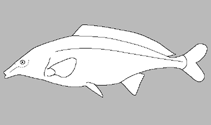 No image available for this species;
drawing shows typical species in Mormyridae.
Google image
drawing shows typical species in Mormyridae.
Clasificación / Nombres Nombres comunes | Sinónimos | Catalog of Fishes(Género, Especie) | ITIS | CoL | WoRMS | Cloffa
> Osteoglossiformes (Bony tongues) > Mormyridae (Elephantfishes)
Etymology: Paramormyrops: Greek, para = near + Greek, mormyros = a fish (Sparus sp) (Ref. 45335); ntotom: The species name, ntotom, is the word for mormyrid fish in the language of the Fang people from northern Gabon, Equatorial Guinea and southern Cameroon (Ref. 116799).
Etymology: Paramormyrops: Greek, para = near + Greek, mormyros = a fish (Sparus sp) (Ref. 45335); ntotom: The species name, ntotom, is the word for mormyrid fish in the language of the Fang people from northern Gabon, Equatorial Guinea and southern Cameroon (Ref. 116799).
Entorno: milieu / zona climática / rango de profundidad / gama de distribución Ecología
; agua dulce bentopelágico. Tropical
Distribución Territorios | Áreas FAO | Ecosistemas | Ocurrencias, apariciones | Mapa de puntos | Introducciones | Faunafri
Africa: Ogowe River in Gabon (Ref. 116799).
Tamaño / Peso / Edad
Descripción breve Claves de identificación | Morfología | Morfometría
Espinas dorsales (total) : 0; Radios blandos dorsales (total) : 19 - 21; Espinas anales: 0; Radios blandos anales: 24 - 26; Vértebra: 41 - 44. Diagnosis: Paramormyrops ntotom is distinguished from all other Lower-Guinea Paramormyrops by a combination of morphological and electrical characteristics: 5 teeth in upper-jaw, 6 in lower; 12 circumpeduncular scales; V-shaped snout profile viewed from above, snout angle 38-50°, corresponding to an interorbital width 0.8-1.05 times the snout length; body depth 14.9-18.1% of standard length, 81-91.6% of body depth at urogenital pore; eye diameter 12.4-14.7% of head length measured to end of opercular bone; snout length 23.8-28.3% of head length; ratio of head length to depth 1.25-1.40; head length 20.4-24.6% of standard length; EOD waveform with two phases, head positive then negative, duration 4.78 ± 1.10 ms with a corresponding peak power spectral frequency, 265 ± 67 Hz; electric organ composed of type NPp electrocytes (Ref. 116799). With its 5/6 teeth, 12 circumpeduncular scales and sharp snout, Paramormyrops ntotom differs from all other described Paramormyrops except P. curvifrons and P. spekodes (Ref. 116799). Five morphological characters distinguish P. ntotom from P. curvifrons: ratio of head length to standard length shorter in P. ntotom compared with P. curvifrons; slight concave depression in the forehead in advance of the orbit and a relatively compact snout compared to P. curvifrons which has a longer snout, downward sloping, often with a slightly protruding chin and upper lip; shorter prepectoral distance relative to predorsal distance; snout angle greater in P. ntotom than P. curvifrons; and the head depth relative to head length greater in P. ntotom than in P. curvifrons; EOD duration slightly longer in P. ntotom compared with P. curvifrons, with extensive overlap; both species have type NPp electrocytes in the electric organ and both exhibit sex differences in EOD duration (Ref. 116799). Paramormyrops ntotom differs from P. sphekodes in the six following morphological characters: larger overall size at sexual maturity; head more elongate and less rounded; snout reduced; larger caudal peduncle depth to length ratio; the smaller eye diameter relative to head length; and the greater EOD duration; when alive P. ntotom is most easily distinguished from P. sphekodes by its longer EOD duration and a correspondingly lower peak spectral frequency; the EODs of P. ntotom and P. sphekodes also differ in shape, with the width of first and second phase being equal for P. ntotom, while W1 is longer than W2 in P. sphekodes; living specimens of these two species also differ in colouration: dorsal and anal fin pigmentation tends to be darker in P. ntotom than P. sphekodes, and the ground colour of the skin tends to be darker chocolate brown compared to yellow brown in P. sphekodes (Ref. 116799).
Body shape (shape guide): elongated.
Body shape (shape guide): elongated.
Ciclo vital y comportamiento de apareamiento Madurez | Reproducción | Puesta | Huevos | Fecundidad | Larva
Referencia principal
Suba sus referencias | Referencias | Coordinador | Colaboradores
Rich, M., J.P. Sullivan and C.D. Hopkins, 2017. Rediscovery and description of Paramormyrops sphekodes (Sauvage, 1879) and a new cryptic Paramormyrops (Mormyridae: Osteoglossiformes) from the Ogooué River of Gabon using morphometrics, DNA sequencing and electrophysiology. Zool. J. Linn. Soc. 180:613-646. (Ref. 116799)
CITES
Not Evaluated
Amenaza para el ser humano
Harmless
Usos humanos
FAO - Publication: search | FishSource |
Más información
Ecología Trófica
Alimentos (presas)
Composición de la dieta
consumo de alimento
Raciones de comida
Despredadores
Alimentos (presas)
Composición de la dieta
consumo de alimento
Raciones de comida
Despredadores
Ecología
Ecología
Ecología
Dinámica de la población
Coeficiente del crecimiento para
Edades / tallas máximas
Longitud-peso rel.
Longitud-longitud rel.
Longitud-frecuencias
Conversión de masas
Reclutamiento
Abundancia
Coeficiente del crecimiento para
Edades / tallas máximas
Longitud-peso rel.
Longitud-longitud rel.
Longitud-frecuencias
Conversión de masas
Reclutamiento
Abundancia
Ciclo de vida
Reproducción
Madurez
Madurez/Gills rel.
Fecundidad
Puesta
Agregaciones de desove
Huevos
Desarrollo de los huevos
Larva
Dinámica larvaria
Reproducción
Madurez
Madurez/Gills rel.
Fecundidad
Puesta
Agregaciones de desove
Huevos
Desarrollo de los huevos
Larva
Dinámica larvaria
Distribución
Territorios
Áreas FAO
Ecosistemas
Ocurrencias, apariciones
Introducciones
BRUVS - Vídeos
Territorios
Áreas FAO
Ecosistemas
Ocurrencias, apariciones
Introducciones
BRUVS - Vídeos
Anatomía
Superficie branquial
Cerebro
Otolito
Superficie branquial
Cerebro
Otolito
Fisiología
Composición corporal
Nutrientes
Consumo del oxígeno
Tipo de natación
Velocidad de natación
Pigmentos visuales
Sonido de peces
Enfermedades y parásitos
Toxicidad (CL50)
Composición corporal
Nutrientes
Consumo del oxígeno
Tipo de natación
Velocidad de natación
Pigmentos visuales
Sonido de peces
Enfermedades y parásitos
Toxicidad (CL50)
Genética
Genoma
Genética
Heterocigosidad
heritabilidad
Diversidad genética
Genoma
Genética
Heterocigosidad
heritabilidad
Diversidad genética
Relacionados con el ser humano
Sistemas de acuicultura
Perfiles de acuicultura
Razas
Ciguatera cases
Sellos, monedas, varios
Sistemas de acuicultura
Perfiles de acuicultura
Razas
Ciguatera cases
Sellos, monedas, varios
Herramientas
Libro electrónico | Guía de campo | Asistente para frecuencias de tallas | Herramienta de ciclo de vida | Mapa de puntos |
Catch-MSY |
Informes especiales
Comprobar el mantenimiento del acuario | Buscar fichas sobre especies | Consulte las hojas informativas sobre acuicultura
Descargar XML
Fuentes de Internet
AFORO (otoliths) | Aquatic Commons | BHL | Cloffa | Websites from users | Check FishWatcher | CISTI | Catalog of Fishes: Género, Especie | DiscoverLife | ECOTOX | FAO - Publication: search | Faunafri | Fishipedia | Fishtrace | GloBI | Google Books | Google Scholar | Google | IGFA World Record | OneZoom | Open Tree of Life | Otolith Atlas of Taiwan Fishes | PubMed | Reef Life Survey | Socotra Atlas | TreeBase | Árbol de la vida | Wikipedia: Go, búsqueda | World Records Freshwater Fishing | Zoobank | Expediente Zoológico
Estimaciones basadas en modelos
Índice de diversidad filogenética (Referencia 82804): PD50 = 0.5010 [Uniqueness, from 0.5 = low to 2.0 = high].
Bayesian length-weight: a=0.00562 (0.00248 - 0.01273), b=3.05 (2.85 - 3.25), in cm total length, based on LWR estimates for this (Sub)family-body shape (Ref. 93245).
Nivel trófico (Referencia 69278): 3.2 ±0.3 se; based on size and trophs of closest relatives
Resiliencia (Referencia 120179): Alto, población duplicada en un tiempo mínimo inferior a 15 meses (Preliminary K or Fecundity.).