



Nothobranchius torgashevi Valdesalici, 2015
Hochladen Photos und videos
Google Bild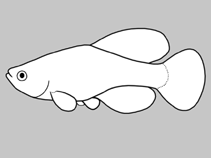 No image available for this species;
drawing shows typical species in Nothobranchiidae.
Google Bild
drawing shows typical species in Nothobranchiidae.
Klassifizierung / Names Namen | Synonyme | Catalog of Fishes(Gattung, Arten) | ITIS | CoL | WoRMS | Cloffa
> Cyprinodontiformes (Rivulines, killifishes and live bearers) > Nothobranchiidae (African rivulines)
Etymology: Nothobranchius: Greek, nothos = false + Greek, brangchia = gill (Ref. 45335); torgashevi: The species is named in honour of aquarist and collector Sergey Torgashev from Elektrostal, Moscow Oblast, Russia, who discovered the species (Ref. 116436).
Eponymy: Sergey Torgashev, Elektrostal, Moscow Oblast, Russia, is a collector and aquarist who discovered the species in Tanzania. (Ref. 128868), visit book page.
Etymology: Nothobranchius: Greek, nothos = false + Greek, brangchia = gill (Ref. 45335); torgashevi: The species is named in honour of aquarist and collector Sergey Torgashev from Elektrostal, Moscow Oblast, Russia, who discovered the species (Ref. 116436).
Eponymy: Sergey Torgashev, Elektrostal, Moscow Oblast, Russia, is a collector and aquarist who discovered the species in Tanzania. (Ref. 128868), visit book page.
Umwelt: Milieu / Klimazone / Tiefenbereich / Verbreitungsgebiet Ökologie
; süßwasser pelagisch; pH range: 8.3 - 8.3. Tropical; 25°C - 30°C (Ref. 116436)
Verbreitung Territorien | FAO Gebiete | Ökosysteme | Vorkommen | Punkt Karte | Einführungen | Faunafri
Africa: Mhwala River, Lake Eyasi basin, in Tanzania (Ref. 116436).
Größe / Gewicht / Alter
Geschlechtsreife: Lm ? range ? - ? cm
Max length : 4.3 cm SL Männchen/unbestimmt; (Ref. 116436); 3.3 cm SL (female)
Max length : 4.3 cm SL Männchen/unbestimmt; (Ref. 116436); 3.3 cm SL (female)
Kurzbeschreibung Bestimmungsschlüssel | Morphologie | Morphometrie
Rückenflossenstacheln (insgesamt) : 0; Rückenflossenweichstrahlen (insgesamt) : 16 - 17; Afterflossenstacheln: 0; Afterflossenweichstrahlen: 17 - 18; Wirbelzahl: 29. Diagnosis: The colour pattern of Nothobranchius torgashevi males is compparable to that of other N. ugandensis group members, comprising light blue scales and a broad, irregular reticulated pattern on the body, vivid orange or red oblique bars on the head and dorsum, a yellow or blue anal fin, and large vivid red spots on the dorsal and anal fins; other shared characters include: head rounded with a slightly concave to nearly straight dorsal profile; predorsal region convex between the nape and posterior extremity of the dorsal fin base; cephalic squamation variable (Ref. 116436). Nothobranchius torgashevi can be distinguished from all other species in the N. ugandensis group by the following combination of characters: flank scales with red margins; caudal fin plain red; pectoral fin hyaline with a few proximal red dots; anal fin light blue with red dots proximally, yellow or creamy white distally; dorsal and anal fins with red margin; 16-17 dorsal fin rays; 17-18 anal fin rays; 31-33 scales in the median lateral series; 11-12 transverse scale rows; 16 circumpeduncular scales (Ref. 116436).
Body shape (shape guide): fusiform / normal.
Body shape (shape guide): fusiform / normal.
Found in a seasonal ditch, less than 1 m deep and without aquatic vegetation, the water light clay grey and turbid with a pH of 8.3 and temperature varying from 25 to 30°C (Ref. 116436).
Lebenszyklus und Paarungsverhalten Geschlechtsreife | Fortpflanzung | Ablaichen | Eier | Fruchtbarkeit | Larven
Hauptreferenz
Laden Sie Ihre Referenzen hoch | Referenzen | Koordinator | Partner
Valdesalici, S., 2015. Nothobranchius torgashevi (Cyprinodontiformes: Nothobranchiidae), a new species of annual killifish with two male colour morphs from the Lake Eyasi basin, central Tanzania. Killi-Data Ser. 2015:17-30. (Ref. 116436)
IUCN Rote Liste Status (Ref. 130435: Version 2025-2 (Global))
Verwundbar (VU) (B1ab(iii)); Date assessed: 12 January 2019
CITES
Not Evaluated
Bedrohung für Menschen
Harmless
Nutzung durch Menschen
FAO - Publication: search | FishSource |
Mehr Information
Trophische Ökologie
Lebensmittel (Beutetiere)
Nahrungszusammensetzung
Nahrungsaufnahme
Lebensmittelrationen
Räuber
Lebensmittel (Beutetiere)
Nahrungszusammensetzung
Nahrungsaufnahme
Lebensmittelrationen
Räuber
Populationsdynamik
Wachstumsparameter
Max. Alter/Größen
Länge-Gewicht-Rel.
Länge-Länge-Verhältnis.
Längenhäufigkeiten
Massenkonvertierung
Rekrutierung
Dichte
Wachstumsparameter
Max. Alter/Größen
Länge-Gewicht-Rel.
Länge-Länge-Verhältnis.
Längenhäufigkeiten
Massenkonvertierung
Rekrutierung
Dichte
Lebenszyklus
Fortpflanzung
Geschlechtsreife
Reifung/Kiemen rel.
Fruchtbarkeit
Ablaichen
Laichaggregationen
Eier
Eientwicklung
Larven
Larven Pop.Dyn.
Fortpflanzung
Geschlechtsreife
Reifung/Kiemen rel.
Fruchtbarkeit
Ablaichen
Laichaggregationen
Eier
Eientwicklung
Larven
Larven Pop.Dyn.
Anatomie
Kiemenoberfläche
Gehirn
Otolith
Kiemenoberfläche
Gehirn
Otolith
Physiologie
Körperliche Zusammensetzung
Nährstoffe
Sauerstoffverbrauch
Schwimmart
Schwimmgeschwindigkeit
Visuelle Pigmente
Fischgeräusche
Krankheiten und Parasiten
Toxizität (LC50s)
Körperliche Zusammensetzung
Nährstoffe
Sauerstoffverbrauch
Schwimmart
Schwimmgeschwindigkeit
Visuelle Pigmente
Fischgeräusche
Krankheiten und Parasiten
Toxizität (LC50s)
Genetik
Genom
Genetik
Heterozygotie
Vererbbarkeit
Genetische Vielfalt
Genom
Genetik
Heterozygotie
Vererbbarkeit
Genetische Vielfalt
Menschenbezogen
Aquakultur-Systeme
Aquakultur Profile
Zuchtlinien
Ciguatera-Fälle
Briefmarken, Münzen, Verschiedenes.
Aquakultur-Systeme
Aquakultur Profile
Zuchtlinien
Ciguatera-Fälle
Briefmarken, Münzen, Verschiedenes.
Tools
Zusatzinformationen
Download XML
Zusammenfassung | Punktdaten | Namen | Photos
Internet Quellen
AFORO (otoliths) | Aquatic Commons | BHL | Cloffa | Websites from users | FishWatcher Einträge suchen | CISTI | Catalog of Fishes: Gattung, Arten | DiscoverLife | ECOTOX | FAO - Publication: search | Faunafri | Fishipedia | Fishtrace | GloBI | Google Books | Google Scholar | Google | IGFA World Record | OneZoom | Open Tree of Life | Otolith Atlas of Taiwan Fishes | PubMed | Reef Life Survey | Socotra Atlas | TreeBase | Tree of Life | Wikipedia: Gehe zu, Suchen | World Records Freshwater Fishing | Zoobank | Zoologischer Rekord
Schätzungen auf der Grundlage von Modellen
|
Phylogenetischer Diversitätsindex (Ref. 82804) |
PD50 = 0.5000 [Uniqueness, from 0.5 = low to 2.0 = high]. |
| Bayesian length-weight | a=0.00603 (0.00251 - 0.01446), b=3.13 (2.93 - 3.33), in cm total length, based on LWR estimates for this (Sub)family-body shape (Ref. 93245). |
|
Trophische Ebene (Ref. 69278) |
3.2 ±0.4 se; based on size and trophs of closest relatives |
|
Anfälligkeit der Fischerei (Ref. 59153) |
Low vulnerability (10 of 100). 🛈 |