



Nothobranchius capriviensis Watters, Wildekamp & Shidlovskiy, 2015
Caprivi Nothobranchius
Uploaden van uw Foto's en video's
Google afbeelding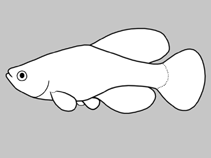 No image available for this species;
drawing shows typical species in Nothobranchiidae.
Google afbeelding
drawing shows typical species in Nothobranchiidae.
Classificatie / Namen Lokale namen | Synoniemen | Catalog of Fishes(Genus, Soort(en)) | ITIS | CoL | WoRMS | Cloffa
> Cyprinodontiformes (Rivulines, killifishes and live bearers) > Nothobranchiidae (African rivulines)
Etymology: Nothobranchius: Greek, nothos = false + Greek, brangchia = gill (Ref. 45335); capriviensis: The species name capriviensis represents a toponym after the Caprivi Strip, the historical name for the narrow extension of northeastern Namibia, where this species occurs; this part of Namibia was originally named after the German statesman Count Leo von Caprivi (Ref. 116076).
Etymology: Nothobranchius: Greek, nothos = false + Greek, brangchia = gill (Ref. 45335); capriviensis: The species name capriviensis represents a toponym after the Caprivi Strip, the historical name for the narrow extension of northeastern Namibia, where this species occurs; this part of Namibia was originally named after the German statesman Count Leo von Caprivi (Ref. 116076).
Milieu: milieu / Klimaatzone / Diepte / verspreidingsgebied Ecologie
; zoet water pelagisch. Tropical
Verspreiding Gebieden | FAO regio's | Ecosystemen | Voorkomen | Verspreidingskaart | Introducties | Faunafri
Africa: eastern part of the Zambezi Region of Namibia (Ref. 116076).
Grootte / Gewicht / Leeftijd
Korte beschrijving Determinatiesleutels | Morfologie | Morfometrie
Dorsale stekels (totaal) : 0; Dorsale zachte stralen (totaal) : 15 - 18; Anale stekels: 0; Anale zachte stralen: 16 - 18. Diagnosis: Nothobranchius capriviensis is known only as blue form, in contrast to N. kafuensis, its closest relative, that occurs as red, blue and intermediate forms; while there are general similarities in male colouration between N. capriviensis and the blue form of N. kafuensis, there are also consistent differences: the male N. capriviensis can be distinguished by the paler shade of blue than the blue phenotype of N. kafuensis, the lack of orange-red scale margins and the orange-red colour on the head of the latter species, and a more prominent and consistent barring on the body of the former; differences in female colouration are not as obvious: scale centers of N. capriviensis are iridescent light blue, whereas those of female N. kafuensis are less prominently blue and have a silver hue (Ref. 116076). Morphologically and meristically, the male N. capriviensis differs from that of N. kafuensis by a deeper body, its mean 35.4% of standard length vs. 31.4%, longer head, its mean 32.5% of standard length vs. 30.7%, a more posterior position of the anal fin, pre-anal length 62.3% of standard length vs. 60.5%, and a higher number of scales around the caudal peduncle, 14-16 vs. 13-14; female N. capriviensis have a more posterior position of the anal fin, pre-anal length 63.9% of standard length vs. 66.8%, when compared with N. kafuensis
Body shape (shape guide): fusiform / normal.
Body shape (shape guide): fusiform / normal.
Found in large, relatively shallow ephemeral pools, which dry up completely on a seasonal basis (Ref. 116076). Eggs deposited in the mud substrate by the adult fish survive therein through the dry season, experiencing a number of phases of development with intervening diapauses; the eggs then hatch at the onset of the rainy season; growth of the fry is rapid and sexual maturity may be attained within four to six weeks (Ref. 116076).
Levenscyclus en paargedrag Maturiteit | Voortplanting | Paaien | Eieren | Fecunditeit | Larven
Hoofdreferentie
Upload uw referenties | Referenties | Coördinator | Medewerkers
Watters, B.R., R.H. Wildekamp and K.M. Shidlovskiy, 2015. Description and biogeography of Nothobranchius capriviensis, a new species of annual killifish from the Zambezi Region of Namibia (Cyprinodontiformes: Nothobranchiidae). J. Am. Killifish Ass. 47(4-6):97-133. (Ref. 116076)
Status op de Rode Lijst van het IUCN (Ref. 130435: Version 2025-2 (Global))
Bedreigd (EN) (B1ab(iii,iv,v)+2ab(iii,iv,v)); Date assessed: 20 October 2018
CITES
Not Evaluated
Gevaar voor de mens
Harmless
Gebruik door de mens
FAO - Publication: search | FishSource |
Meer informatie
Trofische ecologie
Voedsel (prooien)
Dieetsamenstelling
Voedselconsumptie
Voedselrantsoenen
Predatoren
Voedsel (prooien)
Dieetsamenstelling
Voedselconsumptie
Voedselrantsoenen
Predatoren
Populatiedynamica
Groeiparameters
Max. leeftijden / maten
Lengte-gewicht rel.
Lengte-lengte rel.
Lengtefrequenties
Massaconversie
Rekrutering
Abundantie
Groeiparameters
Max. leeftijden / maten
Lengte-gewicht rel.
Lengte-lengte rel.
Lengtefrequenties
Massaconversie
Rekrutering
Abundantie
Levenscyclus
Voortplanting
Maturiteit
Rijpheid/kieuwen rel.
Fecunditeit
Paaien
Paaibestanden
Eieren
Ontwikkeling van de eieren
Larven
Larvale populatiedynamiek
Voortplanting
Maturiteit
Rijpheid/kieuwen rel.
Fecunditeit
Paaien
Paaibestanden
Eieren
Ontwikkeling van de eieren
Larven
Larvale populatiedynamiek
Anatomie
Kieuwoppervlak
Hersenen
Otoliet
Kieuwoppervlak
Hersenen
Otoliet
Fysiologie
Lichaamssamenstelling
Voedingsstoffen
Zuurstofverbruik
Type zwemmen
Zwemsnelheid
Visuele pigmenten
Vis geluid
Ziekten en parasieten
Toxiciteit (LC50)
Lichaamssamenstelling
Voedingsstoffen
Zuurstofverbruik
Type zwemmen
Zwemsnelheid
Visuele pigmenten
Vis geluid
Ziekten en parasieten
Toxiciteit (LC50)
Genetica
genoom
Genetica
Heterozygositeit
Erfelijkheid
Genetische diversiteit
genoom
Genetica
Heterozygositeit
Erfelijkheid
Genetische diversiteit
Menselijk gerelateerd
Aquacultuursystemen
Aquacultuurprofielen
Kweeklijnen
Ciguatera gevallen
Postzegels, munten, diversen.
Aquacultuursystemen
Aquacultuurprofielen
Kweeklijnen
Ciguatera gevallen
Postzegels, munten, diversen.
Tools
Speciale rapporten
Bekijk gegevens voor het houden in een aquarium | Bekijk Fact Sheets voor de soort | Bekijk Aquacultuur Fact Sheets
Download XML
Internetbronnen
AFORO (otoliths) | Aquatic Commons | BHL | Cloffa | Websites from users | Bekijk FishWatcher | CISTI | Catalog of Fishes: Genus, Soort(en) | DiscoverLife | ECOTOX | FAO - Publication: search | Faunafri | Fishipedia | Fishtrace | GloBI | Google Books | Google Scholar | Google | IGFA World Record | OneZoom | Open Tree of Life | Otolith Atlas of Taiwan Fishes | PubMed | Reef Life Survey | Socotra Atlas | TreeBase | Tree of Life | Wikipedia: ga naar, zoek | World Records Freshwater Fishing | Zoobank | Zoological Record
Schattingen op basis van modellen
Fylogenetische diversiteitsindex (Ref. 82804): PD50 = 0.5000 [Uniqueness, from 0.5 = low to 2.0 = high].
Bayesian length-weight: a=0.00603 (0.00250 - 0.01453), b=3.13 (2.93 - 3.33), in cm total length, based on LWR estimates for this (Sub)family-body shape (Ref. 93245).
Trofisch niveau (Ref. 69278): 3.2 ±0.4 se; based on size and trophs of closest relatives