



Maculabatis bineeshi Manjaji-Matsumoto & Last, 2016
Short-tail whipray
Lägg till din observation i Fish Watcher
| Native range | All suitable habitat | Point map | Year 2050 |

|
| This map was computer-generated and has not yet been reviewed. |
| Maculabatis bineeshi AquaMaps Data sources: GBIF OBIS |
Ladda upp din foton och Videor
Bilder | Google image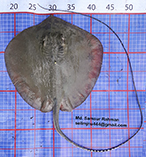 Maculabatis bineeshi
Bild av Rahman, Md. S.
Bilder | Google image
Bild av Rahman, Md. S.
Klassificering / Namn Populärnamn | synonymer | Catalog of Fishes(Släkte, Arter) | ITIS | CoL | WoRMS | Cloffa
Elasmobranchii (hajar och rockor) (sharks and rays) > Myliobatiformes (Stingrays) > Dasyatidae (Stingrays) > Urogymninae
Etymology: bineeshi: Named for Indian biologist K.K. Bineesh.
Eponymy: Dr K K Bineesh (d: 1981) is an Indian biologist who holds a master’s degree and a doctorate awarded by Cochin University of Science and Technology, Kerala (2015). [...] (Ref. 128868), visit book page.
Etymology: bineeshi: Named for Indian biologist K.K. Bineesh.
Eponymy: Dr K K Bineesh (d: 1981) is an Indian biologist who holds a master’s degree and a doctorate awarded by Cochin University of Science and Technology, Kerala (2015). [...] (Ref. 128868), visit book page.
Miljö: miljö / Klimatzon / djupintervall / distributionsområde Ekologi
marina bottenlevande; djupintervall 13 - 22 m (Ref. 110187). Tropical
Utbredning Territorier | FAO områden | Ekosystem | Förekomster | Prickkarta | Utplanteringar | Faunafri
Indian Ocean: Pakistan and India, Bay of Bengal; probably most widely distributed but its occurrence may be strongly habitat dependent.
Storlek / Vikt / Ålder
Könsmognad: Lm ? range ? - ? cm
Max length : 66.0 cm WD hane/ej könsbestämd; (Ref. 110187); 25.0 cm WD (female)
Max length : 66.0 cm WD hane/ej könsbestämd; (Ref. 110187); 25.0 cm WD (female)
Kort beskrivning Bestämningsnycklar | Morfologi | Morfometri
Ryggkotor: 108 - 114. This species (size at least 66 cm DW) is distinguished by the following set of characters: disc is weakly rhomboidal to suboval, its length 93-98% DW; snout is moderately elongate with weak apical lobe, snout angle 116-121°; pectoral-fin apices are broadly rounded; orbits small to medium-sized, barely protruding; relatively narrow mouth, its width 1.2-1.3 in internasal width; distance between first gill slits is 2.2-2.5 times internasal distance; distance between fifth gill slits is 1.4-1.6 times internasal distance, 28-30% of ventral head length; pelvic-fin base is broad, 14-15% DW; main suprascapular denticle is large, yellowish, broadly ovate, usually followed by smaller subtriangular denticle; secondary denticles developing rapidly, forming a broad band extending from interorbit to tail base by 24 cm DW; dorsal disc uniformly light brown, without white spots; pale ventrally with broad, faint and slightly darker lateral margins; tail dark brown to blackish dorsally and white ventrally forward of caudal sting; plain blackish posteriorly or with weak, irregular pale dorsal banding (in young); pectoral-fin radials 127-131; total vertebral count, 108-114, including synarcual centra, monospondylous centra 44-46, pre-sting diplospondylous centra 64-69 (Ref. 110187).
Body shape (shape guide): other (see remarks); Cross section: flattened.
Body shape (shape guide): other (see remarks); Cross section: flattened.
Smallest specimen, immature male at 20 cm WD is postnatal; birth size unknown, but probably ca. 15.0-17.0 cm WD (Ref. 110187).
Livscykel och parningsbeteende Könsmognad | Reproduktion | Lek | Ägg | Fekunditet | Larver
Huvudreferens
Ladda upp dina referenser | referenser | Koordinator : McEachran, John | Medarbetare
Manjaji-Matsumoto, B.M. and P.R. Last, 2016. Two new whiprays, Maculabatis arabica sp. nov. and M. bineeshi sp. nov. (Myliobatiformes: Dasyatidae), from the northern Indian Ocean. Zootaxa 4144(3):335-353. (Ref. 110187)
Status på IUCN:s rödlista (Ref. 130435: Version 2025-2 (Global))
Critically Endangered (CR) (A2cd); Date assessed: 21 May 2020
CITES
Not Evaluated
Hot mot människor
Harmless
Mänskliga användningsområden
FAO - Publication: search | FishSource |
Ytterligare information
Trofisk ekologi
Livsmedelsartiklar (preys)
Födosammansättning
Födointag
Matransoner
Predatorer
Livsmedelsartiklar (preys)
Födosammansättning
Födointag
Matransoner
Predatorer
Ekologi
Ekologi
Ekologi
Populationsdynamik
Tillväxtparametrar
Max. åldrar / storlekar
Längd-vikt rel.
Längd-längd rel.
Längd-frekvenser
Massakonvertering
Rekrytering
Abundans
Tillväxtparametrar
Max. åldrar / storlekar
Längd-vikt rel.
Längd-längd rel.
Längd-frekvenser
Massakonvertering
Rekrytering
Abundans
Livscykel
Reproduktion
Könsmognad
Mognad/Gills rel.
Fekunditet
Lek
Lekande aggregat
Ägg
Utveckling av ägg
Larver
Larvdynamik
Reproduktion
Könsmognad
Mognad/Gills rel.
Fekunditet
Lek
Lekande aggregat
Ägg
Utveckling av ägg
Larver
Larvdynamik
Anatomi
Gälyta
Hjärna
Otolit
Gälyta
Hjärna
Otolit
Fysiologi
Kroppssammansättning
Näringsämnen
Syreförbrukning
Typ av simning
Simhastighet
Visuella pigment
Ljud från fisk
Sjukdomar & Parasiter
Toxicitet (LC50)
Kroppssammansättning
Näringsämnen
Syreförbrukning
Typ av simning
Simhastighet
Visuella pigment
Ljud från fisk
Sjukdomar & Parasiter
Toxicitet (LC50)
Genetik
Genom
Genetik
Heterozygositet
Ärftlighet
Genetisk mångfald
Genom
Genetik
Heterozygositet
Ärftlighet
Genetisk mångfald
Människorelaterad
Vattenbrukssystem
Vattenbruksprofiler
Avelslinjer
Ciguatera-fall
Frimärken, mynt, diverse.
Vattenbrukssystem
Vattenbruksprofiler
Avelslinjer
Ciguatera-fall
Frimärken, mynt, diverse.
Verktyg
Särskilda rapporter
Kontrollera för underhåll av akvarium | Kontrollera om det finns faktablad om arter | Kontrollera om det finns faktablad om vattenbruk
Ladda ner XML
Internet-källor
AFORO (otoliths) | Aquatic Commons | BHL | Cloffa | Websites from users | Check FishWatcher | CISTI | Catalog of Fishes: Släkte, Arter | DiscoverLife | ECOTOX | FAO - Publication: search | Faunafri | Fishipedia | Fishtrace | GloBI | Google Books | Google Scholar | Google | IGFA World Record | OneZoom | Open Tree of Life | Otolith Atlas of Taiwan Fishes | PubMed | Reef Life Survey | Socotra Atlas | TreeBase | Tree of Life | Wikipedia: Go, sök | World Records Freshwater Fishing | Zoobank | Zoologiskt register
Uppskattningar baserade på modeller
Index för fylogenetisk mångfald (Ref. 82804): PD50 = 0.5020 [Uniqueness, from 0.5 = low to 2.0 = high].
Bayesian length-weight: a=0.01023 (0.00482 - 0.02174), b=3.06 (2.86 - 3.26), in cm total length, based on LWR estimates for this (Sub)family-body shape (Ref. 93245).
Trofisk nivå (Ref. 69278): 3.7 ±0.4 se; based on size and trophs of closest relatives