



Maculabatis bineeshi Manjaji-Matsumoto & Last, 2016
Short-tail whipray
Waarneming toevoegen in Fish Watcher
| Native range | All suitable habitat | Point map | Year 2050 |

|
| This map was computer-generated and has not yet been reviewed. |
| Maculabatis bineeshi AquaMaps Data sources: GBIF OBIS |
Uploaden van uw Foto's en video's
Afbeeldingen | Google afbeelding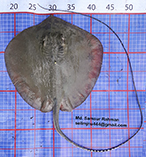 Maculabatis bineeshi
Afbeelding van Rahman, Md. S.
Afbeeldingen | Google afbeelding
Afbeelding van Rahman, Md. S.
Classificatie / Namen Lokale namen | Synoniemen | Catalog of Fishes(Genus, Soort(en)) | ITIS | CoL | WoRMS | Cloffa
Elasmobranchii (haaien en roggen) (sharks and rays) > Myliobatiformes (Stingrays) > Dasyatidae (Stingrays) > Urogymninae
Etymology: bineeshi: Named for Indian biologist K.K. Bineesh.
Eponymy: Dr K K Bineesh (d: 1981) is an Indian biologist who holds a master’s degree and a doctorate awarded by Cochin University of Science and Technology, Kerala (2015). [...] (Ref. 128868), visit book page.
Etymology: bineeshi: Named for Indian biologist K.K. Bineesh.
Eponymy: Dr K K Bineesh (d: 1981) is an Indian biologist who holds a master’s degree and a doctorate awarded by Cochin University of Science and Technology, Kerala (2015). [...] (Ref. 128868), visit book page.
Milieu: milieu / Klimaatzone / Diepte / verspreidingsgebied Ecologie
marien demersaal; diepte 13 - 22 m (Ref. 110187). Tropical
Verspreiding Gebieden | FAO regio's | Ecosystemen | Voorkomen | Verspreidingskaart | Introducties | Faunafri
Indian Ocean: Pakistan and India, Bay of Bengal; probably most widely distributed but its occurrence may be strongly habitat dependent.
Grootte / Gewicht / Leeftijd
Maturiteit: Lm ? range ? - ? cm
Max length : 66.0 cm WD mannelijk / geslacht onbekend; (Ref. 110187); 25.0 cm WD (female)
Max length : 66.0 cm WD mannelijk / geslacht onbekend; (Ref. 110187); 25.0 cm WD (female)
Korte beschrijving Determinatiesleutels | Morfologie | Morfometrie
Wervels: 108 - 114. This species (size at least 66 cm DW) is distinguished by the following set of characters: disc is weakly rhomboidal to suboval, its length 93-98% DW; snout is moderately elongate with weak apical lobe, snout angle 116-121°; pectoral-fin apices are broadly rounded; orbits small to medium-sized, barely protruding; relatively narrow mouth, its width 1.2-1.3 in internasal width; distance between first gill slits is 2.2-2.5 times internasal distance; distance between fifth gill slits is 1.4-1.6 times internasal distance, 28-30% of ventral head length; pelvic-fin base is broad, 14-15% DW; main suprascapular denticle is large, yellowish, broadly ovate, usually followed by smaller subtriangular denticle; secondary denticles developing rapidly, forming a broad band extending from interorbit to tail base by 24 cm DW; dorsal disc uniformly light brown, without white spots; pale ventrally with broad, faint and slightly darker lateral margins; tail dark brown to blackish dorsally and white ventrally forward of caudal sting; plain blackish posteriorly or with weak, irregular pale dorsal banding (in young); pectoral-fin radials 127-131; total vertebral count, 108-114, including synarcual centra, monospondylous centra 44-46, pre-sting diplospondylous centra 64-69 (Ref. 110187).
Body shape (shape guide): other (see remarks); Cross section: flattened.
Body shape (shape guide): other (see remarks); Cross section: flattened.
Smallest specimen, immature male at 20 cm WD is postnatal; birth size unknown, but probably ca. 15.0-17.0 cm WD (Ref. 110187).
Levenscyclus en paargedrag Maturiteit | Voortplanting | Paaien | Eieren | Fecunditeit | Larven
Hoofdreferentie
Upload uw referenties | Referenties | Coördinator : McEachran, John | Medewerkers
Manjaji-Matsumoto, B.M. and P.R. Last, 2016. Two new whiprays, Maculabatis arabica sp. nov. and M. bineeshi sp. nov. (Myliobatiformes: Dasyatidae), from the northern Indian Ocean. Zootaxa 4144(3):335-353. (Ref. 110187)
Status op de Rode Lijst van het IUCN (Ref. 130435: Version 2025-2 (Global))
Ernstig bedreigd (CR) (A2cd); Date assessed: 21 May 2020
CITES
Not Evaluated
Gevaar voor de mens
Harmless
Gebruik door de mens
FAO - Publication: search | FishSource |
Meer informatie
Trofische ecologie
Voedsel (prooien)
Dieetsamenstelling
Voedselconsumptie
Voedselrantsoenen
Predatoren
Voedsel (prooien)
Dieetsamenstelling
Voedselconsumptie
Voedselrantsoenen
Predatoren
Ecologie
Ecologie
Ecologie
Populatiedynamica
Groeiparameters
Max. leeftijden / maten
Lengte-gewicht rel.
Lengte-lengte rel.
Lengtefrequenties
Massaconversie
Rekrutering
Abundantie
Groeiparameters
Max. leeftijden / maten
Lengte-gewicht rel.
Lengte-lengte rel.
Lengtefrequenties
Massaconversie
Rekrutering
Abundantie
Levenscyclus
Voortplanting
Maturiteit
Rijpheid/kieuwen rel.
Fecunditeit
Paaien
Paaibestanden
Eieren
Ontwikkeling van de eieren
Larven
Larvale populatiedynamiek
Voortplanting
Maturiteit
Rijpheid/kieuwen rel.
Fecunditeit
Paaien
Paaibestanden
Eieren
Ontwikkeling van de eieren
Larven
Larvale populatiedynamiek
Anatomie
Kieuwoppervlak
Hersenen
Otoliet
Kieuwoppervlak
Hersenen
Otoliet
Fysiologie
Lichaamssamenstelling
Voedingsstoffen
Zuurstofverbruik
Type zwemmen
Zwemsnelheid
Visuele pigmenten
Vis geluid
Ziekten en parasieten
Toxiciteit (LC50)
Lichaamssamenstelling
Voedingsstoffen
Zuurstofverbruik
Type zwemmen
Zwemsnelheid
Visuele pigmenten
Vis geluid
Ziekten en parasieten
Toxiciteit (LC50)
Genetica
genoom
Genetica
Heterozygositeit
Erfelijkheid
Genetische diversiteit
genoom
Genetica
Heterozygositeit
Erfelijkheid
Genetische diversiteit
Menselijk gerelateerd
Aquacultuursystemen
Aquacultuurprofielen
Kweeklijnen
Ciguatera gevallen
Postzegels, munten, diversen.
Aquacultuursystemen
Aquacultuurprofielen
Kweeklijnen
Ciguatera gevallen
Postzegels, munten, diversen.
Tools
Speciale rapporten
Bekijk gegevens voor het houden in een aquarium | Bekijk Fact Sheets voor de soort | Bekijk Aquacultuur Fact Sheets
Download XML
Internetbronnen
AFORO (otoliths) | Aquatic Commons | BHL | Cloffa | Websites from users | Bekijk FishWatcher | CISTI | Catalog of Fishes: Genus, Soort(en) | DiscoverLife | ECOTOX | FAO - Publication: search | Faunafri | Fishipedia | Fishtrace | GloBI | Google Books | Google Scholar | Google | IGFA World Record | OneZoom | Open Tree of Life | Otolith Atlas of Taiwan Fishes | PubMed | Reef Life Survey | Socotra Atlas | TreeBase | Tree of Life | Wikipedia: ga naar, zoek | World Records Freshwater Fishing | Zoobank | Zoological Record
Schattingen op basis van modellen
Fylogenetische diversiteitsindex (Ref. 82804): PD50 = 0.5020 [Uniqueness, from 0.5 = low to 2.0 = high].
Bayesian length-weight: a=0.01023 (0.00482 - 0.02174), b=3.06 (2.86 - 3.26), in cm total length, based on LWR estimates for this (Sub)family-body shape (Ref. 93245).
Trofisch niveau (Ref. 69278): 3.7 ±0.4 se; based on size and trophs of closest relatives