



Eigenmannia antonioi Peixoto, Dutra & Wosiacki, 2015
Загрузить свой Фото и Видео
Изображение на Google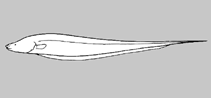 No image available for this species;
drawing shows typical species in Sternopygidae.
Изображение на Google
drawing shows typical species in Sternopygidae.
Классификация / Имена народные названия | синонимы | Catalog of Fishes(род, виды) | ITIS | CoL | WoRMS | Cloffa
> Gymnotiformes (Knifefishes) > Sternopygidae (Glass knifefishes) > Eigenmanninae
Etymology: Eigenmannia: From Eigenmann, 1910, researcher of faunistic studies (Ref. 45335); antonioi: The epithet antonioi is in memory to Antônio da Silva Wanderley, grandfather of the first author (Ref. 115689).
Eponymy: Professor Dr Carl Henry Eigenmann (1863–1927) was a German-born American ichthyologist. [...] Antônio da Silva Wanderley was the first author’s grandfather. (Ref. 128868), visit book page.
Etymology: Eigenmannia: From Eigenmann, 1910, researcher of faunistic studies (Ref. 45335); antonioi: The epithet antonioi is in memory to Antônio da Silva Wanderley, grandfather of the first author (Ref. 115689).
Eponymy: Professor Dr Carl Henry Eigenmann (1863–1927) was a German-born American ichthyologist. [...] Antônio da Silva Wanderley was the first author’s grandfather. (Ref. 128868), visit book page.
Окружающая среда: среда / климатическая зона / пределы глубины / диапазон распространения экология
; пресноводный донно-пелагический. Tropical
распространение Территории | регионы FAO | Экосистемы | места находок | карта точек | интродукции | Faunafri
South America: known only from Rio Anapu at Floresta Nacional de Caxiuanã, a tributary of the lower portion of Rio Amazonas, state of Pará, Brazil (Ref. 115689).
Размер / Вес / Возраст
Краткое описание определительные ключи | морфология | морфометрия
членистые (мягкие) лучи анального плавника: 166 - 207. Diagnosis: can be distinguished from other species in the E. trilineata species group, except E. microstoma and E. trilineata, by the mouth width 20.0–25.1% HL (versus 13.1–18.4% in E. desantanai; 12.9–17.5% in E. guairaca; 12.6–16.1% in E. matintapereira; 13.2–18.1% in E. muirapinima; 10.8–19.0 in E. pavulagem; 9.5–17.2% in E. vicentespelaea; and 9.5–14.6% in E. waiwai); Eigenmannia antonioi differs from E. microstoma and E. trilineata by the suborbital depth 18.4–27.8% HL (versus 29.9–40.8% and 32.5–46.6%, respectively); by the dentition pattern of the premaxilla with 8 to 12 teeth distributed in 2 rows (outermost row with 3 to 6 teeth, innermost row with 4 to 6 teeth) [versus 16 teeth distributed in 3 rows (outermost row with 5 teeth, median row with 6, innermost with 5 teeth) in E. microstoma, and the 31–33 teeth distributed in 4 rows (outermost row with 8 or 9 teeth, 2nd row with 5 or 6, 3rd row with 10; innermost with 7 or 9 teeth) in E. trilineata] and by the length of anterodorsal process of maxillary corresponding to 50% of the width of the posterior nostril (versus equal to the width of the posterior nostril in E. trilineata and E. microstoma); Eigenmannia antonioi can be further distinguished from E. microstoma by the length of the coronomeckelian bone 20% of the length of Meckel’s cartilage (versus 45% of the length of Meckel’s cartilage in E. microstoma); distinguished from E. trilineata by the depth of the posterodorsal expansion on infraorbitals 1 + 2, which approximately equals the total length of infraorbitals 1 + 2 (versus less than 50% of the length of infraorbitals 1 + 2 in E. trilineata), and by 8 or 9 endopterygoid teeth (versus 17 in E. trilineata) (Ref. 115689).
Body shape (shape guide): elongated.
Body shape (shape guide): elongated.
Жизненный цикл и брачное поведение половая зрелость | размножение | нерест | икра | Плодовитость | личинки
Основная ссылка
Загрузите свои рекомендации | ссылки | координатор : Albert, James S. | соавторы
Peixoto, L.A.W., G.M. Dutra and W.B. Wosiacki, 2015. The electric glass knifefishes of the Eigenmannia trilineata species-group (Gymnotiformes: Sternopygidae): monophyly and description of seven new species. Zool. J. Linn. Soc. 175:384-414. (Ref. 115689)
Статус Красного Списка МСОП (Ref. 130435: Version 2025-2 (Global))
Не вызывающий беспокойства (LC) ; Date assessed: 07 January 2021
CITES
Not Evaluated
Угроза для людей
Harmless
Использование человеком
рыболовство: интереса не представляет
FAO - Publication: search | FishSource |
дополнительная информация
Трофическая экология
Пищевые предметы (добыча)
состав пищи
потребление пищи
Продовольственные пайки
хищники
Пищевые предметы (добыча)
состав пищи
потребление пищи
Продовольственные пайки
хищники
экология
экология
экология
Динамика численности населения
Параметры роста
Макс. возраст / размер
Отношение длины к весу.
Отношение длины к длине.
Размерный состав
Преобразование массы
пополнение
численность
Параметры роста
Макс. возраст / размер
Отношение длины к весу.
Отношение длины к длине.
Размерный состав
Преобразование массы
пополнение
численность
Жизненный цикл
размножение
половая зрелость
Зрелость/Жиры относительно.
Плодовитость
нерест
Нерестовые скопления
икра
Развитие икры
личинки
динамика численности личинок
размножение
половая зрелость
Зрелость/Жиры относительно.
Плодовитость
нерест
Нерестовые скопления
икра
Развитие икры
личинки
динамика численности личинок
Анатомия
жаберная область
Мозг
Отолит
жаберная область
Мозг
Отолит
Физиология
Состав тела
Питательные вещества
Потребление кислорода
Тип плавания
Скорость плавания
Зрительные пигменты
Звук рыбы
Болезни и паразиты
Токсичность (LC50s)
Состав тела
Питательные вещества
Потребление кислорода
Тип плавания
Скорость плавания
Зрительные пигменты
Звук рыбы
Болезни и паразиты
Токсичность (LC50s)
генетика
Геном
генетика
Гетерозиготность
наследуемость
Генетическое разнообразие
Геном
генетика
Гетерозиготность
наследуемость
Генетическое разнообразие
Связанные с человеком
Системы аквакультуры
особенности рыбоводства
степень растяжения
Случаи заболевания сигуатерой
Марки, монеты и прочее.
Системы аквакультуры
особенности рыбоводства
степень растяжения
Случаи заболевания сигуатерой
Марки, монеты и прочее.
инструменты
Специальные отчеты
Проверить содержание в аквариумах | Проверить опубликованные видовые данные | Проверить опубликованные данные по аквакультуре
Скачать в формате XML
ресурсы в Интернет
AFORO (otoliths) | Aquatic Commons | BHL | Cloffa | Websites from users | Проверить FishWatcher | CISTI | Catalog of Fishes: род, виды | DiscoverLife | ECOTOX | FAO - Publication: search | Faunafri | Fishipedia | Fishtrace | GloBI | Google Books | Google Scholar | Google | IGFA World Record | OneZoom | Open Tree of Life | Otolith Atlas of Taiwan Fishes | PubMed | Reef Life Survey | Socotra Atlas | TreeBase | Tree of Life | Wikipedia: Вперёд, поиск | World Records Freshwater Fishing | Zoobank | Зоологическая летопись
Оценки, основанные на моделях
Индекс филогенетического разнообразия (ссылка 82804): PD50 = 0.5000 [Uniqueness, from 0.5 = low to 2.0 = high].
Bayesian length-weight: a=0.00355 (0.00161 - 0.00782), b=2.97 (2.78 - 3.16), in cm total length, based on LWR estimates for this (Sub)family-body shape (Ref. 93245).
Трофический уровень (ссылка 69278): 3.1 ±0.3 se; based on size and trophs of closest relatives