



Eigenmannia antonioi Peixoto, Dutra & Wosiacki, 2015
Envoyez vos Photos et vidéos
Images Google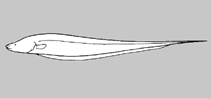 No image available for this species;
drawing shows typical species in Sternopygidae.
Images Google
drawing shows typical species in Sternopygidae.
Classification / Noms Noms communs | Synonymes | Catalog of Fishes(Genre, Espèce) | ITIS | CoL | WoRMS | Cloffa
> Gymnotiformes (Knifefishes) > Sternopygidae (Glass knifefishes) > Eigenmanninae
Etymology: Eigenmannia: From Eigenmann, 1910, researcher of faunistic studies (Ref. 45335); antonioi: The epithet antonioi is in memory to Antônio da Silva Wanderley, grandfather of the first author (Ref. 115689).
Eponymy: Professor Dr Carl Henry Eigenmann (1863–1927) was a German-born American ichthyologist. [...] Antônio da Silva Wanderley was the first author’s grandfather. (Ref. 128868), visit book page.
Etymology: Eigenmannia: From Eigenmann, 1910, researcher of faunistic studies (Ref. 45335); antonioi: The epithet antonioi is in memory to Antônio da Silva Wanderley, grandfather of the first author (Ref. 115689).
Eponymy: Professor Dr Carl Henry Eigenmann (1863–1927) was a German-born American ichthyologist. [...] Antônio da Silva Wanderley was the first author’s grandfather. (Ref. 128868), visit book page.
Environnement : milieu / zone climatique / profondeur / gamme de distribution Écologie
; eau douce benthopélagique. Tropical
Distribution Territoires | Zones FAO | Écosystèmes | Occurrences | Carte par point | Introductions | Faunafri
South America: known only from Rio Anapu at Floresta Nacional de Caxiuanã, a tributary of the lower portion of Rio Amazonas, state of Pará, Brazil (Ref. 115689).
Taille / Poids / Âge
Description synthétique Clés d'identification | Morphologie | Morphométrie
Rayons mous anaux: 166 - 207. Diagnosis: can be distinguished from other species in the E. trilineata species group, except E. microstoma and E. trilineata, by the mouth width 20.0–25.1% HL (versus 13.1–18.4% in E. desantanai; 12.9–17.5% in E. guairaca; 12.6–16.1% in E. matintapereira; 13.2–18.1% in E. muirapinima; 10.8–19.0 in E. pavulagem; 9.5–17.2% in E. vicentespelaea; and 9.5–14.6% in E. waiwai); Eigenmannia antonioi differs from E. microstoma and E. trilineata by the suborbital depth 18.4–27.8% HL (versus 29.9–40.8% and 32.5–46.6%, respectively); by the dentition pattern of the premaxilla with 8 to 12 teeth distributed in 2 rows (outermost row with 3 to 6 teeth, innermost row with 4 to 6 teeth) [versus 16 teeth distributed in 3 rows (outermost row with 5 teeth, median row with 6, innermost with 5 teeth) in E. microstoma, and the 31–33 teeth distributed in 4 rows (outermost row with 8 or 9 teeth, 2nd row with 5 or 6, 3rd row with 10; innermost with 7 or 9 teeth) in E. trilineata] and by the length of anterodorsal process of maxillary corresponding to 50% of the width of the posterior nostril (versus equal to the width of the posterior nostril in E. trilineata and E. microstoma); Eigenmannia antonioi can be further distinguished from E. microstoma by the length of the coronomeckelian bone 20% of the length of Meckel’s cartilage (versus 45% of the length of Meckel’s cartilage in E. microstoma); distinguished from E. trilineata by the depth of the posterodorsal expansion on infraorbitals 1 + 2, which approximately equals the total length of infraorbitals 1 + 2 (versus less than 50% of the length of infraorbitals 1 + 2 in E. trilineata), and by 8 or 9 endopterygoid teeth (versus 17 in E. trilineata) (Ref. 115689).
Body shape (shape guide): elongated.
Body shape (shape guide): elongated.
Cycle de vie et comportement reproducteur Maturité | Reproduction | Frai | Œufs | Fécondité | Larves
Référence principale
Téléchargez vos références | Références | Coordinateur : Albert, James S. | Collaborateurs
Peixoto, L.A.W., G.M. Dutra and W.B. Wosiacki, 2015. The electric glass knifefishes of the Eigenmannia trilineata species-group (Gymnotiformes: Sternopygidae): monophyly and description of seven new species. Zool. J. Linn. Soc. 175:384-414. (Ref. 115689)
Statut dans la liste rouge de l'IUCN (Ref. 130435: Version 2025-2 (Global))
Préoccupation mineure (LC) ; Date assessed: 07 January 2021
CITES
Not Evaluated
Menace pour l'homme
Harmless
Utilisations par l'homme
Pêcheries: sans intérêt
FAO - Publication: search | FishSource |
Plus d'informations
Écologie trophique
Aliments (proies)
Composition du régime alimentaire
Consommation alimentaire
Rations alimentaires
Prédateurs
Aliments (proies)
Composition du régime alimentaire
Consommation alimentaire
Rations alimentaires
Prédateurs
Écologie
Écologie
Écologie
Dynamique des populations
Paramètres de croissance
Âges / tailles maximales
Longueur-poids rel.
Rel. longueur-longueur.
Fréquences de longueurs
Conversion de masse
Recrutement
Abondance
Paramètres de croissance
Âges / tailles maximales
Longueur-poids rel.
Rel. longueur-longueur.
Fréquences de longueurs
Conversion de masse
Recrutement
Abondance
Cycle de vie
Reproduction
Maturité
Maturité/épines rel.
Fécondité
Frai
Agrégats de frai
Œufs
Développement de l'œuf
Larves
Dynamique des populations larvaires
Reproduction
Maturité
Maturité/épines rel.
Fécondité
Frai
Agrégats de frai
Œufs
Développement de l'œuf
Larves
Dynamique des populations larvaires
Anatomie
Surface branchiale
Cerveau
Otolithe
Surface branchiale
Cerveau
Otolithe
Physiologie
Composition corporelle
Nutriments
Consommation d'oxygène
Type de natation
Vitesse de nage
Pigments visuels
Son de poisson
Maladies et parasites
Toxicité (CL50)
Composition corporelle
Nutriments
Consommation d'oxygène
Type de natation
Vitesse de nage
Pigments visuels
Son de poisson
Maladies et parasites
Toxicité (CL50)
Génétique
génôme
Génétique
Hétérozygotie
Héritabilité
Diversité génétique
génôme
Génétique
Hétérozygotie
Héritabilité
Diversité génétique
Liées à l'homme
Systèmes d'aquaculture
Profils d'aquaculture
Souches
Cas de ciguatera
Timbres, pièces de monnaie, divers
Systèmes d'aquaculture
Profils d'aquaculture
Souches
Cas de ciguatera
Timbres, pièces de monnaie, divers
Outils
E-book | Guide de terrain | Générateur de fréquences de longueur | Outil de dynamique de population | Carte par point |
Capture-MSY |
Articles particuliers
Télécharger en XML
Sources Internet
AFORO (otoliths) | Aquatic Commons | BHL | Cloffa | Websites from users | FishWatcher | CISTI | Catalog of Fishes: Genre, Espèce | DiscoverLife | ECOTOX | FAO - Publication: search | Faunafri | Fishipedia | Fishtrace | GloBI | Google Books | Google Scholar | Google | IGFA World Record | OneZoom | Open Tree of Life | Otolith Atlas of Taiwan Fishes | PubMed | Reef Life Survey | Socotra Atlas | TreeBase | Arbre de Vie | Wikipedia: aller à, chercher | World Records Freshwater Fishing | Zoobank | Zoological Record
Estimations basées sur des modèles
Indice de diversité phylogénétique (Réf. 82804): PD50 = 0.5000 [Uniqueness, from 0.5 = low to 2.0 = high].
Bayesian length-weight: a=0.00355 (0.00161 - 0.00782), b=2.97 (2.78 - 3.16), in cm total length, based on LWR estimates for this (Sub)family-body shape (Ref. 93245).
Niveau trophique (Réf. 69278): 3.1 ±0.3 se; based on size and trophs of closest relatives