



Haplochromis pharyngalis Poll & Damas, 1939
muatnaik fotos/gambar dan video
Gambar | imej Google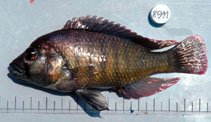 Haplochromis pharyngalis
foto/gambar oleh Schraml, E.
Gambar | imej Google
foto/gambar oleh Schraml, E.
klasifikasi / Nama Nama-nama umum | Sinonim (persamaan) | Catalog of Fishes(Marga, Jenis) | ITIS | CoL | WoRMS | Cloffa
> Cichliformes (Cichlids, convict blennies) > Cichlidae (Cichlids) > Pseudocrenilabrinae
Etymology: Haplochromis: Greek, Haploos = single + Greek, chromis = a fish, perhaps a perch (Ref. 45335).
More on authors: Poll & Damas.
Etymology: Haplochromis: Greek, Haploos = single + Greek, chromis = a fish, perhaps a perch (Ref. 45335).
More on authors: Poll & Damas.
Lingkungan: lingkungan / zona iklim / kisaran kedalaman / jangkauan distribusi Ekologi
; air tawar bentopelagis. Tropical; 1°N - 1°S
Penyebaran Wilayah | Daerah-daerah FAO | Ekosistem | Kemunculan | peta titik | Introduksi | Faunafri
Africa: Lake Edward, Kazinga Channel and Lake George (Ref. 4983, 128436). In Lake George, rare outside of Kashaka Bay (Ref. 128436).
Ukuran / Berat / umur
deskripsi pendek Kunci identifiaksi (pengenalan) | Morfologi | Morfometrik
Duri punggung (Keseluruhan (total)) : 15 - 17; duri punggung lunak (Keseluruhan (total)) : 7 - 10; Duri dubur: 3; Sirip dubur lunak: 7 - 9; vertebrata, bertulang belakang: 28 - 31. Diagnosis: Haplochromis pharyngalis differs from all species from the Lake Edward system, except Haplochromis fuscus, by a rounded caudal fin; very small, round and depply embedded chest scales, 7-11 pectoral-pelvic scales; small nape scales, and dominant males with white-blue first ray of pelvic fins (Ref. 128436). It differs from H. fuscus by an acute vs. blunt snout with a more shallow inclination, 40°-45° vs. 45°-60°; rounded vs. nearly squared dental arcades; and fewer rowsof inner oral teeth, 2-3, rarely 4, vs. 4-5 (Ref. 128436). It shares with H. elegans and H. aeneocolor a generalised Haplochromis morphology; it differs from both by 3-5 vs. 2-3 infraorbital chekk scales, deeper cheeks, 24.0-31.2% of head length vs. 19.2-23.8% and 20.1-24.4%, slightly smaller eyes, 26.9-33.1% of head length vs. 29.9-36.2% and 29.7-35.0%, and dominant males with green-yellow vs. blue and yellow flanks, respectively (Ref. 128436). Some specimens from Lake Edward share with Haplochromis mylodon, Haplochromis concilians, Haplochromis placodus and Haplochromis malacophagus an enlarged pharyngeal apparatus set with molariform teeth; it differs from all by recurved vs. straight outer oral teeth and from H. mylodon and H. concilians by the colour pattern of dominant males with green-yellow vs. blue flanks and faint vs. well-defined nostril and interorbital stripes; the latter is also diagnostic in preserved specimens (Ref. 128436).
The stomachs of a small number of specimens which were examined contained both larval and emergent insects (Ref. 558). Specimens from Lake George insectivorous, those from Lake Edward both insectivorous and molluscivorous (Ref. 128436).
Siklus hidup dan perilaku kawin Kematangan | Reproduksi, perkembang biakan | Pemijahan | telur-telur | Fekunditas | Larva
Mouthbrooding by females (Ref. 2059).
rujukan utama
Unggah referensi Anda | Acuan | Koordinator : Kullander, Sven O. | mitra
Vranken, A., M. Van Steenberge, A. Balagizi and J. Snoeks, 2020. The synonymy of Haplochromis pharyngalis and Haplochromis petronius (Cichlidae). J. Fish Biol. 97(5):1554-1559. (Ref. 128436)
Status IUCN Red List (Ref. 130435: Version 2025-2 (Global))
kurang bimbang (LC) ; Date assessed: 07 September 2021
CITES
Not Evaluated
ancaman kepada manusia
Harmless
penggunaan manusia
FAO - Publication: search | FishSource |
informasi lanjut
Dinamika populasi
Parameter pertumbuhan
Maks. usia / ukuran
Panjang-berat rel.
Panjang-panjang rel.
ukuran frekuensi
Konversi massa
pemulihan
Kelimpahan
Parameter pertumbuhan
Maks. usia / ukuran
Panjang-berat rel.
Panjang-panjang rel.
ukuran frekuensi
Konversi massa
pemulihan
Kelimpahan
Siklus hidup
Reproduksi, perkembang biakan
Kematangan
Kedewasaan / insang rel.
Fekunditas
Pemijahan
Agregasi pemijahan
telur-telur
pekembangan telor
Larva
Dinamika larva
Reproduksi, perkembang biakan
Kematangan
Kedewasaan / insang rel.
Fekunditas
Pemijahan
Agregasi pemijahan
telur-telur
pekembangan telor
Larva
Dinamika larva
Anatomi
Area insang
Otak
Otolith
Area insang
Otak
Otolith
Fisiologi
Komposisi tubuh
Nutrisi
Konsumsi oksigen
Jenis renang
Kecepatan berenang
Pigmen visual
Suara ikan
Penyakit & Parasit
Toksisitas (LC50)
Komposisi tubuh
Nutrisi
Konsumsi oksigen
Jenis renang
Kecepatan berenang
Pigmen visual
Suara ikan
Penyakit & Parasit
Toksisitas (LC50)
Genetika
genom
Genetika
Heterozigositas
Diturunkan
Keanekaragaman Genetik
genom
Genetika
Heterozigositas
Diturunkan
Keanekaragaman Genetik
Yang berhubungan dengan manusia
Sistem akuakultur
profil budidaya air
Strain
Kasus Ciguatera
Perangko, koin, dll.
Sistem akuakultur
profil budidaya air
Strain
Kasus Ciguatera
Perangko, koin, dll.
Alat, peralatan
E-book | Penuntun lapangan | tanda freqkuenci panjang | peringkat sejarah hidup | peta titik |
Tangkap-MSY |
laporan khas
muat turun XML
Sumber internet
AFORO (otoliths) | Aquatic Commons | BHL | Cloffa | Websites from users | semak peneliti ikan | CISTI | Catalog of Fishes: Marga, Jenis | DiscoverLife | ECOTOX | FAO - Publication: search | Faunafri | Fishipedia | Fishtrace | GloBI | Google Books | Google Scholar | Google | IGFA World Record | OneZoom | Open Tree of Life | Otolith Atlas of Taiwan Fishes | PubMed | Reef Life Survey | Socotra Atlas | TreeBase | Tree of Life | Wikipedia: pergi, Cari | World Records Freshwater Fishing | Zoobank | Catatan Zoologi
Estimasi berdasarkan model
Indeks keanekaragaman filogenetik (Acuan 82804): PD50 = 0.5000 [Uniqueness, from 0.5 = low to 2.0 = high].
Bayesian length-weight: a=0.00389 (0.00180 - 0.00842), b=3.12 (2.94 - 3.30), in cm total length, based on all LWR estimates for this body shape (Ref. 93245).
Tingkat Trofik (Acuan 69278): 3.2 ±0.40 se; based on food items.
Daya lenting (Acuan 120179): Tinggi, Waktu penggandaan populasi minimum kurang dari 15 bulan (Preliminary K or Fecundity.).