



Carregue seu(sua) Fotos e vídeos
Imagem do Google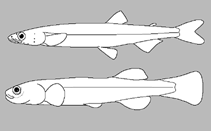 No image available for this species;
drawing shows typical species in Galaxiidae.
Imagem do Google
drawing shows typical species in Galaxiidae.
Classificação / Nomes Nomes comuns | Sinônimos | Catalog of Fishes(Gênero, Espécies) | ITIS | CoL | WoRMS | Cloffa
> Galaxiiformes (Southern smelts) > Galaxiidae (Galaxiids) > Galaxiinae
Etymology: Galaxias: Greek, galaxias, ou = a kind of fish (Ref. 45335); fuscus: Name from Latin 'fusc' meaning brown, dark, dusky or tawny, the author probably was referring to the distinctive and dark bars on the sides of the body which he referred to as '...prominent dark oval blotches..' and the live colouration of the majority of this species is a dusky orange-brown, and the type material is currently also a tawny colour, hence the species name is apt.
Etymology: Galaxias: Greek, galaxias, ou = a kind of fish (Ref. 45335); fuscus: Name from Latin 'fusc' meaning brown, dark, dusky or tawny, the author probably was referring to the distinctive and dark bars on the sides of the body which he referred to as '...prominent dark oval blotches..' and the live colouration of the majority of this species is a dusky orange-brown, and the type material is currently also a tawny colour, hence the species name is apt.
Meio ambiente: milieu / Zona climática / intervalo de profundidade / faixa de distribuição Ecologia
; Água doce bentopelágico; não migratória (Ref. 98815); intervalo de profundidade 0 - 1 m (Ref. 98815). Subtropical
Distribuição Territórios | Áreas da FAO | Ecossistemas | Ocorrências | Mapa de pontos | Introduções | Faunafri
Oceania: endemic to the Goulburn River system in central Victoria, Australia.
Tamanho / Peso / Idade
Maturidade: Lm ? range ? - ? cm
Max length : 16.5 cm FL macho/indeterminado; (Ref. 98815); peso máx. publicado: 30.00 g (Ref. 98815); idade máx. registrada: 15 anos (Ref. 98815)
Max length : 16.5 cm FL macho/indeterminado; (Ref. 98815); peso máx. publicado: 30.00 g (Ref. 98815); idade máx. registrada: 15 anos (Ref. 98815)
Descrição suscinta Chaves de identificação | Morfologia | Morfometria
Raios dorsais (total) : 8 - 12; Raios anais : 9 - 12; Vértebras: 51 - 56. Galaxias fuscus is distinguished from all its congeners within the Galaxias olidus complex by a combination of the following characters: overall color ranging from dull to moderately bright orange, yellow-orange to reddish orange; body pattern generally absent except sides of trunk with a series of large, distinctive, dark bars surrounded by halos present, generally centered on the lateral line, relatively widely spaced and extending from above the pectoral fin base to above the pelvic fin base, very rarely faint blotches also on dorsal surface; dorsal surface of trunk broadly flattened anteriorly from above pelvic fin bases; caudal peduncle very deep (7.2-10.4 % SL); long caudal fin (12.1-19.2 % SL), much longer than caudal peduncle; long anal fin (14.2-18.6 % SL); large pectoral and pelvic fins (11.4-17.6 and 9.5-16.2 % SL, respectively); pelvic fins set far back (prepelvic length 53.4 % SL); large bulbous head, length 21.0-26.7 % SL and longer than pelvic fin to anal fin length, relatively wide and deep (56.7-75.6 and 35.5-53.3 % HL); nostrils short, not visible from ventral view; mouth large, with long upper and lower jaws (33.9-46.7 and 30.2-43.6 % HL respectively) and wide gape (34.3-53.9 % HL); most posterior extent of mouth about 0.8 ED below ventral margin of eye; 0-1 pyloric caecae, short (1.0 % SL) when present; and anal fin origin usually under 0.78 distance posteriorly along dorsal fin base (Ref. 98815).
Body shape (shape guide): elongated; Cross section: oval.
Body shape (shape guide): elongated; Cross section: oval.
Facultative air-breathing in the genus (Ref. 126274); Occurs together with Galaxias olidus at one site (Raspberry Creek, Woods Point) though considered to have been sympatric with other populations before alien trout severely fragmented populations and substantially altered distributional patterns. Considered to have been historically sympatric with Galaxias arcanus and very possibly with Galaxias oliros at the very downstream extent of its range. Inhabits small to medium-sized (0.7-11.0 m average width), moderately to fast flowing, steep gradient, shallow (0.1-0.4 m average depth), creeks and rivers, all typically cool to cold. Stream substrate is composed of bedrock, boulder, cobble, with smaller amounts of pebble, gravel and sand. Streams are usually well shaded by dense overhanging riparian vegetation. Instream habitat usually has accumulations of large and small timber debris, rocks and tree roots in undercut banks. Forages off the bottom and mid water in pools and at the end of riffle/glide sections and feeds mostly on aquatic and terrestrial insects. Spawns from late September to early October, though males can be running ripe from about April, and females ripe from mid-June. Adults may live to around 15 years of age (Ref. 98815).
Ciclo de vida ou comportamento de acasalamento Maturidade | Reprodução | Desova | Ovos | Fecundidade | Larvas
Referência principal
Carregar suas referências | Referências | Coordenador : Berra, Tim M. | Colaboradores
Raadik, T.A., 2014. Fifteen from one: a revision of the Galaxias olidus Günther, 1866 complex (Teleostei, Galaxiidae) in south-eastern Australia recognises three previously described taxa and describes 12 new species. Zootaxa 3898(1):001-198. (Ref. 98815)
Status na Lista Vermelha da UICN (Ref. 130435: Version 2025-2 (Global))
Em perigo (EN) (A3bce; B1ab(i,ii,iii,iv,v)+2ab(i,ii,iii,iv,v)); Date assessed: 14 February 2019
CITES
Not Evaluated
Ameaça para os humanos
Harmless
Uso pelos humanos
FAO - Publication: search | FishSource |
Mais informação
Ecologia Trófica
Itens alimentares (presas)
Composição da dieta
Consumo alimentar
Rações alimentares
Predadores
Itens alimentares (presas)
Composição da dieta
Consumo alimentar
Rações alimentares
Predadores
Ecologia
Ecologia
Ecologia
Dinâmica populacional
Parâmetros de crescimento
Idade máxima / tamanhos
Relação comprimento-peso.
Relação comprimento-comprimento.
Frequências de comprimento
Conversão de massa
Recrutamento
Abundância
Parâmetros de crescimento
Idade máxima / tamanhos
Relação comprimento-peso.
Relação comprimento-comprimento.
Frequências de comprimento
Conversão de massa
Recrutamento
Abundância
Ciclo de vida
Reprodução
Maturidade
Maturidade/Rel. das guelras
Fecundidade
Desova
Agregações de desova
Ovos
Desenvolvimento dos ovos
Larvas
Dinâmica larval
Reprodução
Maturidade
Maturidade/Rel. das guelras
Fecundidade
Desova
Agregações de desova
Ovos
Desenvolvimento dos ovos
Larvas
Dinâmica larval
Anatomia
Área branquial
Cérebro
Otólito
Área branquial
Cérebro
Otólito
Fisiologia
Composição corporal
Nutrientes
Consumo de oxigênio
Tipo de natação
Velocidade de natação
Pigmentos visuais
Som de peixe
Doenças e Parasitas
Toxicidade (LC50s)
Composição corporal
Nutrientes
Consumo de oxigênio
Tipo de natação
Velocidade de natação
Pigmentos visuais
Som de peixe
Doenças e Parasitas
Toxicidade (LC50s)
Genética
genoma
Genética
Heterozigosidade
Hereditariedade
Diversidade genética
genoma
Genética
Heterozigosidade
Hereditariedade
Diversidade genética
Relacionado a humanos
Sistemas de aquicultura
Perfis para aquacultura
Estirpes
Casos de Ciguatera
Selos, moedas, diversos.
Sistemas de aquicultura
Perfis para aquacultura
Estirpes
Casos de Ciguatera
Selos, moedas, diversos.
Ferramentas
Livro eletrônico | Guia de campo | Ferramenta auxiliar de frequências de comprimento | Ferramenta sobre a história de vida | Mapa de pontos |
Catch-MSY |
Relatórios especiais
Checar Manutenção em Aquário | Checar Planilhas de Fatos sobre as Espécies | Checar Planilhas de Fatos sobre Aquicultura
Baixar XML
Fontes da internet
AFORO (otoliths) | Aquatic Commons | BHL | Cloffa | Websites from users | Checar Observador de Peixes (FishWatcher) | CISTI | Catalog of Fishes: Gênero, Espécies | DiscoverLife | ECOTOX | FAO - Publication: search | Faunafri | Fishipedia | Fishtrace | GloBI | Google Books | Google Scholar | Google | IGFA World Record | OneZoom | Open Tree of Life | Otolith Atlas of Taiwan Fishes | PubMed | Reef Life Survey | Socotra Atlas | TreeBase | Árvore da vida | Wikipedia: Ir para, procura | World Records Freshwater Fishing | Zoobank | Registro zoológico
Estimativas baseadas em modelos
Índice de diversidade filogenética (Ref. 82804): PD50 = 0.5000 [Uniqueness, from 0.5 = low to 2.0 = high].
Bayesian length-weight: a=0.00490 (0.00206 - 0.01165), b=3.12 (2.91 - 3.33), in cm total length, based on LWR estimates for this (Sub)family-body shape (Ref. 93245).
Nível Trófico (Ref. 69278): 3.2 ±0.5 se; based on size and trophs of closest relatives
Resiliência (Ref. 120179): Elevada, tempo mínimo de duplicação da população menor que 15 meses (Preliminary K or Fecundity.).