



Ginglymostoma unami Del Moral-Flores, Ramírez-Antonio, Angulo & Pérez-Ponce de León, 2015
Hochladen Photos und videos
Google Bild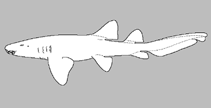 No image available for this species;
drawing shows typical species in Ginglymostomatidae.
Google Bild
drawing shows typical species in Ginglymostomatidae.
Klassifizierung / Names Namen | Synonyme | Catalog of Fishes(Gattung, Arten) | ITIS | CoL | WoRMS | Cloffa
Elasmobranchii (Haie und Rochen) (sharks and rays) > Orectolobiformes (Carpet sharks) > Ginglymostomatidae (Nurse sharks)
Etymology: Ginglymostoma: ginglymus (Gr.), hinge; stoma (Gr.), mouth, presumably referring to how corner of mouth has a hinged appearance (See ETYFish); unami: In honor of UNAM (Universidad Nacional Autónoma de México), for the “vital role it plays in educating the people of México” (translation) (See ETYFish).
Eponymy: This is an acronym of the Universidad Nacional Autónoma de México (UNAM). (Ref. 128868), visit book page.
Etymology: Ginglymostoma: ginglymus (Gr.), hinge; stoma (Gr.), mouth, presumably referring to how corner of mouth has a hinged appearance (See ETYFish); unami: In honor of UNAM (Universidad Nacional Autónoma de México), for the “vital role it plays in educating the people of México” (translation) (See ETYFish).
Eponymy: This is an acronym of the Universidad Nacional Autónoma de México (UNAM). (Ref. 128868), visit book page.
Umwelt: Milieu / Klimazone / Tiefenbereich / Verbreitungsgebiet Ökologie
seewasser benthopelagisch. Tropical
Verbreitung Territorien | FAO Gebiete | Ökosysteme | Vorkommen | Punkt Karte | Einführungen | Faunafri
Eastern Pacific: endemic in the area, from Mexico (Baja California including Gulf of Mexico) to Peru.
Größe / Gewicht / Alter
Kurzbeschreibung Bestimmungsschlüssel | Morphologie | Morphometrie
This species is distinguished from G. cirratum by comparing several meristic characters where the distance between the prebanchial and interdorsal regions, and that of the posterior end of the second dorsal fin and the beginning of the caudal lobe, are both shorter; it also differs by the position of the insertion of the first dorsal fin with regard to the pelvic fins and in the form and number of keels on the dermal denticles and teeth morphology (Ref. 113902).
Body shape (shape guide): other (see remarks); Cross section: other (see remarks).
Body shape (shape guide): other (see remarks); Cross section: other (see remarks).
Lebenszyklus und Paarungsverhalten Geschlechtsreife | Fortpflanzung | Ablaichen | Eier | Fruchtbarkeit | Larven
Hauptreferenz
Laden Sie Ihre Referenzen hoch | Referenzen | Koordinator : Compagno, Leonard J.V. | Partner
Del Moral-Flores, L., E. Ramírez-Antonio, A. Angulo and G. Pérez-Ponce de León, 2015. Ginglymostoma unami sp. nov. (Chondrichthes: Orectolobidae: Ginglomostomidae): una especie nueva de tiburón gata del Pacífico oriental tropical. Revista Mexicana de Biodiversidad 86:48-58. (Ref. 113902)
IUCN Rote Liste Status (Ref. 130435: Version 2025-2 (Global))
stark gefährdet (EN) (A2cd); Date assessed: 08 February 2019
CITES
Not Evaluated
Bedrohung für Menschen
Harmless
Nutzung durch Menschen
FAO - Publication: search | FishSource |
Mehr Information
Trophische Ökologie
Lebensmittel (Beutetiere)
Nahrungszusammensetzung
Nahrungsaufnahme
Lebensmittelrationen
Räuber
Lebensmittel (Beutetiere)
Nahrungszusammensetzung
Nahrungsaufnahme
Lebensmittelrationen
Räuber
Ökologie
Ökologie
Ökologie
Populationsdynamik
Wachstumsparameter
Max. Alter/Größen
Länge-Gewicht-Rel.
Länge-Länge-Verhältnis.
Längenhäufigkeiten
Massenkonvertierung
Rekrutierung
Dichte
Wachstumsparameter
Max. Alter/Größen
Länge-Gewicht-Rel.
Länge-Länge-Verhältnis.
Längenhäufigkeiten
Massenkonvertierung
Rekrutierung
Dichte
Lebenszyklus
Fortpflanzung
Geschlechtsreife
Reifung/Kiemen rel.
Fruchtbarkeit
Ablaichen
Laichaggregationen
Eier
Eientwicklung
Larven
Larven Pop.Dyn.
Fortpflanzung
Geschlechtsreife
Reifung/Kiemen rel.
Fruchtbarkeit
Ablaichen
Laichaggregationen
Eier
Eientwicklung
Larven
Larven Pop.Dyn.
Anatomie
Kiemenoberfläche
Gehirn
Otolith
Kiemenoberfläche
Gehirn
Otolith
Physiologie
Körperliche Zusammensetzung
Nährstoffe
Sauerstoffverbrauch
Schwimmart
Schwimmgeschwindigkeit
Visuelle Pigmente
Fischgeräusche
Krankheiten und Parasiten
Toxizität (LC50s)
Körperliche Zusammensetzung
Nährstoffe
Sauerstoffverbrauch
Schwimmart
Schwimmgeschwindigkeit
Visuelle Pigmente
Fischgeräusche
Krankheiten und Parasiten
Toxizität (LC50s)
Genetik
Genom
Genetik
Heterozygotie
Vererbbarkeit
Genetische Vielfalt
Genom
Genetik
Heterozygotie
Vererbbarkeit
Genetische Vielfalt
Menschenbezogen
Aquakultur-Systeme
Aquakultur Profile
Zuchtlinien
Ciguatera-Fälle
Briefmarken, Münzen, Verschiedenes.
Aquakultur-Systeme
Aquakultur Profile
Zuchtlinien
Ciguatera-Fälle
Briefmarken, Münzen, Verschiedenes.
Tools
Zusatzinformationen
Download XML
Zusammenfassung | Punktdaten | Namen | Photos
Internet Quellen
AFORO (otoliths) | Aquatic Commons | BHL | Cloffa | Websites from users | FishWatcher Einträge suchen | CISTI | Catalog of Fishes: Gattung, Arten | DiscoverLife | ECOTOX | FAO - Publication: search | Faunafri | Fishipedia | Fishtrace | GloBI | Google Books | Google Scholar | Google | IGFA World Record | OneZoom | Open Tree of Life | Otolith Atlas of Taiwan Fishes | PubMed | Reef Life Survey | Socotra Atlas | TreeBase | Tree of Life | Wikipedia: Gehe zu, Suchen | World Records Freshwater Fishing | Zoobank | Zoologischer Rekord
Schätzungen auf der Grundlage von Modellen
Phylogenetischer Diversitätsindex (Ref. 82804): PD50 = 0.8125 [Uniqueness, from 0.5 = low to 2.0 = high].
Bayesian length-weight: a=0.01000 (0.00244 - 0.04107), b=3.04 (2.81 - 3.27), in cm total length, based on all LWR estimates for this body shape (Ref. 93245).
Trophische Ebene (Ref. 69278): 4.0 ±0.3 se; based on size and trophs of closest relatives