



Bythaelurus tenuicephalus Kaschner, Weigmann & Thiel, 2015
Narrowhead catshark
Waarneming toevoegen in Fish Watcher
| Native range | All suitable habitat | Point map | Year 2050 |

|
| This map was computer-generated and has not yet been reviewed. |
| Bythaelurus tenuicephalus AquaMaps Data sources: GBIF OBIS |
Uploaden van uw Foto's en video's
Afbeeldingen | Google afbeelding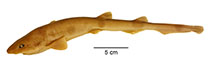 Bythaelurus tenuicephalus
Male Afbeelding van Weigmann, S.
Afbeeldingen | Google afbeelding
Male Afbeelding van Weigmann, S.
Classificatie / Namen Lokale namen | Synoniemen | Catalog of Fishes(Genus, Soort(en)) | ITIS | CoL | WoRMS | Cloffa
Elasmobranchii (haaien en roggen) (sharks and rays) > Carcharhiniformes (Ground sharks) > Pentanchidae (Deepwater catsharks)
Etymology: Bythaelurus: bythos (Gr.), depths of the sea, referring to its deepwater habitat; ailouros (Gr.), cat, probably an allusion to the vernacular “catshark,” so named for its cat-like eyes (See ETYFish); tenuicephalus: tenuis (L.), slender; cephalus, from kephale (Gr.), head, referring to its “remarkably” narrow head and snout (See ETYFish).
Etymology: Bythaelurus: bythos (Gr.), depths of the sea, referring to its deepwater habitat; ailouros (Gr.), cat, probably an allusion to the vernacular “catshark,” so named for its cat-like eyes (See ETYFish); tenuicephalus: tenuis (L.), slender; cephalus, from kephale (Gr.), head, referring to its “remarkably” narrow head and snout (See ETYFish).
Milieu: milieu / Klimaatzone / Diepte / verspreidingsgebied Ecologie
marien pelagic-oceanic; diepte 463 - 550 m (Ref. 106604). Tropical
Verspreiding Gebieden | FAO regio's | Ecosystemen | Voorkomen | Verspreidingskaart | Introducties | Faunafri
Western Indian Ocean: off Tanzania and Mozambique.
Grootte / Gewicht / Leeftijd
Korte beschrijving Determinatiesleutels | Morfologie | Morfometrie
This species is distinguished from its congeners by the following characters: slender head and snout, only slightly bell-shaped in dorsoventral view without distinct lateral indention (vs. distinctly bell-shaped snouts with a strong lateral indention anterior to outer nostrils); has broader claspers in adult males, the base width 2.1% TL (vs. 1.51.8% TL of congeners in the western Indian Ocean); further differs from B. clevai by having a smaller maximum size and a color pattern of fewer and smaller blotches, larger oral papillae, a shorter snout, and broader claspers without knob-like apex and with a smaller envelope and a subtriangular (vs. subrectangular) exorhipidion; differs from B. hispidus by having a longer snout, a longer dorsal-caudal space, broader clasper without knob-like apex, and fewer vertebral centra; differs from B. lutarius by having a smaller maximum size and has a blotched (vs. largely plain) coloration, numerous (vs. lacking) oral papillae, shorter anterior nasal flaps, a longer caudal fin, a shorter pelvic anal space, and shorter and broader claspers (Ref. 104913).
Body shape (shape guide): other (see remarks); Cross section: angular.
Body shape (shape guide): other (see remarks); Cross section: angular.
Levenscyclus en paargedrag Maturiteit | Voortplanting | Paaien | Eieren | Fecunditeit | Larven
Hoofdreferentie
Upload uw referenties | Referenties | Coördinator | Medewerkers
Kaschner, C.J., S. Weigmann and R. Thiel, 2015. Bythaelurus tenuicephalus n. sp., a new deep-water catshark (Carcharhiniformes, Scyliorhinidae) from the western Indian Ocean. Zootaxa 4013(1):120-138. (Ref. 104913)
Status op de Rode Lijst van het IUCN (Ref. 130435: Version 2025-2 (Global))
Niet bedreigd (LC) ; Date assessed: 25 April 2018
CITES
Not Evaluated
Gevaar voor de mens
Harmless
Gebruik door de mens
FAO - Publication: search | FishSource |
Meer informatie
Trofische ecologie
Voedsel (prooien)
Dieetsamenstelling
Voedselconsumptie
Voedselrantsoenen
Predatoren
Voedsel (prooien)
Dieetsamenstelling
Voedselconsumptie
Voedselrantsoenen
Predatoren
Populatiedynamica
Groeiparameters
Max. leeftijden / maten
Lengte-gewicht rel.
Lengte-lengte rel.
Lengtefrequenties
Massaconversie
Rekrutering
Abundantie
Groeiparameters
Max. leeftijden / maten
Lengte-gewicht rel.
Lengte-lengte rel.
Lengtefrequenties
Massaconversie
Rekrutering
Abundantie
Levenscyclus
Voortplanting
Maturiteit
Rijpheid/kieuwen rel.
Fecunditeit
Paaien
Paaibestanden
Eieren
Ontwikkeling van de eieren
Larven
Larvale populatiedynamiek
Voortplanting
Maturiteit
Rijpheid/kieuwen rel.
Fecunditeit
Paaien
Paaibestanden
Eieren
Ontwikkeling van de eieren
Larven
Larvale populatiedynamiek
Anatomie
Kieuwoppervlak
Hersenen
Otoliet
Kieuwoppervlak
Hersenen
Otoliet
Fysiologie
Lichaamssamenstelling
Voedingsstoffen
Zuurstofverbruik
Type zwemmen
Zwemsnelheid
Visuele pigmenten
Vis geluid
Ziekten en parasieten
Toxiciteit (LC50)
Lichaamssamenstelling
Voedingsstoffen
Zuurstofverbruik
Type zwemmen
Zwemsnelheid
Visuele pigmenten
Vis geluid
Ziekten en parasieten
Toxiciteit (LC50)
Genetica
genoom
Genetica
Heterozygositeit
Erfelijkheid
Genetische diversiteit
genoom
Genetica
Heterozygositeit
Erfelijkheid
Genetische diversiteit
Menselijk gerelateerd
Aquacultuursystemen
Aquacultuurprofielen
Kweeklijnen
Ciguatera gevallen
Postzegels, munten, diversen.
Aquacultuursystemen
Aquacultuurprofielen
Kweeklijnen
Ciguatera gevallen
Postzegels, munten, diversen.
Tools
Speciale rapporten
Bekijk gegevens voor het houden in een aquarium | Bekijk Fact Sheets voor de soort | Bekijk Aquacultuur Fact Sheets
Download XML
Internetbronnen
AFORO (otoliths) | Aquatic Commons | BHL | Cloffa | Websites from users | Bekijk FishWatcher | CISTI | Catalog of Fishes: Genus, Soort(en) | DiscoverLife | ECOTOX | FAO - Publication: search | Faunafri | Fishipedia | Fishtrace | GloBI | Google Books | Google Scholar | Google | IGFA World Record | OneZoom | Open Tree of Life | Otolith Atlas of Taiwan Fishes | PubMed | Reef Life Survey | Socotra Atlas | TreeBase | Tree of Life | Wikipedia: ga naar, zoek | World Records Freshwater Fishing | Zoobank | Zoological Record
Schattingen op basis van modellen
Fylogenetische diversiteitsindex (Ref. 82804): PD50 = 0.5001 [Uniqueness, from 0.5 = low to 2.0 = high].
Bayesian length-weight: a=0.01000 (0.00244 - 0.04107), b=3.04 (2.81 - 3.27), in cm total length, based on all LWR estimates for this body shape (Ref. 93245).
Trofisch niveau (Ref. 69278): 3.3 ±0.0 se; based on diet studies.
Weerstandsvermogen (Ref. 120179): Zeer laag, minimale populatieverdubbelingstijd meer dan 14 jaar (Preliminary K or Fecundity.).