



Ladda upp din foton och Videor
Google image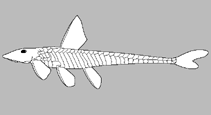 No image available for this species;
drawing shows typical species in Loricariidae.
Google image
drawing shows typical species in Loricariidae.
Klassificering / Namn Populärnamn | synonymer | Catalog of Fishes(Släkte, Arter) | ITIS | CoL | WoRMS | Cloffa
> Siluriformes (Catfishes) > Loricariidae (Armored catfishes) > Hypostominae
Etymology: Peckoltia: Because of Gustavo Peckolt,member of the Natural History Commission of Rondon (Ref. 45335); lujani: Named for the former graduate student of JWA, Dr. Nathan Lujan, who has led expeditions to some of the most remote regions of South America and obtained some of the most important specimens for the study of loricariid systematics specifically as well as South American fish systematics and ecology in general. In the process, he has given JWA more taxonomic work in the last decade than he had thought possible, and he is very thankful.
Eponymy: Gustavo Peckolt (1861–1923) was a Brazilian-born German botanist and pharmacist. [...] Dr Nathan Keller Lujan (d: 1976) is an ichthyologist, taxonomist, ecologist and evolutionary biologist who is a postdoctoral researcher at the Canadian Department of Fisheries and Oceans, Toronto. [...] (Ref. 128868), visit book page.
Etymology: Peckoltia: Because of Gustavo Peckolt,member of the Natural History Commission of Rondon (Ref. 45335); lujani: Named for the former graduate student of JWA, Dr. Nathan Lujan, who has led expeditions to some of the most remote regions of South America and obtained some of the most important specimens for the study of loricariid systematics specifically as well as South American fish systematics and ecology in general. In the process, he has given JWA more taxonomic work in the last decade than he had thought possible, and he is very thankful.
Eponymy: Gustavo Peckolt (1861–1923) was a Brazilian-born German botanist and pharmacist. [...] Dr Nathan Keller Lujan (d: 1976) is an ichthyologist, taxonomist, ecologist and evolutionary biologist who is a postdoctoral researcher at the Canadian Department of Fisheries and Oceans, Toronto. [...] (Ref. 128868), visit book page.
Miljö: miljö / Klimatzon / djupintervall / distributionsområde Ekologi
; sötvatten bottenlevande. Tropical
Utbredning Territorier | FAO områden | Ekosystem | Förekomster | Prickkarta | Utplanteringar | Faunafri
South America: Venezuela and Colombia.
Storlek / Vikt / Ålder
Kort beskrivning Bestämningsnycklar | Morfologi | Morfometri
Mjukstrålar i ryggfenan (totalt) : 9; Mjukstrålar i analfenan: 5. Peckoltia lujani is distinguished from P. pankimpuju by having well developed color and eyes; from all congeners except P. braueri, P. capitulata, P. compta, P. greedoi, P. oligospila, P. otali, and P. stimulata by having the abdomen largely naked posterior to the pectoral girdle (vs. only small naked patches at insertions of pelvic fins); from all congeners except P. furcata, P. greedoi, P. pankimpuju, and P. sabaji by having the dentaries meet at an angle greater than 90°; from P. ephippiata and P. greedoi by having large spots or blotches on the posterolateral surface of head and nape (vs. very small, very faint spots); from P. ephippiata by lacking slight keels on the lateral plates, particularly the median series (vs. slight keels present), by the presence of bands in the dorsal fin (vs. dorsal fin with light rays and dark membranes), by having fewer teeth, 20-37 dentary, 23-45 premaxillary (vs. 39-72 dentary, 41-73 premaxillary in P. ephippiata); from P. greedoi by having the pectoral-fin spine relaxed position only slightly dorsally, pointing maximally to dorsal insertion of caudal fin (vs. angled dorsally, pointing at insertion of dorsal fin) and pectoral-fin spine reaching less than one plate of the ventral series beyond the pelvic base when adpressed ventral to pelvic fin (vs. two or more). Peckoltia lujani can be diagnosed from Etsaputu by possessing more than six evertible cheek odontodes, the largest of which extending posterior to the eye (vs. six or fewer, the largest not extending beyond the exposed portion of the opercle). It can be separated from Hemiancistrus (except ‘H.’ landoni) and Ancistomus by having prominent dorsal saddles (vs. dark or light spots or entirely dark); and from all Hemiancistrus and Ancistomus by the presence of bands in the caudal fin and absence of free spots (vs. absence of bands or presence of some free spots) and bands in the dorsal fin (vs. spots or no markings).
Peckoltia lujani occurs in the same region as P. caenosa and identification of these two species when juveniles is difficult. Peckoltia lujani can be distinguished from adult P. caenosa by the absence of vermiculations on the abdomen and head, and from all P. caenosa by having the dentaries meet in a broad arc that is greater than 120° (vs. meeting at an angle less than 90°), and by having fewer teeth (all except one specimen with 24-37 dentary teeth and 22-45 premaxillary teeth [16 and 19 respectively in aberrant specimen] vs. 10-18 dentary teeth and 11-21 premaxillary teeth) (Ref. 99824).
Body shape (shape guide): elongated.
Body shape (shape guide): elongated.
Facultative air-breathing in the genus (Ref. 126274)
Livscykel och parningsbeteende Könsmognad | Reproduktion | Lek | Ägg | Fekunditet | Larver
Huvudreferens
Ladda upp dina referenser | referenser | Koordinator : Fisch-Muller, Sonia | Medarbetare
Armbruster, J.W., D.C. Werneke and M. Tan, 2015. Three new species of saddled loricariid catfishes, and a review of Hemiancistrus, Peckoltia, and allied genera (Siluriformes). Zookeys 480:97-123. (Ref. 99824)
Status på IUCN:s rödlista (Ref. 130435: Version 2025-2 (Global))
Least Concern (LC) ; Date assessed: 21 August 2020
CITES
Not Evaluated
Hot mot människor
Harmless
Mänskliga användningsområden
FAO - Publication: search | FishSource |
Ytterligare information
Trofisk ekologi
Livsmedelsartiklar (preys)
Födosammansättning
Födointag
Matransoner
Predatorer
Livsmedelsartiklar (preys)
Födosammansättning
Födointag
Matransoner
Predatorer
Populationsdynamik
Tillväxtparametrar
Max. åldrar / storlekar
Längd-vikt rel.
Längd-längd rel.
Längd-frekvenser
Massakonvertering
Rekrytering
Abundans
Tillväxtparametrar
Max. åldrar / storlekar
Längd-vikt rel.
Längd-längd rel.
Längd-frekvenser
Massakonvertering
Rekrytering
Abundans
Livscykel
Reproduktion
Könsmognad
Mognad/Gills rel.
Fekunditet
Lek
Lekande aggregat
Ägg
Utveckling av ägg
Larver
Larvdynamik
Reproduktion
Könsmognad
Mognad/Gills rel.
Fekunditet
Lek
Lekande aggregat
Ägg
Utveckling av ägg
Larver
Larvdynamik
Anatomi
Gälyta
Hjärna
Otolit
Gälyta
Hjärna
Otolit
Fysiologi
Kroppssammansättning
Näringsämnen
Syreförbrukning
Typ av simning
Simhastighet
Visuella pigment
Ljud från fisk
Sjukdomar & Parasiter
Toxicitet (LC50)
Kroppssammansättning
Näringsämnen
Syreförbrukning
Typ av simning
Simhastighet
Visuella pigment
Ljud från fisk
Sjukdomar & Parasiter
Toxicitet (LC50)
Genetik
Genom
Genetik
Heterozygositet
Ärftlighet
Genetisk mångfald
Genom
Genetik
Heterozygositet
Ärftlighet
Genetisk mångfald
Människorelaterad
Vattenbrukssystem
Vattenbruksprofiler
Avelslinjer
Ciguatera-fall
Frimärken, mynt, diverse.
Vattenbrukssystem
Vattenbruksprofiler
Avelslinjer
Ciguatera-fall
Frimärken, mynt, diverse.
Verktyg
Särskilda rapporter
Kontrollera för underhåll av akvarium | Kontrollera om det finns faktablad om arter | Kontrollera om det finns faktablad om vattenbruk
Ladda ner XML
Internet-källor
AFORO (otoliths) | Aquatic Commons | BHL | Cloffa | Websites from users | Check FishWatcher | CISTI | Catalog of Fishes: Släkte, Arter | DiscoverLife | ECOTOX | FAO - Publication: search | Faunafri | Fishipedia | Fishtrace | GloBI | Google Books | Google Scholar | Google | IGFA World Record | OneZoom | Open Tree of Life | Otolith Atlas of Taiwan Fishes | PubMed | Reef Life Survey | Socotra Atlas | TreeBase | Tree of Life | Wikipedia: Go, sök | World Records Freshwater Fishing | Zoobank | Zoologiskt register
Uppskattningar baserade på modeller
Index för fylogenetisk mångfald (Ref. 82804): PD50 = 0.5000 [Uniqueness, from 0.5 = low to 2.0 = high].
Bayesian length-weight: a=0.01549 (0.00726 - 0.03306), b=2.96 (2.79 - 3.13), in cm total length, based on LWR estimates for this (Sub)family-body shape (Ref. 93245).
Resiliens (Ref. 120179): Hög, lägsta populationsfördubblingstid mindre än 15 månader (Preliminary K or Fecundity.).