



Farlowella yarigui Ballen & Mojica, 2014
Carica il tuo foto e Video
Google image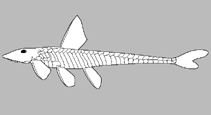 No image available for this species;
drawing shows typical species in Loricariidae.
Google image
drawing shows typical species in Loricariidae.
Classificazione / Nomi Nomi Comuni | Sinonimi | Catalog of Fishes(Genere, Specie) | ITIS | CoL | WoRMS | Cloffa
> Siluriformes (Catfishes) > Loricariidae (Armored catfishes) > Loricariinae
Etymology: Farlowella: Because of W. G. Farlow, from Harvard University (Ref. 45335); yarigui: The specific name is an arbitrary combination of letters in reference to the Parque Nacional Natural Serranía de los Yariguíes, Departamento de Santander, Colombia, in recognition of its conservation efforts in the Eastern Colombian Andes. A noun in apposition.
Eponymy: Dr William Gilson Farlow (1844–1919) was an American physician and botanist who specialised in algae. [...] (Ref. 128868), visit book page.
Etymology: Farlowella: Because of W. G. Farlow, from Harvard University (Ref. 45335); yarigui: The specific name is an arbitrary combination of letters in reference to the Parque Nacional Natural Serranía de los Yariguíes, Departamento de Santander, Colombia, in recognition of its conservation efforts in the Eastern Colombian Andes. A noun in apposition.
Eponymy: Dr William Gilson Farlow (1844–1919) was an American physician and botanist who specialised in algae. [...] (Ref. 128868), visit book page.
Ambiente: milieu / zona climatica / distribuzione batimetrica / gamma di distribuzione Ecologia
; acqua dolce benthopelagico. Tropical
Distribuzione Territories | Aree FAO | Ecosistemi | Presenze | Mappa dei ritrovamenti | Introduzioni | Faunafri
South America: Río Topón, middle río Magdalena Basin in Colombia.
Dimensione / Peso / Età
Breve descrizione Chiavi di identificazione | Morfologia | Morfometria
This species belongs to the Farlowella acus species group by the presence of long breeding odontodes on the snout in mature males, four rows of lateral body plates from the anteriormost portion of body to posterior margin of dorsal- and anal-fin base, and two complete rows of ventral plates and no single plate between pelvic-fin insertions. Diagnosed from other members of the F. acus species group by having the median anterior lateral row of plates diamond-shaped (vs. hexagonal in shape in F. acus, F. colombiensis, F. martini, F. venezuelensis and F. vittata). Further differs from F. martini by having dark interradial membranes on the caudal fin (vs. interradial membranes clear in F. martini). Distinguished from members of the Farlowella curtirostra species group by having restricted odontodes on sides of the snout but not extending onto the cheek region (vs. hypertrophied odontodes in breeding males extensive on sides of the snout and cheek); from members of the F. amazona species group by having notably concave lateral margins of the snout (vs. lateral margins of the snout straight to nearly straight) and eyes not elevated on the head (vs. eyes elevated on the head); from species of the Farlowella nattereri species group as well as from Farlowella gracilis by having four rows of lateral plates (vs. five rows in F. gracilis and F. nattereri species group); and from species of the F. knerii and F. mariaelenae species groups by having two abdominal plate rows (vs. three abdominal rows in the F. knerii and F. mariaelenae species groups) (Ref. 94974).
Body shape (shape guide): elongated.
Body shape (shape guide): elongated.
Facultative air-breathing in the genus (Ref. 126274); Found among wood sticks and partially-submerged vegetation using a bottom net. Encountered only in such microhabitat despite collection efforts throughout the main channel of the río Topón. Occurs together with Astyanax caucanus, A. magdalenae, A. filiferus, Roeboides dayi, Sturisoma cf. panamense, Chaetostoma sp., Lasiancistrus caucanus, Creagrutus cf. guanes and Hemibrycon sp. (Ref. 94974).
Ciclo vitale e comportamento di accoppiamento Maturità | Riproduzione | Deposizione | Uova | Fecondità | Larve
Riferimento principale
Caricare le referenze | Bibliografia | Coordinatore : Fisch-Muller, Sonia | Collaboratori
Ballen, G.A. and J.I. Mojica, 2014. A new trans-Andean stick catfish of the genus Farlowella Eigenmann & Eigenmann, 1889 (Siluriformes: Loricariidae) with the first record of the genus for the río Magdalena basin in Colombia. Zootaxa 3765(2):134-142. (Ref. 94974)
Stato della Lista Rossa IUCN (Ref. 130435: Version 2025-2 (Global))
Data deficient (DD) ; Date assessed: 10 October 2014
CITES
Not Evaluated
Minaccia per l'uomo
Harmless
Usi umani
FAO - Publication: search | FishSource |
Informazioni ulteriori
Ecologia trofica
Articoli alimentari (prede)
Alimentazione
Consumo di cibo
Razioni alimentari
Predatori
Articoli alimentari (prede)
Alimentazione
Consumo di cibo
Razioni alimentari
Predatori
Dinamica della popolazione
Parametri di crescita
Età massima / dimensioni massime
Rapporto lunghezza-peso.
Lunghezza-lunghezza rel.
Lunghezza-frequenze
Conversione di massa
Reclutamento
Abbondanza
Parametri di crescita
Età massima / dimensioni massime
Rapporto lunghezza-peso.
Lunghezza-lunghezza rel.
Lunghezza-frequenze
Conversione di massa
Reclutamento
Abbondanza
Ciclo di vita
Riproduzione
Maturità
Maturità/Gli occhielli sono relativi.
Fecondità
Deposizione
Aggregazioni riproduttive
Uova
Sviluppo delle uova
Larve
Dinamica popolazioni larvali
Riproduzione
Maturità
Maturità/Gli occhielli sono relativi.
Fecondità
Deposizione
Aggregazioni riproduttive
Uova
Sviluppo delle uova
Larve
Dinamica popolazioni larvali
Anatomia
Area branchiale
Cervello
Otolite
Area branchiale
Cervello
Otolite
Fisiologia
Composizione corporea
Nutrienti
Consumo di ossigeno
Tipo di nuoto
Velocità di nuoto
Pigmenti visivi
Suono del pesce
Malattie e parassiti
Tossicità (LC50)
Composizione corporea
Nutrienti
Consumo di ossigeno
Tipo di nuoto
Velocità di nuoto
Pigmenti visivi
Suono del pesce
Malattie e parassiti
Tossicità (LC50)
Genetica
Genome
Genetica
Eterozigosi
Ereditarietà
Diversità genetica
Genome
Genetica
Eterozigosi
Ereditarietà
Diversità genetica
Legato all'uomo
Sistemi di acquacoltura
Profili di acquacoltura
Varietà
Casi di Ciguatera
Francobolli, monete, materiale vario.
Sistemi di acquacoltura
Profili di acquacoltura
Varietà
Casi di Ciguatera
Francobolli, monete, materiale vario.
Strumenti
Libro elettronico | Giuda pratica | Generatore frequenze di lunghezza | Strumento Parametri Biologici | Mappa dei ritrovamenti |
Cattura-MSY |
Rapporti speciali
Controllo della manutenzione dell'acquario | Verificare la presenza di schede informative sulle specie | Verifica delle schede informative sull'acquacoltura
Scarica XML
Fonti Internet
AFORO (otoliths) | Aquatic Commons | BHL | Cloffa | Websites from users | Check FishWatcher | CISTI | Catalog of Fishes: Genere, Specie | DiscoverLife | ECOTOX | FAO - Publication: search | Faunafri | Fishipedia | Fishtrace | GloBI | Google Books | Google Scholar | Google | IGFA World Record | OneZoom | Open Tree of Life | Otolith Atlas of Taiwan Fishes | PubMed | Reef Life Survey | Socotra Atlas | TreeBase | Tree of Life | Wikipedia: Go, ricerca | World Records Freshwater Fishing | Zoobank | Record zoologico
Stime basate su modelli
Indice di diversità filogenetica (Fonte Biblio. 82804): PD50 = 0.5000 [Uniqueness, from 0.5 = low to 2.0 = high].
Bayesian length-weight: a=0.00398 (0.00185 - 0.00857), b=3.11 (2.93 - 3.29), in cm total length, based on LWR estimates for this (Sub)family-body shape (Ref. 93245).
Livello trofico (Fonte Biblio. 69278): 2.6 ±0.2 se; based on size and trophs of closest relatives
Resilienza (Fonte Biblio. 120179): Alto, tempo minimo di raddoppiamento della popolazione meno di 15 mesi (Preliminary K or Fecundity.).