



Hypostomus basilisko Tencatt, Zawadzki & Froehlich, 2014
Envoyez vos Photos et vidéos
Images | Images Google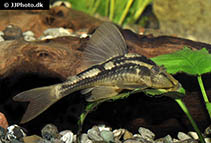 Hypostomus basilisko
Photo de JJPhoto
Images | Images Google
Photo de JJPhoto
Classification / Noms Noms communs | Synonymes | Catalog of Fishes(Genre, Espèce) | ITIS | CoL | WoRMS | Cloffa
> Siluriformes (Catfishes) > Loricariidae (Armored catfishes) > Hypostominae
Etymology: Hypostomus: Greek, hypo = under + Greek, stoma = mouth (Ref. 45335).
Etymology: Hypostomus: Greek, hypo = under + Greek, stoma = mouth (Ref. 45335).
Environnement : milieu / zone climatique / profondeur / gamme de distribution Écologie
; eau douce démersal. Tropical
Distribution Territoires | Zones FAO | Écosystèmes | Occurrences | Carte par point | Introductions | Faunafri
South America: Rio Salobra basin of the rio Paraguay basin, Bodoquena Plateau in Mato Grosso do Sul, Brazil.
Taille / Poids / Âge
Description synthétique Clés d'identification | Morphologie | Morphométrie
Épines dorsales (Total) : 2; Rayons mous dorsaux (Total) : 7; Rayons mous anaux: 5. Hypostomus basilisko is distinguished from all congeners, except those belonging to the H. cochliodon group, by having the following unique combination of characters: absence of notch between metapterygoid and hyomandibula(vs. presence of notch); and strongly angled dentaries, less than 80° (vs. shallow angle between dentaries, generally more
than 80°). It differs the other members of H. cochliodon group, except H. pagei and H. soniae, by the absence of spots on body and fins (vs. presence of spots). It is distinguished from H. pagei by having highly developed keels on lateral series of plates (vs. keels weak, almost absent); from H. soniae for having teeth with a large spoon-shaped mesial cusp and a lateral cusp, if present, almost imperceptible (vs. teeth with mesial cusp conspicuously enlarged and rounded but not spoon shaped; distinct lateral cusp) and massive odontodes covering the dorsal region of head and trunk, forming well-developed keels (vs. less developed odontodes on head and trunk, keels absent or
weakly-developed). It can be distinguished from H. soniae by the possession of many well-developed papilla on the internal surface of anterior and posterior jaws (vs. few papillae on the internal surface of anterior and posterior jaws); from H. cochliodon and H. khimaeraby having 27 vertebrae (29 and 28, respectively); from H. hondae (Regan) and H. plecostomoides (Eigenmann) by the absence of platelets in the skin around dorsal-fin base (vs. presence); from H. levis by the presence of an adipose fin (vs. absence); from H. taphorni by having both caudal-fin lobes evenly colored (vs. bicolored caudal fin with ventral lobe darker) (Ref. 97225).
Body shape (shape guide): elongated.
Body shape (shape guide): elongated.
Facultative air-breathing in the genus (Ref. 126274); Occurs in clear-water streams and rivers. Larger fish remain during the day lying on soft-bottom patches (mainly on sand, sometimes on leaf litter) at deeper sites and forage mainly during the night at shallower areas with rocky bottom. Grazing during the day were occasionally observed. Small fish forage during the day and night, always in shallower areas. Individuals feed mainly on periphyton from rocky substrates, but also explore from submerged logs and branches (Ref. 97225).
Cycle de vie et comportement reproducteur Maturité | Reproduction | Frai | Œufs | Fécondité | Larves
Référence principale
Téléchargez vos références | Références | Coordinateur : Fisch-Muller, Sonia | Collaborateurs
Tencatt, L.F.C., C.H. Zawadzki and O. Froehlich, 2014. Two new species of the Hypostomus cochliodon group (Siluriformes: Loricariidae) from the rio Paraguay basin, with a redescription of Hypostomus cochliodon Kner, 1854. Neotrop. Ichthyol. 12(3):585-602. (Ref. 97225)
CITES
Not Evaluated
Menace pour l'homme
Harmless
Utilisations par l'homme
Pêcheries: sans intérêt
FAO - Publication: search | FishSource |
Plus d'informations
Écologie trophique
Aliments (proies)
Composition du régime alimentaire
Consommation alimentaire
Rations alimentaires
Prédateurs
Aliments (proies)
Composition du régime alimentaire
Consommation alimentaire
Rations alimentaires
Prédateurs
Dynamique des populations
Paramètres de croissance
Âges / tailles maximales
Longueur-poids rel.
Rel. longueur-longueur.
Fréquences de longueurs
Conversion de masse
Recrutement
Abondance
Paramètres de croissance
Âges / tailles maximales
Longueur-poids rel.
Rel. longueur-longueur.
Fréquences de longueurs
Conversion de masse
Recrutement
Abondance
Cycle de vie
Reproduction
Maturité
Maturité/épines rel.
Fécondité
Frai
Agrégats de frai
Œufs
Développement de l'œuf
Larves
Dynamique des populations larvaires
Reproduction
Maturité
Maturité/épines rel.
Fécondité
Frai
Agrégats de frai
Œufs
Développement de l'œuf
Larves
Dynamique des populations larvaires
Anatomie
Surface branchiale
Cerveau
Otolithe
Surface branchiale
Cerveau
Otolithe
Physiologie
Composition corporelle
Nutriments
Consommation d'oxygène
Type de natation
Vitesse de nage
Pigments visuels
Son de poisson
Maladies et parasites
Toxicité (CL50)
Composition corporelle
Nutriments
Consommation d'oxygène
Type de natation
Vitesse de nage
Pigments visuels
Son de poisson
Maladies et parasites
Toxicité (CL50)
Génétique
génôme
Génétique
Hétérozygotie
Héritabilité
Diversité génétique
génôme
Génétique
Hétérozygotie
Héritabilité
Diversité génétique
Liées à l'homme
Systèmes d'aquaculture
Profils d'aquaculture
Souches
Cas de ciguatera
Timbres, pièces de monnaie, divers
Systèmes d'aquaculture
Profils d'aquaculture
Souches
Cas de ciguatera
Timbres, pièces de monnaie, divers
Outils
E-book | Guide de terrain | Générateur de fréquences de longueur | Outil de dynamique de population | Carte par point |
Capture-MSY |
Articles particuliers
Télécharger en XML
Sources Internet
AFORO (otoliths) | Aquatic Commons | BHL | Cloffa | Websites from users | FishWatcher | CISTI | Catalog of Fishes: Genre, Espèce | DiscoverLife | ECOTOX | FAO - Publication: search | Faunafri | Fishipedia | Fishtrace | GloBI | Google Books | Google Scholar | Google | IGFA World Record | OneZoom | Open Tree of Life | Otolith Atlas of Taiwan Fishes | PubMed | Reef Life Survey | Socotra Atlas | TreeBase | Arbre de Vie | Wikipedia: aller à, chercher | World Records Freshwater Fishing | Zoobank | Zoological Record
Estimations basées sur des modèles
Indice de diversité phylogénétique (Réf. 82804): PD50 = 0.5000 [Uniqueness, from 0.5 = low to 2.0 = high].
Bayesian length-weight: a=0.01862 (0.00938 - 0.03698), b=3.01 (2.85 - 3.17), in cm total length, based on LWR estimates for this species & Genus-body shape (Ref. 93245).
Résilience (Réf. 120179): Milieu, temps minimum de doublement de population : 1,4 à 4,4 années (Preliminary K or Fecundity.).