This website uses cookies to enhance your browsing experience and ensure the functionality of our site. For more detailed information about the types of cookies we use and how we protect your privacy, please visit our Privacy Information page.
×
Cookie Settings
This website uses different types of cookies to enhance your experience. Please select your preferences below:
> Eupercaria/misc (Various families in series Eupercaria) > Labridae (Wrasses) > Julidinae
Etymology: Macropharyngodon:Greek, makros = great + Greek, pharyngx = pharynx + Greek,odous = teeth (Ref. 45335); pakoko:Named for the famous Marquesan warrior Pakoko, last chieftain who led the Marquesan resistance to the French during his time (died in 1984); noun in apposition.
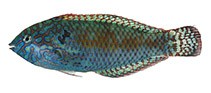
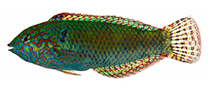
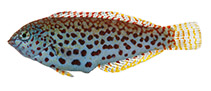
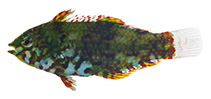
เงี่ยงครีบหลัง (รวม) : 9; ก้านครีบอ่อนที่หาง (รวม) : 11; เงี่ยงครีบก้น: 3; ก้านครีบอ่อนที่ก้น: 11. This species is distinguished by the following characters: D IX,11; A III,11; pectoral rays 12 (plus upper rudimentary ray); 2-3 pores on anterior lateral-line scales;17 (15-17) gill rakers. Colour pattern of females: no black spot on chest at base of gill openings; widely-spaced spots on body, especially on head; small bright yellow spots in vertical row on caudal fin; pale pelvic fins with 3 cross-bands (reddish orange to yellow); along the base of anal fin are small reddish spots. Colour pattern of males: green head and body with scales having a dark purplish brown bar, those laterally and ventrally on body with bar preceded by a blue line; curved black humeral blotch outline with iridescent blue followed by a broad and irregular longitudinal band of a dark yellow-orange network superimposed over and adjacent to the bar pattern on scales; head with an anastomosing pattern of red bands edged with dark purple and iridescent blue; cheek with an inverted irregular 'U'-shaped band; upper base of pectoral fin with a small black spot; dorsal and anal fins reddish with blue-ringed green spots with black border and some spots are merging and forming vertical reticulations; caudal fin has reddish reticulations around greenish yellow spots with black borders, the distal margin has a broad red band followed by a black outline then whitish tips on ray; pelvic fin translucent or colored, outermost rays faintly reddish yellow with innermost rays translucent. Colour of juveniles: few irregular black blotches on body with irregular red bars on anal fin broadly joined distally with yellow; a small black spot instead of an ocellus posteriorly on the dorsal fin and no large back spots and ocellus on the anal fin (Ref. 97238). Body shape (shape guide): fusiform / normal; Cross section: compressed.
Delrieu-Trottin, E,, J.T. Williams and S. Planes, 2014. Macropharyngodon pakoko, a new species of wrasse (Teleostei: Labridae) endemic to the Marquesas Islands, French Polynesia. Zootaxa 3857(3):433-443. (Ref. 97238)
สถานะบัญชีแดงของ IUCN (Ref. 130435: Version 2025-2 (Global))