



Hypostomus kuarup Zawadzki, Birindelli & Lima, 2012
Ανεβάστε το φωτογραφίες και Βίντεο
Google image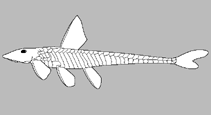 No image available for this species;
drawing shows typical species in Loricariidae.
Google image
drawing shows typical species in Loricariidae.
Ταξινόμηση / Ονόματα Κοινά ονόματα | Συνώνυμα | Catalog of Fishes(Γένος, Είδη) | ITIS | CoL | WoRMS | Cloffa
> Siluriformes (Catfishes) > Loricariidae (Armored catfishes) > Hypostominae
Etymology: Hypostomus: Greek, hypo = under + Greek, stoma = mouth (Ref. 45335); kuarup: Kuarup or Quarup is an origin myth and a festivity shared by most the ethnical groups living in the upper portion of the Xingu Indigenous Park. The first Kuarup is said to have taken place at the Saginhenhu, a locality recently identified by the Indians as being the Cachoeira do Adelino, one of the localities from where this new species occurs.
Eponymy: Kuarup, or Quarup, is an origin myth and a festivity shared by most of the ethnic groups living in the upper portion of the Xingu Indigenous Park, Brazil. (Ref. 128868), visit book page.
Etymology: Hypostomus: Greek, hypo = under + Greek, stoma = mouth (Ref. 45335); kuarup: Kuarup or Quarup is an origin myth and a festivity shared by most the ethnical groups living in the upper portion of the Xingu Indigenous Park. The first Kuarup is said to have taken place at the Saginhenhu, a locality recently identified by the Indians as being the Cachoeira do Adelino, one of the localities from where this new species occurs.
Eponymy: Kuarup, or Quarup, is an origin myth and a festivity shared by most of the ethnic groups living in the upper portion of the Xingu Indigenous Park, Brazil. (Ref. 128868), visit book page.
Περιβάλλον: περιβάλλον / κλιματική ζώνη / εύρος βάθους / εύρος διανομής Οικολογία
; Γλυκού νερού βενθικό(ς). Tropical
Κατανομή Εδάφη | Περιοχές FAO | Οικοσυστήματα | Παρουσίες | Σημειακός χάρτης | Εισαγωγές | Faunafri
South America: Rio Culuene, upper rio Xingu basin in Mato Grosso, Brazil.
Μέγεθος / Βάρος / Ηλικία
Γεννητική Ωρίμανση: Lm ? range ? - ? cm
Max length : 21.8 cm SL αρσενικό/απροσδιόριστο; (Ref. 91068)
Max length : 21.8 cm SL αρσενικό/απροσδιόριστο; (Ref. 91068)
Σύντομη περιγραφή Κλείδες προσδιορισμού | Μορφολογία | Μορφομετρία
Ραχιαίες άκανθες (συνολικά) : 2; Μαλακές ραχιαίες ακτίνες (συνολικά) : 7; Μαλακές εδρικές ακτίνες: 5. Can be diagnosed from other species of Hypostomus, excluding H. alatus, H. denticulatus, H. francisci, H. johnii, H. isbrueckeri, H. luteomaculatus, H. meleagris, H. multidens, H. mutucae, H. regani, H. strigaticeps, and H. ternetzi, by having high number of teeth (58 to 101, mean 77 on premaxilla, and 58 to 105, mean 80 on dentary) (vs. lower number of teeth, rarely more than 50 on both premaxilla and dentary). Differs from H. alatus, H. francisci, H. luteomaculatus, H. meleagris, H. multidens, H. regani, and H. strigaticeps by having dark spots over body and fins (vs. pale spots) and additionally from H. alatus, H. francisci, H. luteomaculatus, and H. regani by having a large premaxillary ramus, 24.0-29.9% of HL, mean 27.1% and large dentary ramus, 22.2-30.2% of HL, mean 27.0% (vs. relatively small premaxillary and dentary ramus, approximately or less than 20% of HL). Distinguished from H. denticulatus by having teeth with asymmetric cusps (vs. teeth with symmetrical cusps); from H. isbrueckeri by possessing an homogeneous caudal-fin ground color (vs. a yellow band on
distal caudal-fin margin in mature males); from H. johnii by having dark spots over body and fins usually faded (vs. dark spots over body and fins always conspicuous), abdomen
mostly naked (vs. mostly plated), and by having the upper and lower caudal-fin rays almost similar in length (vs. lower ray considerably longer than upper); from H. mutucae by
having caudal peduncle wide, width approximately equal to depth at adipose-fin origin (vs. caudal peduncle compressed, depth approximately twice the width at adipose-fin origin),
relatively robust teeth on both jaws (vs. slender teeth on both jaws), and body with small dark spots (vs. body with large dark blotches, approximately similar to larger than eye diameter,
in specimens around 100 mm SL); from H. ternetzi by having a roughly flat interorbital and predorsal region (vs. interorbital and predorsal region with prominent median keel) and abdomen mostly naked (vs. mostly plated) (Ref. 91068).
Body shape (shape guide): elongated.
Body shape (shape guide): elongated.
Facultative air-breathing in the genus (Ref. 126274); Inhabits rapid stretches. Collected in the rio Culuene in the former rapids which are now the current area of reservoir Paranatinga II. The type locality is used to be a rapid area that dried out after the construction of the the Paranatinga II hydroelectric Dam and this species still exists at a fish ladder built at the type locality and certainly also at rapids situated both above (at the mouth of the rio Maria) and below the reservoir (Cachoeira do Adelino). Sympatric with Hypostomus faveolus (Ref. 91068).
Κύκλος ζωής και συμπεριφορά ζευγαρώματος Γεννητική Ωρίμανση | Αναπαραγωγή | Γεννοβολία | Αβγά | Γονιμότητα | Προνύμφες
Κύρια αναφορά
Ανεβάστε τις αναφορές σας | Αναφορές | Συντονιστής : Fisch-Muller, Sonia | Συνεργάτες
Zawadzki, C.H., J.L.O. Birindelli and F.C.T. Lima, 2012. A new armored catfish species of the genus Hypostomus Lacépède, 1803 (Siluriformes: Loricariidae) from the upper rio Xingu basin, Brazil. Neotrop. Ichthyol. 10(2):245-253. (Ref. 91068)
Κατάσταση Κόκκινου Καταλόγου IUCN (Ref. 130435: Version 2025-2 (Global))
Least Concern (LC) ; Date assessed: 07 November 2018
CITES
Not Evaluated
Απειλή για τον άνθρωπο
Harmless
Ανθρώπινες χρήσεις
αλιεία: χωρίς ενδιαφέρον
FAO - Publication: search | FishSource |
Περισσότερες πληροφορίες
Τροφική Οικολογία
Τρόφιμα (θηράματα)
Σύσταση δίαιτας
Κατανάλωση τροφής
Μερίδες τροφίμων
Θηρευτές
Τρόφιμα (θηράματα)
Σύσταση δίαιτας
Κατανάλωση τροφής
Μερίδες τροφίμων
Θηρευτές
Οικολογία
Οικολογία
Οικολογία
Πληθυσμιακή δυναμική
Παράμετροι Αύξησης
Μέγιστες ηλικίες / μεγέθη
Μήκος-βάρος σχετ.
Μήκος-μήκος rel.
Μήκος-συχνότητες
Μετατροπή μάζας
Στρατολόγηση
Αφθονία
Παράμετροι Αύξησης
Μέγιστες ηλικίες / μεγέθη
Μήκος-βάρος σχετ.
Μήκος-μήκος rel.
Μήκος-συχνότητες
Μετατροπή μάζας
Στρατολόγηση
Αφθονία
Κύκλος ζωής
Αναπαραγωγή
Γεννητική Ωρίμανση
Ωριμότητα / Gills rel.
Γονιμότητα
Γεννοβολία
Συγκεντρώσεις αναπαραγωγής
Αβγά
Ανάπτυξη αυγών
Προνύμφες
Δυναμική προνυμφών
Αναπαραγωγή
Γεννητική Ωρίμανση
Ωριμότητα / Gills rel.
Γονιμότητα
Γεννοβολία
Συγκεντρώσεις αναπαραγωγής
Αβγά
Ανάπτυξη αυγών
Προνύμφες
Δυναμική προνυμφών
Ανατομία
Επιφάνεια βραγχίων
Εγκέφαλος
Ωτόλιθος
Επιφάνεια βραγχίων
Εγκέφαλος
Ωτόλιθος
Φυσιολογία
Σύνθεση σώματος
Θρεπτικά συστατικά
Κατανάλωση οξυγόνου
Τύπος κολύμβησης
Ταχύτητα κολύμβησης
Οπτικές χρωστικές ουσίες
Ήχος ψαριών
Ασθένειες & παράσιτα
Τοξικότητα (LC50)
Σύνθεση σώματος
Θρεπτικά συστατικά
Κατανάλωση οξυγόνου
Τύπος κολύμβησης
Ταχύτητα κολύμβησης
Οπτικές χρωστικές ουσίες
Ήχος ψαριών
Ασθένειες & παράσιτα
Τοξικότητα (LC50)
Γενετική
Γονιδίωμα
Γενετική
Ετεροζυγωτία
Κληρονομικότητα
Γενετική ποικιλομορφία
Γονιδίωμα
Γενετική
Ετεροζυγωτία
Κληρονομικότητα
Γενετική ποικιλομορφία
Ανθρώπινη σχέση
Συστήματα υδατοκαλλιέργειας
Προφίλ υδατοκαλλιεργειών
Στελέχοι
Περιπτώσεις Ciguatera
Γραμματόσημα, νομίσματα, διάφορα.
Συστήματα υδατοκαλλιέργειας
Προφίλ υδατοκαλλιεργειών
Στελέχοι
Περιπτώσεις Ciguatera
Γραμματόσημα, νομίσματα, διάφορα.
Εργαλεία
Ηλεκτρονικό βιβλίο | Οδηγός πεδίου | Ανάλυση κατά μήκος συνθέσεων | Εργαλείο ιστορίας ζωής | Σημειακός χάρτης |
Catch-MSY |
Ειδικές εκθέσεις
Έλεγχος για συντήρηση ενυδρείου | Ελέγξτε για ενημερωτικά δελτία ειδών | Ελέγξτε για ενημερωτικά δελτία υδατοκαλλιέργειας
Λήψη XML
Διαδικτυακές πηγές
AFORO (otoliths) | Aquatic Commons | BHL | Cloffa | Websites from users | Check FishWatcher | CISTI | Catalog of Fishes: Γένος, Είδη | DiscoverLife | ECOTOX | FAO - Publication: search | Faunafri | Fishipedia | Fishtrace | GloBI | Google Books | Google Scholar | Google | IGFA World Record | OneZoom | Open Tree of Life | Otolith Atlas of Taiwan Fishes | PubMed | Reef Life Survey | Socotra Atlas | TreeBase | Δέντρο Ζωής | Wikipedia: Go, αναζήτηση | World Records Freshwater Fishing | Zoobank | Zoological Record
Εκτιμήσεις βάσει μοντέλων
Δείκτης φυλογενετικής ποικιλότητας (Αναφ. 82804): PD50 = 0.5000 [Uniqueness, from 0.5 = low to 2.0 = high].
Bayesian length-weight: a=0.01585 (0.00726 - 0.03460), b=2.95 (2.78 - 3.12), in cm total length, based on LWR estimates for this Genus-body shape (Ref. 93245).
Ελαστικότητα (Αναφ. 120179): Μεσαίο(α), ελάχιστος χρόνος για διπλασιασμό πληθυσμού 1,4 - 4,4 έτη (Preliminary K or Fecundity.).