



Spectracanthicus zuanoni Chamon & Rapp Py-Daniel, 2014
Sube tu fotos y Vídeos
Imágenes | Google image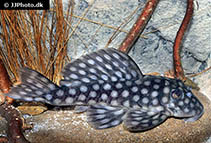 Spectracanthicus zuanoni
Foto de JJPhoto
Imágenes | Google image
Foto de JJPhoto
Clasificación / Nombres Nombres comunes | Sinónimos | Catalog of Fishes(Género, Especie) | ITIS | CoL | WoRMS | Cloffa
> Siluriformes (Catfishes) > Loricariidae (Armored catfishes) > Hypostominae
Etymology: Spectracanthicus: Latin, spectrum = look, apparition + Greek, akantha = thorn (Ref. 45335); zuanoni: Named for Jansen Zuanon (INPA) due to his contribution to the knowledge of Neotropical Ichthyology. Jansen Zuanon was also the first ichthyologist who collected and identified this species as a new one.
Eponymy: Dr Jansen Alfredo Sampaio Zuanon is a Brazilian ichthyolgist and ecologist. [...] (Ref. 128868), visit book page.
Etymology: Spectracanthicus: Latin, spectrum = look, apparition + Greek, akantha = thorn (Ref. 45335); zuanoni: Named for Jansen Zuanon (INPA) due to his contribution to the knowledge of Neotropical Ichthyology. Jansen Zuanon was also the first ichthyologist who collected and identified this species as a new one.
Eponymy: Dr Jansen Alfredo Sampaio Zuanon is a Brazilian ichthyolgist and ecologist. [...] (Ref. 128868), visit book page.
Entorno: milieu / zona climática / rango de profundidad / gama de distribución Ecología
; agua dulce demersal. Tropical
Distribución Territorios | Áreas FAO | Ecosistemas | Ocurrencias, apariciones | Mapa de puntos | Introducciones | Faunafri
South America: Rio Xingu basin in Pará State, Brazil.
Tamaño / Peso / Edad
Madurez: Lm ? range ? - ? cm
Max length : 24.0 cm TL macho / no sexado; (Ref. 126097); peso máximo publicado: 220.00 g (Ref. 126097)
Max length : 24.0 cm TL macho / no sexado; (Ref. 126097); peso máximo publicado: 220.00 g (Ref. 126097)
Descripción breve Claves de identificación | Morfología | Morfometría
Radios blandos dorsales (total) : 8; Radios blandos anales: 5; Vértebra: 26. This is distinguished from other species of Spectracanthicus by its color pattern consisting of large, white spots (vs. small yellowish dots in S. murinus, S. punctatissimus, and S. tocantinensis , and dark gray lacking dots in S. immaculatus). It also differs from congeners, except S. murinus, by having larger orbital diameter up to 29.2% of HL (vs. up to 25.7% in S. punctatissimus, 20.3% in S. tocantinensis, 16.2% in S. immaculatus). It can be further separated from S. murinus by having rounded dorsal view of the snout, bar-shaped, eversible opercle with conspicuous odontodes, and four unbranched anal-fin rays (vs. snout slightly pointed; opercle triangle-shaped, not eversible, lacking conspicuous odontodes; three anal-fin unbranched rays); from S. tocantinensis by having 19-43 dentary teeth (vs. 8-16) and by the infraorbital 4 forming just a small area of orbit (vs. forming posterior edge of orbit almost totally) (Ref. 95496).
Body shape (shape guide): fusiform / normal.
Body shape (shape guide): fusiform / normal.
Feeds actively at night on algae and other food items off periphyton by grazing over rock bottom. Found in rock-bottom areas subjected to backwater and strong currents. Occurs individually or in groups of three, under shelter boulders (adults) and spaces beneath rocks (juveniles), up to 2m deep. Juveniles co-inhabit with other loricariids such as Ancistrus sp., A. ranunculus, Baryancistrus xanthellus, Spectracanthicus punctatissimus , Hopliancistrus tricornis, Parancistrus nudiventris, Peckoltia vittata, and Pseudancistrus aff. barbatus (Ref. 95496).
Ciclo vital y comportamiento de apareamiento Madurez | Reproducción | Puesta | Huevos | Fecundidad | Larva
Referencia principal
Suba sus referencias | Referencias | Coordinador : Fisch-Muller, Sonia | Colaboradores
Chamon, C.C. and L.H. Rapp Py-Daniel, 2014. Taxonomic revision of Spectracanthicus Nijssen & Isbrücker (Loricariidae: Hypostominae: Ancistrini), with description of three new species. Neotrop. Ichthyol. 12(1):1-25. (Ref. 95496)
CITES
Not Evaluated
Amenaza para el ser humano
Harmless
Usos humanos
Pesquerías: comercial; Acuario: Comercial
FAO - Publication: search | FishSource |
Más información
Ecología Trófica
Alimentos (presas)
Composición de la dieta
consumo de alimento
Raciones de comida
Despredadores
Alimentos (presas)
Composición de la dieta
consumo de alimento
Raciones de comida
Despredadores
Dinámica de la población
Coeficiente del crecimiento para
Edades / tallas máximas
Longitud-peso rel.
Longitud-longitud rel.
Longitud-frecuencias
Conversión de masas
Reclutamiento
Abundancia
Coeficiente del crecimiento para
Edades / tallas máximas
Longitud-peso rel.
Longitud-longitud rel.
Longitud-frecuencias
Conversión de masas
Reclutamiento
Abundancia
Ciclo de vida
Reproducción
Madurez
Madurez/Gills rel.
Fecundidad
Puesta
Agregaciones de desove
Huevos
Desarrollo de los huevos
Larva
Dinámica larvaria
Reproducción
Madurez
Madurez/Gills rel.
Fecundidad
Puesta
Agregaciones de desove
Huevos
Desarrollo de los huevos
Larva
Dinámica larvaria
Distribución
Territorios
Áreas FAO
Ecosistemas
Ocurrencias, apariciones
Introducciones
BRUVS - Vídeos
Territorios
Áreas FAO
Ecosistemas
Ocurrencias, apariciones
Introducciones
BRUVS - Vídeos
Anatomía
Superficie branquial
Cerebro
Otolito
Superficie branquial
Cerebro
Otolito
Fisiología
Composición corporal
Nutrientes
Consumo del oxígeno
Tipo de natación
Velocidad de natación
Pigmentos visuales
Sonido de peces
Enfermedades y parásitos
Toxicidad (CL50)
Composición corporal
Nutrientes
Consumo del oxígeno
Tipo de natación
Velocidad de natación
Pigmentos visuales
Sonido de peces
Enfermedades y parásitos
Toxicidad (CL50)
Genética
Genoma
Genética
Heterocigosidad
heritabilidad
Diversidad genética
Genoma
Genética
Heterocigosidad
heritabilidad
Diversidad genética
Relacionados con el ser humano
Sistemas de acuicultura
Perfiles de acuicultura
Razas
Ciguatera cases
Sellos, monedas, varios
Sistemas de acuicultura
Perfiles de acuicultura
Razas
Ciguatera cases
Sellos, monedas, varios
Herramientas
Libro electrónico | Guía de campo | Asistente para frecuencias de tallas | Herramienta de ciclo de vida | Mapa de puntos |
Catch-MSY |
Informes especiales
Comprobar el mantenimiento del acuario | Buscar fichas sobre especies | Consulte las hojas informativas sobre acuicultura
Descargar XML
Fuentes de Internet
AFORO (otoliths) | Aquatic Commons | BHL | Cloffa | Websites from users | Check FishWatcher | CISTI | Catalog of Fishes: Género, Especie | DiscoverLife | ECOTOX | FAO - Publication: search | Faunafri | Fishipedia | Fishtrace | GloBI | Google Books | Google Scholar | Google | IGFA World Record | OneZoom | Open Tree of Life | Otolith Atlas of Taiwan Fishes | PubMed | Reef Life Survey | Socotra Atlas | TreeBase | Árbol de la vida | Wikipedia: Go, búsqueda | World Records Freshwater Fishing | Zoobank | Expediente Zoológico
Estimaciones basadas en modelos
Índice de diversidad filogenética (Referencia 82804): PD50 = 0.5312 [Uniqueness, from 0.5 = low to 2.0 = high].
Bayesian length-weight: a=0.01072 (0.00421 - 0.02727), b=3.03 (2.81 - 3.25), in cm total length, based on LWR estimates for this (Sub)family-body shape (Ref. 93245).
Resiliencia (Referencia 120179): Medio, población duplicada en un tiempo mínimo de 1.4-4.4 años (Preliminary K or Fecundity.).