



Lägg till din observation i Fish Watcher
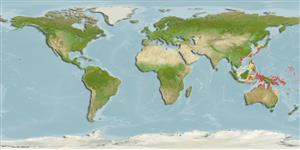
| Native range | All suitable habitat | Point map | Year 2050 |
|
| This map was computer-generated and has not yet been reviewed. |
| Gobiodon aoyagii AquaMaps Data sources: GBIF OBIS |
Ladda upp din foton och Videor
Bilder | Google image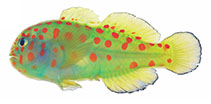 Gobiodon aoyagii
Female Bild av Suzuki, T.
Bilder | Google image
Female Bild av Suzuki, T.
Klassificering / Namn Populärnamn | synonymer | Catalog of Fishes(Släkte, Arter) | ITIS | CoL | WoRMS | Cloffa
> Gobiiformes (Gobies) > Gobiidae (Gobies) > Gobiinae
Etymology: Gobiodon: Latin, gobius = gudgeon + Greek, odous = teeth (Ref. 45335); aoyagii: Named for Hyoji Aoyagi (1912-1971), a Japanese ichthyologist.
Eponymy: Dr Hyoji Aoyagi (1912–1971) was a Japanese ichthyologist. [...] (Ref. 128868), visit book page.
Etymology: Gobiodon: Latin, gobius = gudgeon + Greek, odous = teeth (Ref. 45335); aoyagii: Named for Hyoji Aoyagi (1912-1971), a Japanese ichthyologist.
Eponymy: Dr Hyoji Aoyagi (1912–1971) was a Japanese ichthyologist. [...] (Ref. 128868), visit book page.
Miljö: miljö / Klimatzon / djupintervall / distributionsområde Ekologi
marina bentopelagisk; djupintervall 2 - 10 m (Ref. 94251). Subtropical
Utbredning Territorier | FAO områden | Ekosystem | Förekomster | Prickkarta | Utplanteringar | Faunafri
Western Pacific: Japan to Australia, including the Philippines, East Indies (Cocos Is. Or Indonesia) and Papua New Guinea.
Storlek / Vikt / Ålder
Kort beskrivning Bestämningsnycklar | Morfologi | Morfometri
Taggstrålar i ryggfenan (totalt) : 7; Mjukstrålar i ryggfenan (totalt) : 9 - 11; Taggstrålar i analfenan: 1; Mjukstrålar i analfenan: 8 - 9; Ryggkotor: 25 - 27. This species is distinguished by the following characters: many reddish spots/stripes on a yellow-green or sky-blue body; when alive or freshly-collected, it differs from similar reddish-spotted/lined congeners, G. erythrospilus and G. histrio, by having the following unique coloration: 2 reddish circular spots (rather than linear spots) on pectoral-fin base (vs. reddish markings on pectoral-fin base usually forming vertical bars in G. erythrospilus and G. histrio, except for small specimens of the former with discontinuous bars); reddish spots on ventral surface of head (vs. none); reddish crescent-like bar along bases of pectoral fin rays absent (vs. present); in in alcohol-preserved specimens, all reddish spots are largely or entirely faded, but this species can be readily identified by having its unique squamation, i.e., 3-4 rows of weakly ctenoid and/or cycloid scales on caudal peduncle (vs. no scales or a single row of minute cycloid scales on caudal peduncle in the congeners); with a deep, inflected interopercular-isthmus groove; unsegmented caudal-fin rays, upper with 5-6, lower with 4-6; no distinct dusky spot at dorsoposterior corner of operculum (Ref. 94251).
Body shape (shape guide): short and / or deep; Cross section: oval.
Body shape (shape guide): short and / or deep; Cross section: oval.
Facultative air-breathing in the genus (Ref. 126274); Observed in protected bays and reef edges and slopes of Japan, in the interstices among branches of corals of the genus Acropora. In Papua New Guinea and the Great Barrier Reef, it is reported to almost totally be confined to Acropora tenuis (Ref. 94251).
Livscykel och parningsbeteende Könsmognad | Reproduktion | Lek | Ägg | Fekunditet | Larver
Huvudreferens
Ladda upp dina referenser | referenser | Koordinator | Medarbetare
Shibukawa, K., Suzuki, T. and M. Aizawa, 2013. Gobiodon aoyagii, a new coral goby (Actinopterygii, Gobiidae, Gobiinae) from the West Pacific, with redescription of a similarly colored Congener Gobiodon erythrospilus Bleeker, 1875. Bull. Nat. Mus. Nat. Sci. 39(3):143-165. (Ref. 94251)
Status på IUCN:s rödlista (Ref. 130435: Version 2025-2 (Global))
Sårbar (VU) (A4c); Date assessed: 26 June 2018
CITES
Not Evaluated
Hot mot människor
Harmless
Mänskliga användningsområden
FAO - Publication: search | FishSource |
Ytterligare information
Trofisk ekologi
Livsmedelsartiklar (preys)
Födosammansättning
Födointag
Matransoner
Predatorer
Livsmedelsartiklar (preys)
Födosammansättning
Födointag
Matransoner
Predatorer
Ekologi
Ekologi
Ekologi
Populationsdynamik
Tillväxtparametrar
Max. åldrar / storlekar
Längd-vikt rel.
Längd-längd rel.
Längd-frekvenser
Massakonvertering
Rekrytering
Abundans
Tillväxtparametrar
Max. åldrar / storlekar
Längd-vikt rel.
Längd-längd rel.
Längd-frekvenser
Massakonvertering
Rekrytering
Abundans
Livscykel
Reproduktion
Könsmognad
Mognad/Gills rel.
Fekunditet
Lek
Lekande aggregat
Ägg
Utveckling av ägg
Larver
Larvdynamik
Reproduktion
Könsmognad
Mognad/Gills rel.
Fekunditet
Lek
Lekande aggregat
Ägg
Utveckling av ägg
Larver
Larvdynamik
Anatomi
Gälyta
Hjärna
Otolit
Gälyta
Hjärna
Otolit
Fysiologi
Kroppssammansättning
Näringsämnen
Syreförbrukning
Typ av simning
Simhastighet
Visuella pigment
Ljud från fisk
Sjukdomar & Parasiter
Toxicitet (LC50)
Kroppssammansättning
Näringsämnen
Syreförbrukning
Typ av simning
Simhastighet
Visuella pigment
Ljud från fisk
Sjukdomar & Parasiter
Toxicitet (LC50)
Genetik
Genom
Genetik
Heterozygositet
Ärftlighet
Genetisk mångfald
Genom
Genetik
Heterozygositet
Ärftlighet
Genetisk mångfald
Människorelaterad
Vattenbrukssystem
Vattenbruksprofiler
Avelslinjer
Ciguatera-fall
Frimärken, mynt, diverse.
Vattenbrukssystem
Vattenbruksprofiler
Avelslinjer
Ciguatera-fall
Frimärken, mynt, diverse.
Verktyg
Särskilda rapporter
Kontrollera för underhåll av akvarium | Kontrollera om det finns faktablad om arter | Kontrollera om det finns faktablad om vattenbruk
Ladda ner XML
Internet-källor
AFORO (otoliths) | Aquatic Commons | BHL | Cloffa | Websites from users | Check FishWatcher | CISTI | Catalog of Fishes: Släkte, Arter | DiscoverLife | ECOTOX | FAO - Publication: search | Faunafri | Fishipedia | Fishtrace | GloBI | Google Books | Google Scholar | Google | IGFA World Record | OneZoom | Open Tree of Life | Otolith Atlas of Taiwan Fishes | PubMed | Reef Life Survey | Socotra Atlas | TreeBase | Tree of Life | Wikipedia: Go, sök | World Records Freshwater Fishing | Zoobank | Zoologiskt register
Uppskattningar baserade på modeller
Önskad temperatur (Ref. 123201): 24.9 - 29.3, mean 28.6 °C (based on 1154 cells).
Index för fylogenetisk mångfald (Ref. 82804): PD50 = 0.5000 [Uniqueness, from 0.5 = low to 2.0 = high].
Bayesian length-weight: a=0.01995 (0.00906 - 0.04395), b=3.01 (2.83 - 3.19), in cm total length, based on all LWR estimates for this body shape (Ref. 93245).
Trofisk nivå (Ref. 69278): 3.3 ±0.4 se; based on size and trophs of closest relatives
Resiliens (Ref. 120179): Hög, lägsta populationsfördubblingstid mindre än 15 månader (Preliminary K or Fecundity.).