



Eugnathichthys virgatus Stiassny, Denton & Monsembula Iyaba, 2013
Adicionar o seu Fotografias e vídeos
Imagem do Google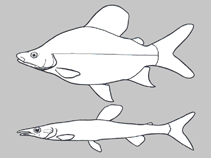 No image available for this species;
drawing shows typical species in Distichodontidae.
Imagem do Google
drawing shows typical species in Distichodontidae.
Classificação / Nomes Nomes comuns | Sinónimos | Catalog of Fishes(Género, Espécies) | ITIS | CoL | WoRMS | Cloffa
> Characiformes (Characins) > Distichodontidae (Distichodus)
Etymology: Eugnathichthys: Greek, eu = good + Greek, gnathos = jaw + Greek, ichthys = fish (Ref. 45335); virgatus: This species is named virgatus, from the Latin, in reference to the conspicuous midlateral band or streak forming the characteristic pigmentation patterning of the species in life and in preservation (Ref. 94471).
Etymology: Eugnathichthys: Greek, eu = good + Greek, gnathos = jaw + Greek, ichthys = fish (Ref. 45335); virgatus: This species is named virgatus, from the Latin, in reference to the conspicuous midlateral band or streak forming the characteristic pigmentation patterning of the species in life and in preservation (Ref. 94471).
Ambiente: milieu / zona climática / intervalo de profundidade / gama de distribuição Ecologia
; Água doce bentopelágico. Tropical
Distribuição Territórios | Áreas FAO | Ecossistemas | Ocorrências | Mapa dos pontos | Introduções | Faunafri
Africa: middle Congo River basin, in the Sangha, Lulonga, Ruki (Ref. 94471), Itimbiri and Aruwimi (Ref. 106290), in Republic of Congo and Democratic Republic of the Congo. Possibly also in the Ubangi (Ref. 94471).
Tamanho / Peso / Idade
Descrição breve Chaves de identificação | Morfologia | Morfometria
Espinhos dorsais (total) : 0; Raios dorsais moles (total) : 15 - 17; Espinhos anais: 0; Raios anais moles: 11 - 12; Vértebras: 42 - 43. Diagnosis: Eugnathichthys virgatus is unique among congeners in the possession of body pigmentation dominated by a broad lateral band intersected by numerous vertical bars resulting in a midlateral, checkerboard-like pigmentation patterning both in life and in preservation (Ref. 94471). Internally it is characterized by a marked reduction in dentition on the fifth ceratobranchial elements of the pharynx; externally it differs from congeners in the possession of a reduced total number of pectoral-fin rays, 13-15 vs. 16-18 (Ref. 94471). Eugnathichthys virgatus is further readily distinguished from E. eetveldii by the possession of 66-72 pored lateral line scales from opercle to caudal flexion vs. 96-103; 10-12 scale rows between the lateral line and the dorsal-fin origin vs. 14 or 15; and 8 or 9 scale rows between the lateral line and pelvic-fin insertion vs. 10 (Ref. 94471).It differs from E. macroterolepis in the possession of 8 or 9 scale rows between the lateral line and the pelvic-fin insertion vs. 6 or 7 (Ref. 94471).
This species lives in heavily shaded, highly humic forest rivers (Ref. 94471). Gut morphology and contents suggest that the species feeds exclusively on fish fins (Ref. 94471).
Ciclo de vida e comportamento de acasalamento Maturidade | Reprodução | Desova | Ovos | Fecundidade | Larvas
Referência principal
Carregar as suas referências | Referências | Coordenador | Colaboradores
Stiassny, M.L.J., J.S.S. Denton and Monsembula Iyaba R.J.C., 2013. A new ectoparasitic distichodontid of the genus Eugnathichthys (Characiformes: Citharinoidei) from the Congo basin of central Africa, with a molecular phylogeny for the genus. Zootaxa 3693(4):479-490. (Ref. 94471)
CITES
Not Evaluated
Ameaça para o homem
Harmless
Utilização humana
FAO - Publication: search | FishSource |
Mais informação
Ecologia Trófica
Produtos alimentares (presas)
Composição da dieta
Consumo alimentar
Rações alimentares
Predadores
Produtos alimentares (presas)
Composição da dieta
Consumo alimentar
Rações alimentares
Predadores
Dinâmica das populações
Parâmetros de crescimento
Idades / tamanhos máximos
Comprimento-peso rel.
Comprimento-comprimento rel.
Frequência de comprimento
Conversão de massa
Recrutamento
Abundância
Parâmetros de crescimento
Idades / tamanhos máximos
Comprimento-peso rel.
Comprimento-comprimento rel.
Frequência de comprimento
Conversão de massa
Recrutamento
Abundância
Ciclo de vida
Reprodução
Maturidade
Maturidade/Rel. das guelras
Fecundidade
Desova
Agregações de desova
Ovos
Desenvolvimento dos ovos
Larvas
Dinâmica larvar
Reprodução
Maturidade
Maturidade/Rel. das guelras
Fecundidade
Desova
Agregações de desova
Ovos
Desenvolvimento dos ovos
Larvas
Dinâmica larvar
Anatomia
Área branquial
Cérebro
Otólitos
Área branquial
Cérebro
Otólitos
Fisiologia
Composição corporal
Nutrientes
Consumo de oxigénio
Tipo de natação
Velocidade de natação
Pigmentos visuais
Som de peixe
Doenças e Parasitas
Toxicidade (LC50s)
Composição corporal
Nutrientes
Consumo de oxigénio
Tipo de natação
Velocidade de natação
Pigmentos visuais
Som de peixe
Doenças e Parasitas
Toxicidade (LC50s)
Genética
genoma
Genética
Heterozigotia
Hereditariedade
Diversidade genética
genoma
Genética
Heterozigotia
Hereditariedade
Diversidade genética
Relacionado com o ser humano
Sistemas de aquacultura
Perfis para aquacultura
Estirpes
Casos de Ciguatera
Selos, moedas, diversos.
Sistemas de aquacultura
Perfis para aquacultura
Estirpes
Casos de Ciguatera
Selos, moedas, diversos.
Ferramentas
E-book | Guia de campo | Ferramenta auxiliar de frequências de comprimento | Ferramenta sobre a história de vida | Mapa dos pontos |
Captura-MSY |
Relatórios especiais
Descarregue XML
Fontes da internet
AFORO (otoliths) | Aquatic Commons | BHL | Cloffa | Websites from users | Consultar FishWatcher | CISTI | Catalog of Fishes: Género, Espécies | DiscoverLife | ECOTOX | FAO - Publication: search | Faunafri | Fishipedia | Fishtrace | GloBI | Google Books | Google Scholar | Google | IGFA World Record | OneZoom | Open Tree of Life | Otolith Atlas of Taiwan Fishes | PubMed | Reef Life Survey | Socotra Atlas | TreeBase | Árvore da vida | Wikipedia: ir para, procurar | World Records Freshwater Fishing | Zoobank | Registo zoológico
Estimativas baseadas em modelos
Índice de diversidade filogenética (Ref. 82804): PD50 = 0.6250 [Uniqueness, from 0.5 = low to 2.0 = high].
Bayesian length-weight: a=0.00447 (0.00186 - 0.01072), b=3.17 (2.97 - 3.37), in cm total length, based on LWR estimates for this (Sub)family-body shape (Ref. 93245).
Nível Trófico (Ref. 69278): 3.0 ±0.3 se; based on size and trophs of closest relatives