



Characidium papachibe Peixoto & Wosiacki, 2013
分類 / 名稱 俗名 | 同種異名 | Catalog of Fishes(屬, 種) | ITIS | CoL | WoRMS | Cloffa
Teleostei > Characiformes (Characins) > Crenuchidae (South American darters) > Characidiinae
Etymology: Characidium: Diminutive of Charax, -akos = a fish without identification (Ref. 45335); papachibe: The name is a reference to 'papa-chibé, a traditional name associated with the State of Pará natives, and pays homage to the people of Pará.
Eponymy: Papa-chibé is a name traditionally associated with people from the Brazilian state of Pará, which is where this species occurs. (Ref. 128868), visit book page.
Etymology: Characidium: Diminutive of Charax, -akos = a fish without identification (Ref. 45335); papachibe: The name is a reference to 'papa-chibé, a traditional name associated with the State of Pará natives, and pays homage to the people of Pará.
Eponymy: Papa-chibé is a name traditionally associated with people from the Brazilian state of Pará, which is where this species occurs. (Ref. 128868), visit book page.
環境: 環境 / 氣候帶 / 深度上下限 / 配送範圍 生態學
分布 領土 | FAO區域 | 生態系 | 發現紀錄 | 分布圖 | 簡介 | Faunafri
South America: Rio Aruã, tributary of the Rio Tapajós basin, lower Amazon in Brazil.
大小 / 重量 / 年齡
簡短描述 檢索表 | 型態特徵 | 形態測量圖
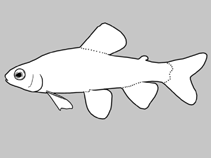
背的軟條 (總數) : 12 - 13; 臀鰭軟條: 8 - 9; 脊椎骨: 34. It is diagnosed from other species of Characidium, except C. serrano and C. heirmostigmata, by having anteriorly oblique, midlateral bands centered on lateral line or just ventral thereof and not reaching either the dorsum or the ventrum, anterior bands. It differs from from C. serrano and C. heirmostigmata by having the following characters: 3 scales above and 3 below the lateral line (vs. 4 or 5 above and 4 or 5 below the lateral line in C. serrano and C. heirmostigmata); 10 scales around the caudal peduncle (vs. 12 in C. serrano and C. heirmostigmata); and snout length 15.0-18.8% HL (vs. 23.4-26.9% HL in C. serrano and 20.3- 27.8% HL in C. heirmostigmata). It can be further distinguished from C. heirmostigmata by having 12-15 oblique bars (vs. 8-11), 8 or 9 anal-fin rays (vs. 10 or 11), 10 or 11 pectoral-fin rays (vs. 13 or 14), and head length 25.7-29.2% SL (vs. 22.4-24.6% SL). It can be further separated from C. serrano by having 29-33 scales on the lateral line (vs. 37-39) and interorbital distance 19.0-25.0% HL (vs. 11.9-17.2 HL). This species is slightly similar to the psammophile species C. heinianum, C. longum, C. pellucidum, and C. pteroides because of its reticulated color pattern. However, it is distinguished from those species by the presence of the anteriorly oblique bars. It can be further distinguished from C. longum by having 10 or 11 pectoral-fin rays (vs. 13 or 14), 10 scale series around the caudal peduncle (vs. 12), body depth at dorsal-fin origin 18.9-25.7% SL (vs. 9.3-15.8% SL), and body depth at anal-fin origin 12.2-17.8% SL (vs. 7.5-11.0% SL); from another psammophile species, Geryichthys sterbai, by the presence of the adipose fin (vs. absence), by the presence of ectopterygoid teeth (vs. absence), by the 10 scale series around the caudal peduncle (vs. 12); and by absence of rhomboidal bars (vs. presence) (Ref. 93226).
Body shape (shape guide): fusiform / normal.
Body shape (shape guide): fusiform / normal.
Inhabits stream with shallow margins about 1-1.8 m deep, dense aquatic vegetation, sandy bottom and margins composed of decaying plant matter (Ref. 93226).
生命週期和交配行為 成熟度 | 繁殖 | 產卵場 | 卵 | 孕卵數 | 仔魚
主要參考資料
上傳您的推薦信 | 參考文獻 | 合作者 | 合作者
Peixoto, L.A.W. and W.B. Wosiacki, 2013. A new species of Characidium Agassiz (Characiformes: Crenuchidae) from the Lower Amazon. Copeia 2013(1):52-57. (Ref. 93226)
CITES
Not Evaluated
對人類具威脅
人類使用
FAO - Publication: search | FishSource |
更多資訊
營養生態學
食物項目(獵物)
食性組成
食物消耗量
食物配給
捕食者
食物項目(獵物)
食性組成
食物消耗量
食物配給
捕食者
生態學
生態學
生態學
人口動態
成長參數
最大年齡/尺寸
長度重量比
長度關係
長度-頻率
質量轉換
入添量
豐度
成長參數
最大年齡/尺寸
長度重量比
長度關係
長度-頻率
質量轉換
入添量
豐度
解剖學
鰓區
腦部
耳石
鰓區
腦部
耳石
生理學
身體成分
營養素
耗氧量
游泳類型
游泳速度
視覺色素
魚聲
疾病與寄生蟲
毒性 (LC50s)
身體成分
營養素
耗氧量
游泳類型
游泳速度
視覺色素
魚聲
疾病與寄生蟲
毒性 (LC50s)
遺傳學
基因組
遺傳學
異種性
遺傳率
遺傳多樣性
基因組
遺傳學
異種性
遺傳率
遺傳多樣性
工具
特別的報告
下載 XML
網路資源
AFORO (otoliths) | Aquatic Commons | BHL | Cloffa | Websites from users | 檢查 FishWatcher | CISTI | Catalog of Fishes: 屬, 種 | DiscoverLife | ECOTOX | FAO - Publication: search | Faunafri | Fishipedia | Fishtrace | GloBI | Google Books | Google Scholar | Google | IGFA World Record | OneZoom | Open Tree of Life | Otolith Atlas of Taiwan Fishes | PubMed | Reef Life Survey | Socotra Atlas | TreeBase | 樹狀分類階層 | Wikipedia: 去, 搜尋 | World Records Freshwater Fishing | Zoobank | 動物學的記錄
基於模型的估計
系統發育多樣性指數 (參考文獻 82804): PD50 = 0.5000 [Uniqueness, from 0.5 = low to 2.0 = high].
Bayesian length-weight: a=0.01122 (0.00514 - 0.02450), b=3.04 (2.87 - 3.21), in cm total length, based on all LWR estimates for this body shape (Ref. 93245).
營養階層 (參考文獻 69278): 3.2 ±0.3 se; based on size and trophs of closest relatives