



Pseudamiops springeri Gon, Bogorodsky & Mal, 2013
Ajouter votre observation dans Fish Watcher
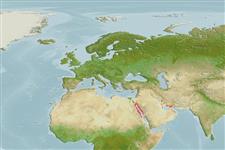
| Native range | All suitable habitat | Point map | Year 2050 |
|
| This map was computer-generated and has not yet been reviewed. |
| Pseudamiops springeri AquaMaps Data sources: GBIF OBIS |
Envoyez vos Photos et vidéos
Images Google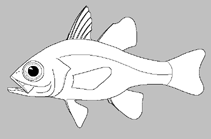 No image available for this species;
drawing shows typical species in Apogonidae.
Images Google
drawing shows typical species in Apogonidae.
Classification / Noms Noms communs | Synonymes | Catalog of Fishes(Genre, Espèce) | ITIS | CoL | WoRMS | Cloffa
> Kurtiformes (Nurseryfishes, cardinalfishes.) > Apogonidae (Cardinalfishes) > Pseudamiinae
Etymology: Pseudamiops: Greek, pseudes = false + Greek, amia = a kind of shark + Greek, ops = appearance (Ref. 45335); springeri: Named for Dr Victor G. Springer, USNM, who collected the holotype.
Eponymy: Dr Victor Gruschka Springer (d: 1928) is an American ichthyologist. [...] (Ref. 128868), visit book page.
Etymology: Pseudamiops: Greek, pseudes = false + Greek, amia = a kind of shark + Greek, ops = appearance (Ref. 45335); springeri: Named for Dr Victor G. Springer, USNM, who collected the holotype.
Eponymy: Dr Victor Gruschka Springer (d: 1928) is an American ichthyologist. [...] (Ref. 128868), visit book page.
Environnement : milieu / zone climatique / profondeur / gamme de distribution Écologie
marin récifal; profondeur 5 - 18 m (Ref. 94042). Tropical
Distribution Territoires | Zones FAO | Écosystèmes | Occurrences | Carte par point | Introductions | Faunafri
Western Indian Ocean: Red Sea, northern part of the Gulf of Aqaba and the Strait of Jubal,Egypt and north of Jeddah, Saudi Arabia.
Taille / Poids / Âge
Description synthétique Clés d'identification | Morphologie | Morphométrie
Épines dorsales (Total) : 7; Rayons mous dorsaux (Total) : 8; Épines anales: 2; Rayons mous anaux: 8; Vertèbres: 24. This species is distinguished by the following characters: D VI+I,8; A II,8; pectoral-fin rays 13; preopercle edge smooth or with 3-4 minute serrations ventrally; pseudobranch with 2-4 filaments; vomer without canine teeth; genital opening flanked by 2 slender papillae, one in front and one behind it; anterior nostril with skin flap, about twice nostril diameter, posteriorly on nostril’s rim, reaching at most half way to posterior nostril; no supraneural bones. Colour in life: body and head transparent, red gills, large peritoneal melanophores, series of eggs (opaque white, ovate objects), dark kidney and vertebral column clearly visible, grayish brown iris; after death, body of smaller paratype opaque white, gradually becoming translucent posteriorly and with small dusky spot behind eye on temporal area, gills partially visible through translucent opercle, large peritoneal melanophores clearly visible through abdominal body wall, black pupil black and silvery iris, but sometimes with irregular blackish markings and denser dorsally, clear fins; in alcohol, body cream white to yellowish dark brown; peritoneum with large stellate melanophores often visible through abdominal body wall; pale fins (Ref. 94042).
Body shape (shape guide): elongated; Cross section: oval.
Body shape (shape guide): elongated; Cross section: oval.
Similar to its congeners, this species is very cryptic, living deep inside caves. The smallest individual was collected about 2-3 m from the entrance of a cave on a seaward reef at 18 m deep, while others were found in caves at 5 and 11 m depth (Ref. 94042).
Cycle de vie et comportement reproducteur Maturité | Reproduction | Frai | Œufs | Fécondité | Larves
Référence principale
Téléchargez vos références | Références | Coordinateur | Collaborateurs
Gon, O., S.V. Bogorodsky and A.O. Mal, 2013. Description of a new species of the cardinalfish genus Pseudamiops (Perciformes, Apogonidae) from the Red Sea. Zootaxa 3701(1):093-100. (Ref. 94042)
CITES
Not Evaluated
Menace pour l'homme
Harmless
Utilisations par l'homme
Pêcheries: sans intérêt
FAO - Publication: search | FishSource |
Plus d'informations
Écologie trophique
Aliments (proies)
Composition du régime alimentaire
Consommation alimentaire
Rations alimentaires
Prédateurs
Aliments (proies)
Composition du régime alimentaire
Consommation alimentaire
Rations alimentaires
Prédateurs
Écologie
Écologie
Écologie
Dynamique des populations
Paramètres de croissance
Âges / tailles maximales
Longueur-poids rel.
Rel. longueur-longueur.
Fréquences de longueurs
Conversion de masse
Recrutement
Abondance
Paramètres de croissance
Âges / tailles maximales
Longueur-poids rel.
Rel. longueur-longueur.
Fréquences de longueurs
Conversion de masse
Recrutement
Abondance
Cycle de vie
Reproduction
Maturité
Maturité/épines rel.
Fécondité
Frai
Agrégats de frai
Œufs
Développement de l'œuf
Larves
Dynamique des populations larvaires
Reproduction
Maturité
Maturité/épines rel.
Fécondité
Frai
Agrégats de frai
Œufs
Développement de l'œuf
Larves
Dynamique des populations larvaires
Anatomie
Surface branchiale
Cerveau
Otolithe
Surface branchiale
Cerveau
Otolithe
Physiologie
Composition corporelle
Nutriments
Consommation d'oxygène
Type de natation
Vitesse de nage
Pigments visuels
Son de poisson
Maladies et parasites
Toxicité (CL50)
Composition corporelle
Nutriments
Consommation d'oxygène
Type de natation
Vitesse de nage
Pigments visuels
Son de poisson
Maladies et parasites
Toxicité (CL50)
Génétique
génôme
Génétique
Hétérozygotie
Héritabilité
Diversité génétique
génôme
Génétique
Hétérozygotie
Héritabilité
Diversité génétique
Liées à l'homme
Systèmes d'aquaculture
Profils d'aquaculture
Souches
Cas de ciguatera
Timbres, pièces de monnaie, divers
Systèmes d'aquaculture
Profils d'aquaculture
Souches
Cas de ciguatera
Timbres, pièces de monnaie, divers
Outils
E-book | Guide de terrain | Générateur de fréquences de longueur | Outil de dynamique de population | Carte par point |
Capture-MSY |
Articles particuliers
Télécharger en XML
Sources Internet
AFORO (otoliths) | Aquatic Commons | BHL | Cloffa | Websites from users | FishWatcher | CISTI | Catalog of Fishes: Genre, Espèce | DiscoverLife | ECOTOX | FAO - Publication: search | Faunafri | Fishipedia | Fishtrace | GloBI | Google Books | Google Scholar | Google | IGFA World Record | OneZoom | Open Tree of Life | Otolith Atlas of Taiwan Fishes | PubMed | Reef Life Survey | Socotra Atlas | TreeBase | Arbre de Vie | Wikipedia: aller à, chercher | World Records Freshwater Fishing | Zoobank | Zoological Record
Estimations basées sur des modèles
Température préférée (Réf. 123201): 25 - 28, mean 27.1 °C (based on 34 cells).
Indice de diversité phylogénétique (Réf. 82804): PD50 = 0.5312 [Uniqueness, from 0.5 = low to 2.0 = high].
Bayesian length-weight: a=0.00389 (0.00180 - 0.00842), b=3.12 (2.94 - 3.30), in cm total length, based on all LWR estimates for this body shape (Ref. 93245).
Niveau trophique (Réf. 69278): 3.2 ±0.4 se; based on size and trophs of closest relatives
Résilience (Réf. 120179): Haut, temps minimum de doublement de population inférieur à 15 mois (Preliminary K or Fecundity.).